


RF attenuators get hot because they dissipate part of the incoming signal power. Higher attenuation generally leaves less power at the output and more heat in the pad.
How it works in practice
For an approximately matched passive pad, dissipation is incident power minus transmitted power. The resulting temperature depends on thermal resistance, airflow, mounting and ambient temperature. A hot housing does not by itself prove failure, but continued operation requires compliance with the manufacturer's temperature and derating limits.
Example and interpretation
At 5 W input and 10 dB attenuation, ideal transmitted power is 0.5 W and pad dissipation is approximately 4.5 W.
Checks before use
- Calculate expected dissipation
- Check rated mounting conditions
- Allow specified airflow
- Monitor temperature during commissioning
Important limit
Do not cover cooling surfaces or use the output-power value as the heat estimate.
Related Centron RF product
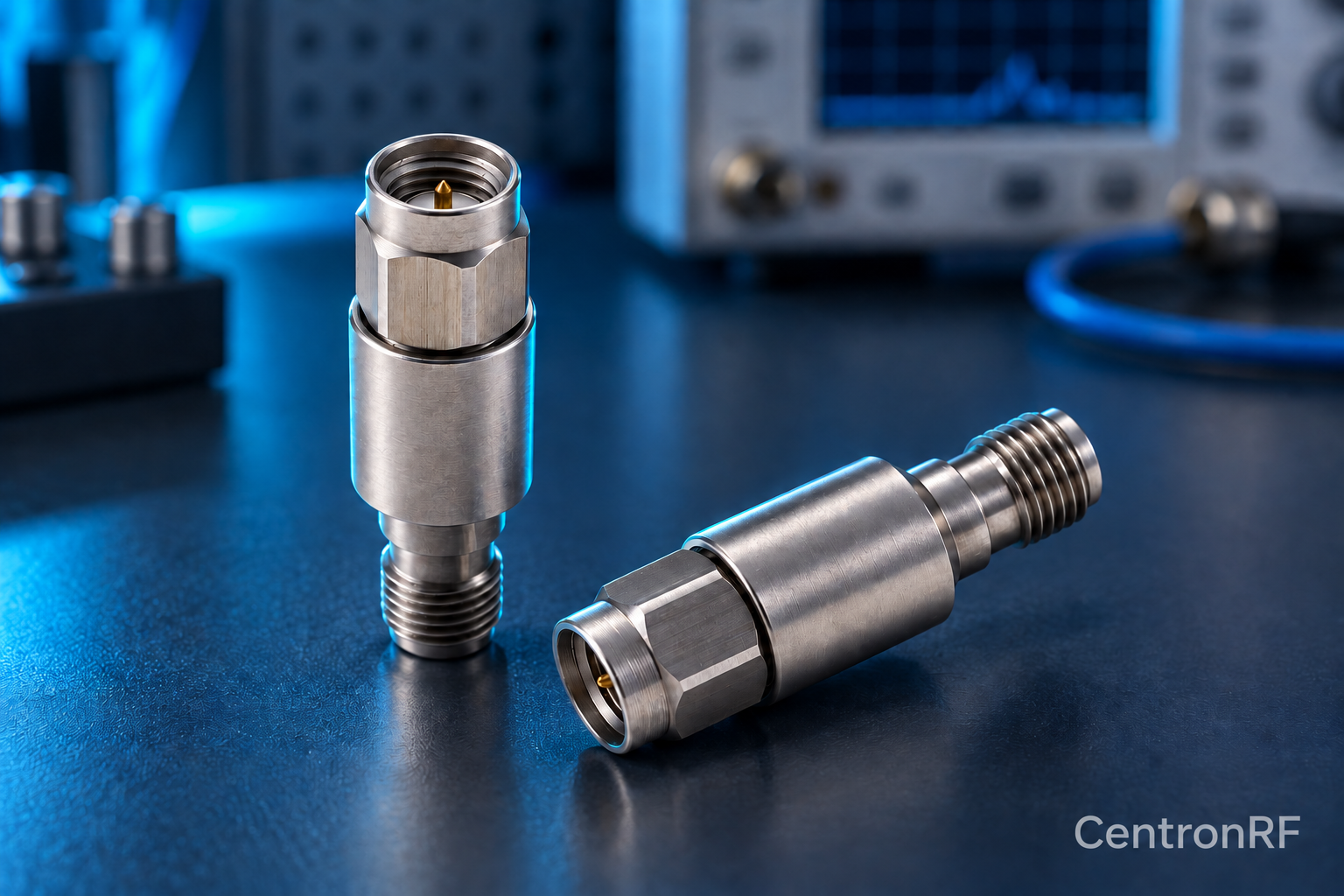
SMA 5 W 6 GHz fixed attenuator. The SMA 5 W model is listed as a 50-ohm fixed attenuator with a DC–6 GHz range. Select an available attenuation option and verify the current tolerance, cooling conditions and pulse limits for your application.
Further reading
Keysight: Spectrum Analysis Basics. This background reference explains general principles; the selected Centron RF model’s datasheet governs its own ratings.
Related guides
Educational guide. Numerical examples use the stated assumptions and are not test results for a supplied unit.