


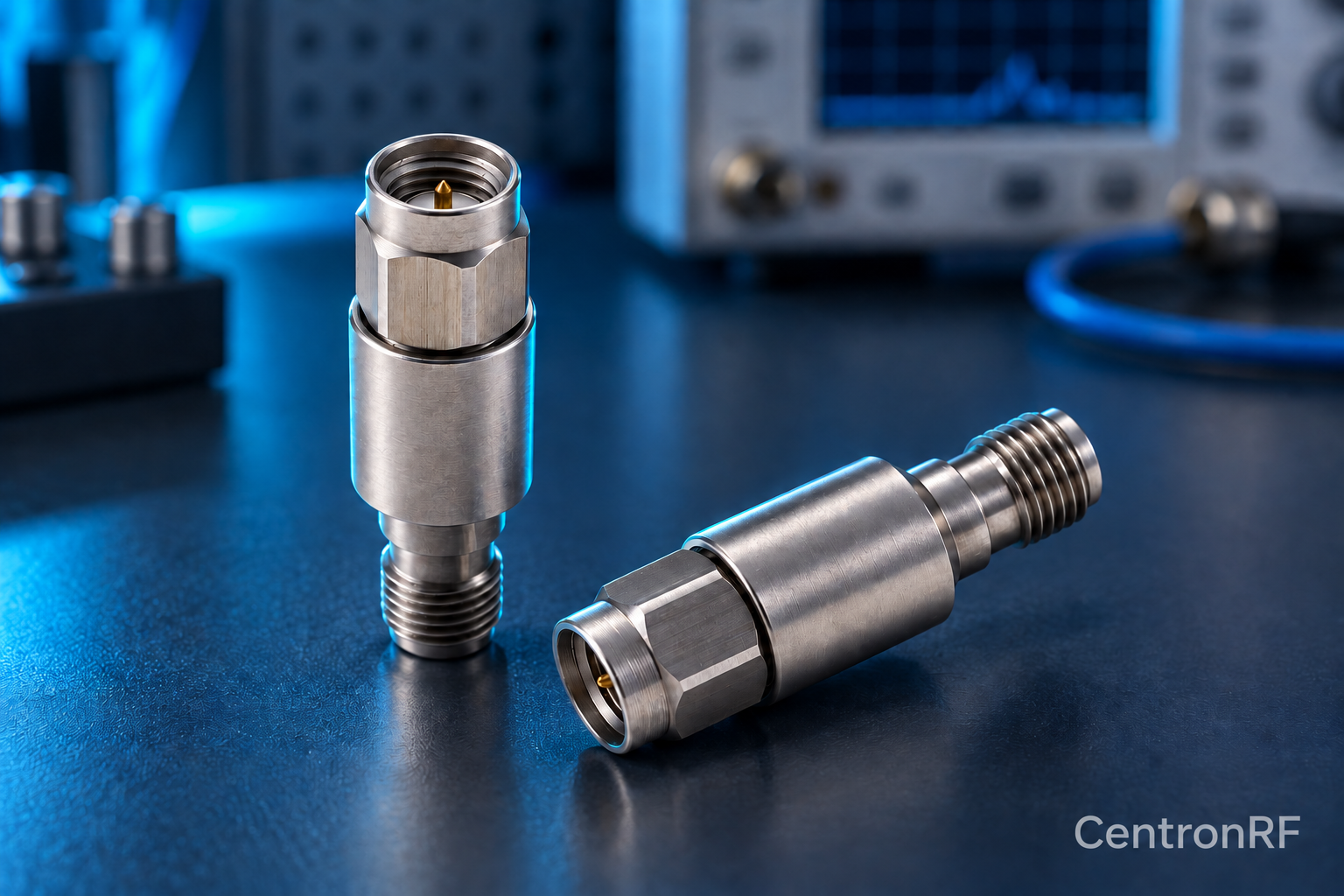
Many passive resistive RF attenuators are reciprocal, but permissible power and preferred connection direction must be checked for the particular model.
How it works in practice
Reciprocal transmission means the small-signal forward and reverse transfer characteristics match under corresponding reference conditions. It does not prove equal thermal stress in both orientations. An asymmetrical construction, connector arrangement or high-power design can have specified input and output roles. Follow markings and the datasheet.
Example and interpretation
A pad may show similar low-power S21 and S12 while still requiring the manufacturer's designated high-power input connection.
Checks before use
- Read input and output markings
- Check the manufacturer's direction guidance
- Compare forward and reverse small-signal results
- Use the specified orientation at power
Important limit
Do not equate small-signal reciprocity with unrestricted high-power reversal.
Related Centron RF product
SMA 5 W 6 GHz fixed attenuator. The SMA 5 W model is listed as a 50-ohm fixed attenuator with a DC–6 GHz range. Select an available attenuation option and verify the current tolerance, cooling conditions and pulse limits for your application.
Further reading
Keysight: Spectrum Analysis Basics. This background reference explains general principles; the selected Centron RF model’s datasheet governs its own ratings.
Related guides
Educational guide. Numerical examples use the stated assumptions and are not test results for a supplied unit.