


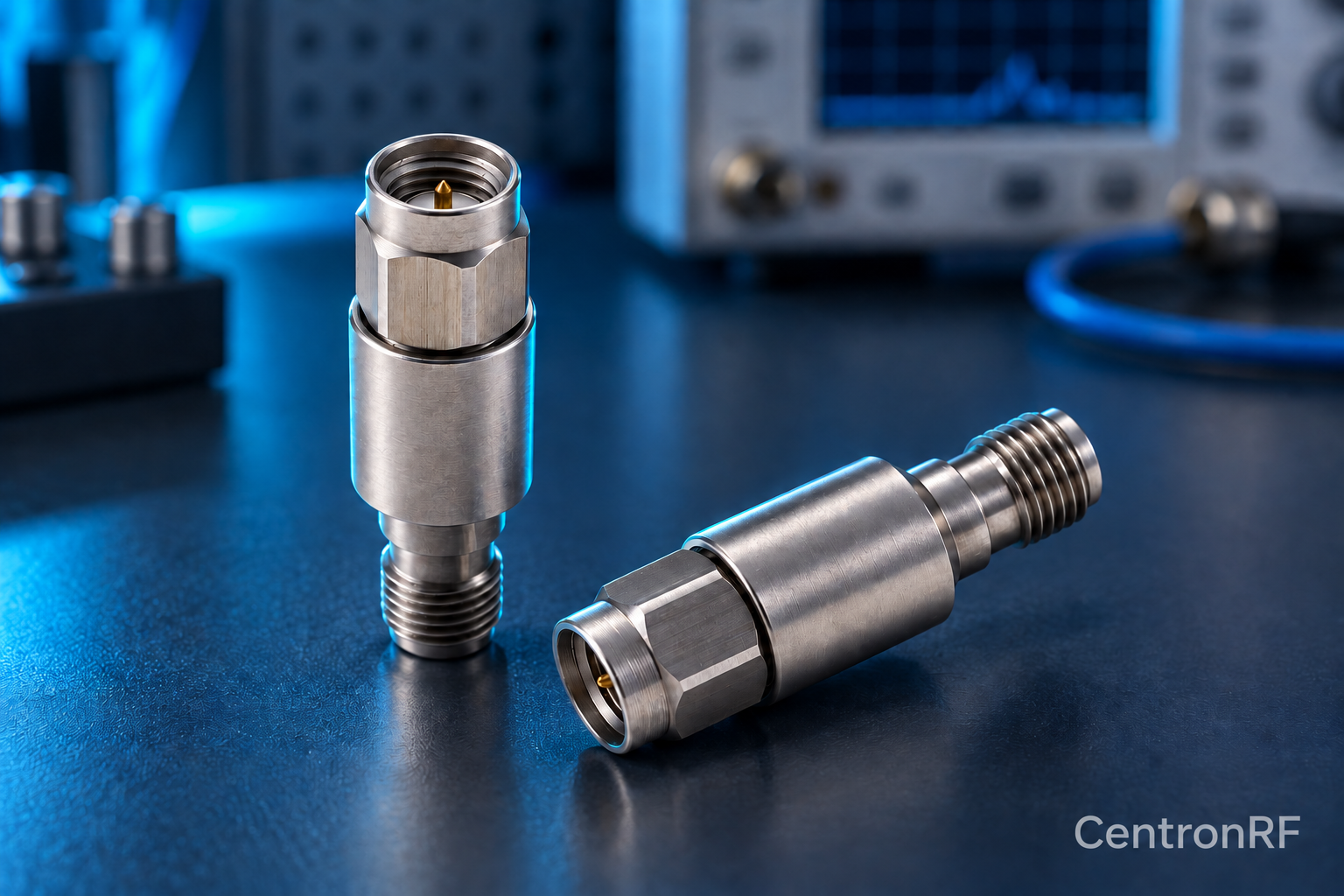
In a cascade, the first RF attenuator sees the highest incident power. Place components according to individual input ratings and verify the assembled signal path.
How it works in practice
Nominal attenuation values add in dB for an approximately matched chain. Power ratings do not add in the same way. The first device must handle the source; the next receives the first device's reduced output. Match errors and adapters can change the measured loss, so characterize the full chain.
Example and interpretation
A 10 W source followed by ideal 10 dB and 20 dB pads delivers about 1 W to the second pad and 0.01 W to the final load.
Checks before use
- Calculate input to each stage
- Check every individual rating
- Place adequately rated hardware first
- Measure complete-chain attenuation
Important limit
Two 5 W pads in series do not form a 10 W input-rated attenuator.
Related Centron RF product
SMA 5 W 6 GHz fixed attenuator. The SMA 5 W model is listed as a 50-ohm fixed attenuator with a DC–6 GHz range. Select an available attenuation option and verify the current tolerance, cooling conditions and pulse limits for your application.
Further reading
Keysight: Spectrum Analysis Basics. This background reference explains general principles; the selected Centron RF model’s datasheet governs its own ratings.
Related guides
Educational guide. Numerical examples use the stated assumptions and are not test results for a supplied unit.