


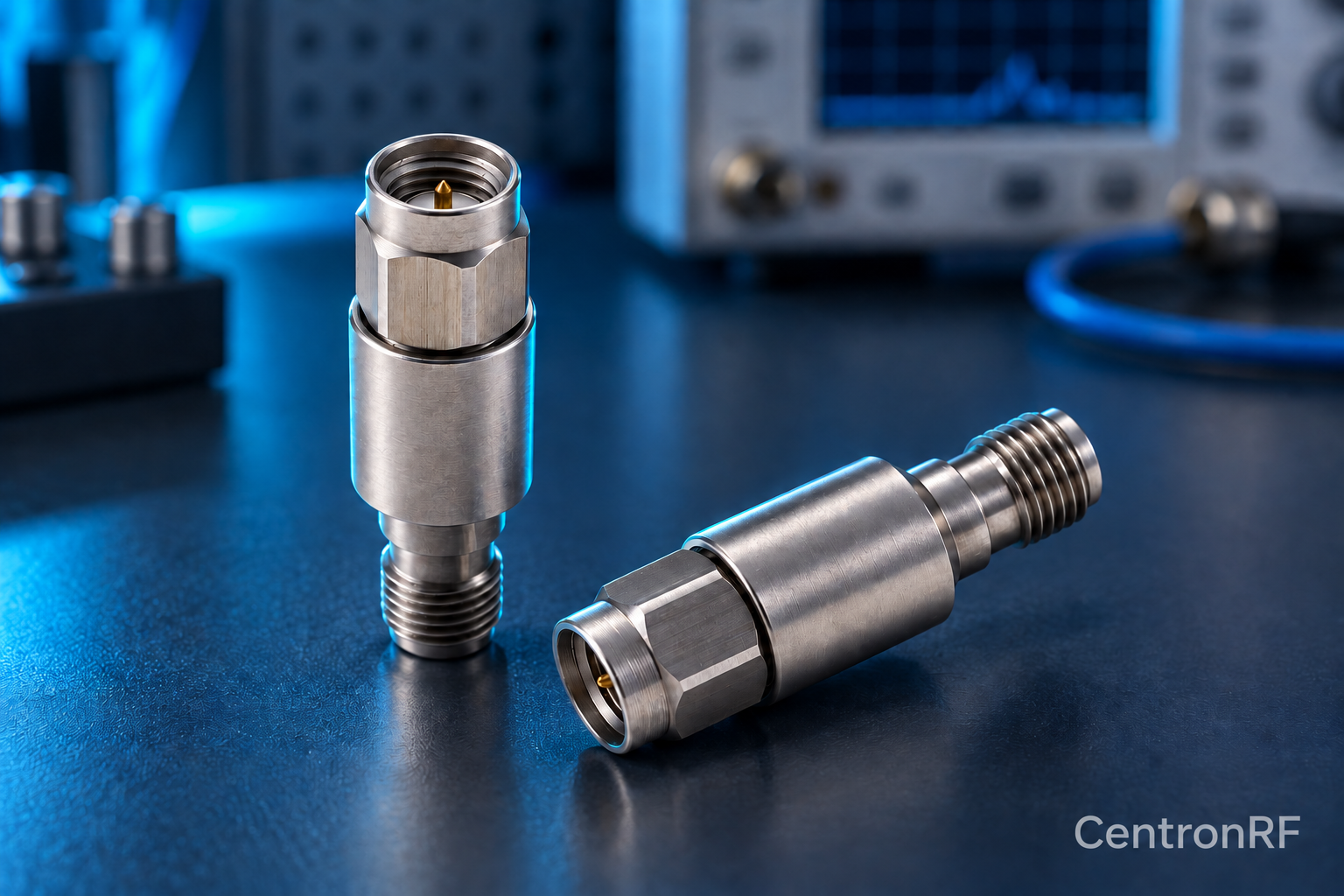
A well-matched attenuator can reduce the effect of reflections returning from a downstream device. This can improve measurement stability at the cost of signal loss.
How it works in practice
The downstream reflection passes through the pad twice before returning to the source. In an ideal matched reciprocal pad, this round trip reduces the reflected wave relative to the forward wave by twice the one-way attenuation in dB. Real pad reflections and instrument noise limit the benefit.
Example and interpretation
A 6 dB ideal pad introduces 12 dB of additional round-trip loss to a reflection from the downstream load.
Checks before use
- Check the pad's own return loss
- Budget the reduced signal level
- Measure system stability
- Keep noise-floor effects in the uncertainty budget
Important limit
Attenuation can mask a poor load match without repairing the load.
Related Centron RF product
SMA 5 W 6 GHz fixed attenuator. The SMA 5 W model is listed as a 50-ohm fixed attenuator with a DC–6 GHz range. Select an available attenuation option and verify the current tolerance, cooling conditions and pulse limits for your application.
Further reading
Keysight: Spectrum Analysis Basics. This background reference explains general principles; the selected Centron RF model’s datasheet governs its own ratings.
Related guides
- Attenuators Before an LNA: Protection Versus Sensitivity
- RF Attenuator Pulse Ratings: What Average Watts Miss
Educational guide. Numerical examples use the stated assumptions and are not test results for a supplied unit.