


Average RF power does not describe the full stress from pulses. Pulse peak power, duration, repetition rate and permitted energy must also be within specification.
How it works in practice
A low duty cycle reduces long-term heating but can leave high instantaneous voltage and current. Resistive elements and connectors may have separate peak limits. Ask for model-specific pulse information instead of converting an average rating into an assumed pulse rating. Use the waveform's true envelope and repetition pattern.
Example and interpretation
A 100 W rectangular pulse train at 10 percent duty cycle averages 10 W, but a 10 W average-rated component is not thereby approved for those pulses.
Checks before use
- Record pulse peak power
- Record width and repetition rate
- Obtain pulse or energy limits
- Confirm thermal and peak limits together
Important limit
Do not qualify pulsed service using average watts alone.
Related Centron RF product
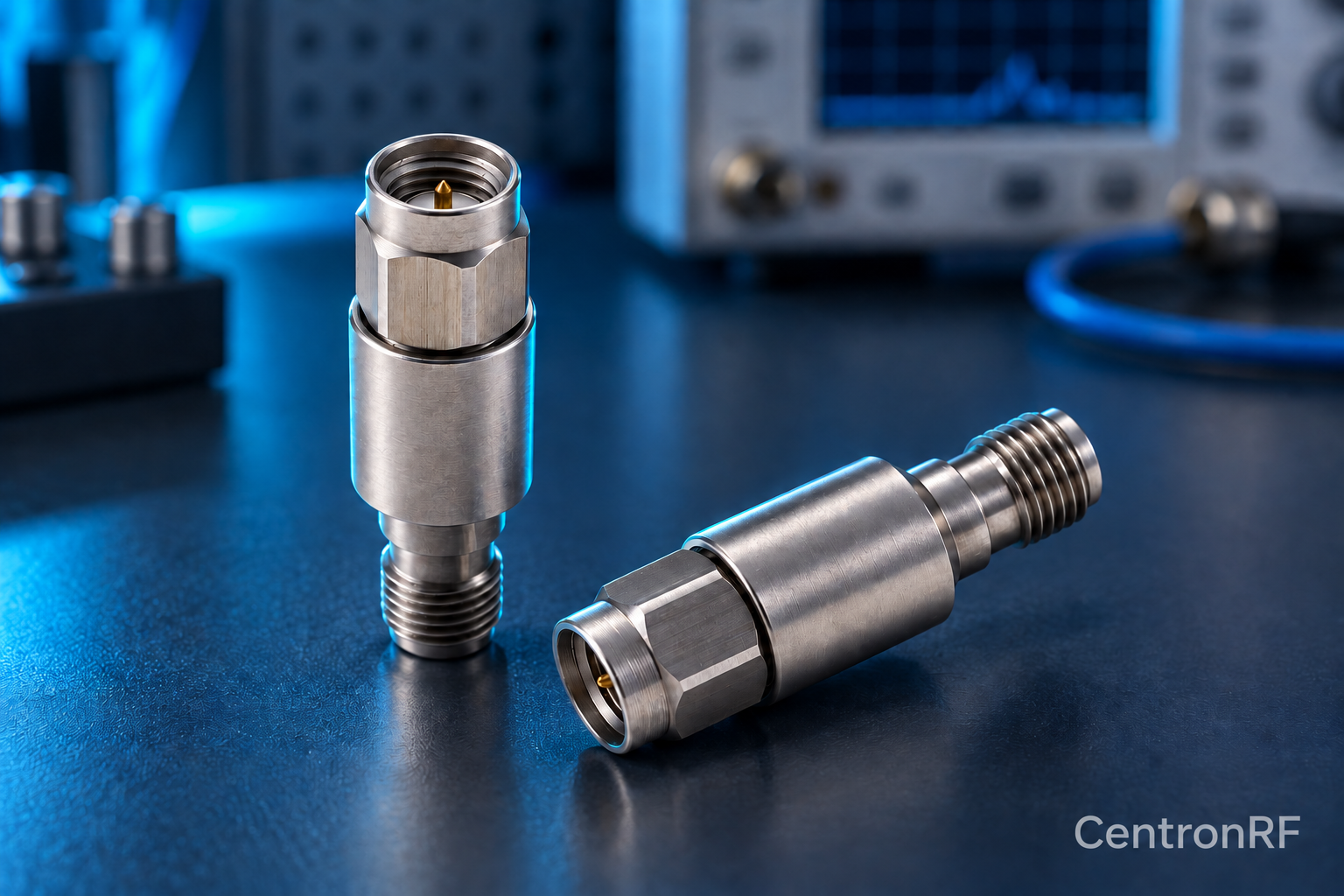
SMA 5 W 6 GHz fixed attenuator. The SMA 5 W model is listed as a 50-ohm fixed attenuator with a DC–6 GHz range. Select an available attenuation option and verify the current tolerance, cooling conditions and pulse limits for your application.
Further reading
Keysight: Spectrum Analysis Basics. This background reference explains general principles; the selected Centron RF model’s datasheet governs its own ratings.
Related guides
- Does a 0 dB RF Attenuator Have Zero Loss?
- RF Attenuator Versus RF Filter: Which Problem Are You Solving?
Educational guide. Numerical examples use the stated assumptions and are not test results for a supplied unit.