


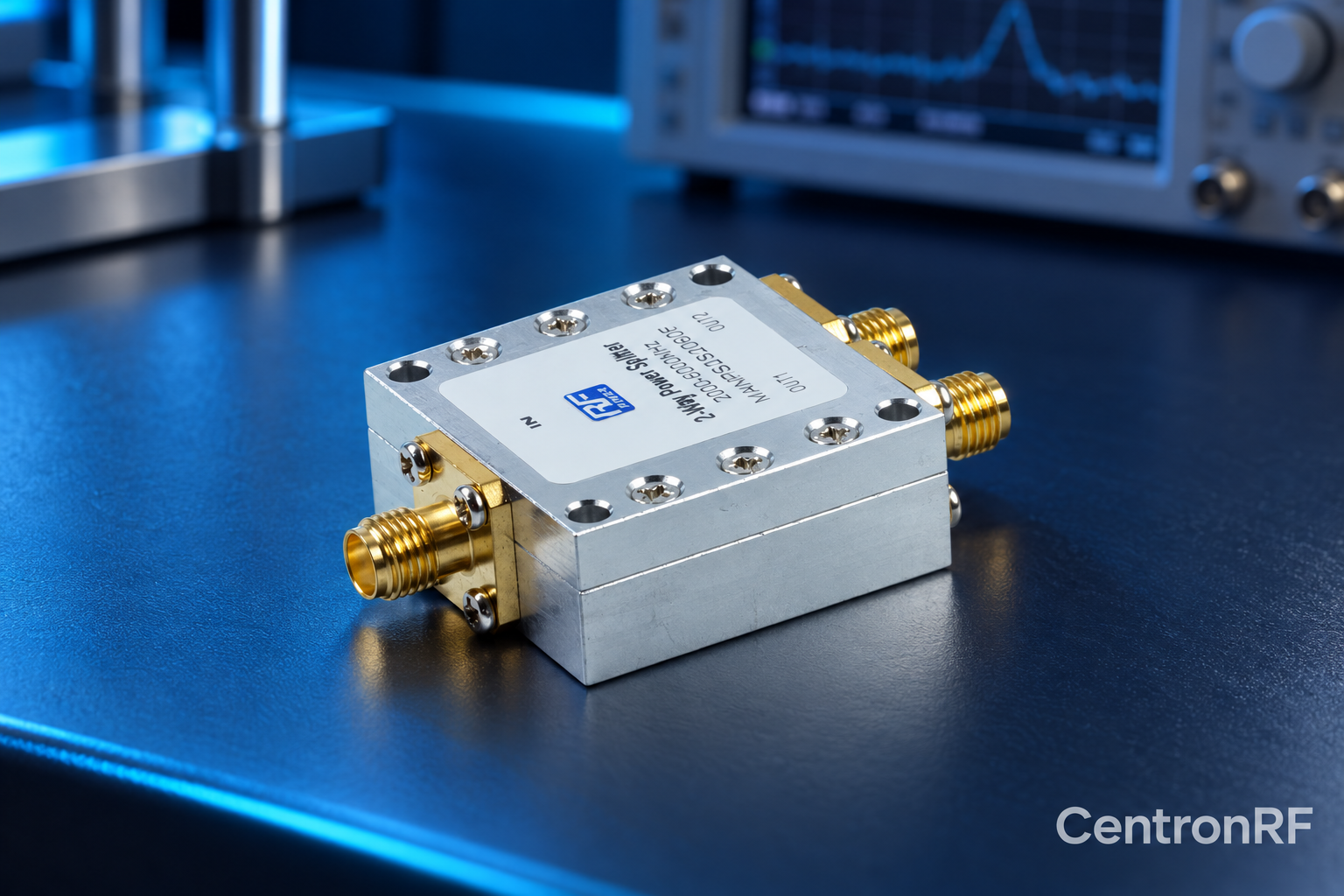
Some passive reciprocal dividers support combining, but permissible power and behavior depend on topology, phase, matching and the manufacturer's specifications.
How it works in practice
Combining coherent signals is different from adding unrelated sources. Imbalanced signals can dissipate power in isolation elements or appear at unwanted ports. Check explicit combining limits and source interaction. Do not connect transmitters together through an unspecified splitter merely because it is passive.
Example and interpretation
Two equal coherent inputs can combine efficiently only with the required phase relationship and a compatible network.
Checks before use
- Confirm combining support
- Check source coherence
- Check imbalance ratings
- Rate internal and external terminations
Important limit
Forward divider power does not automatically equal permitted combining power.
Related Centron RF product
RF power divider range. Compare the exact divider model, port count and current datasheet. Some catalog titles show inconsistent frequency ranges, so confirm the supplied model’s full passband, loss, isolation and power limits before selection.
Further reading
Mini-Circuits: Understanding Power Splitters. This background reference explains general principles; the selected Centron RF model’s datasheet governs its own ratings.
Related guides
Educational guide. Numerical examples use the stated assumptions and are not test results for a supplied unit.