


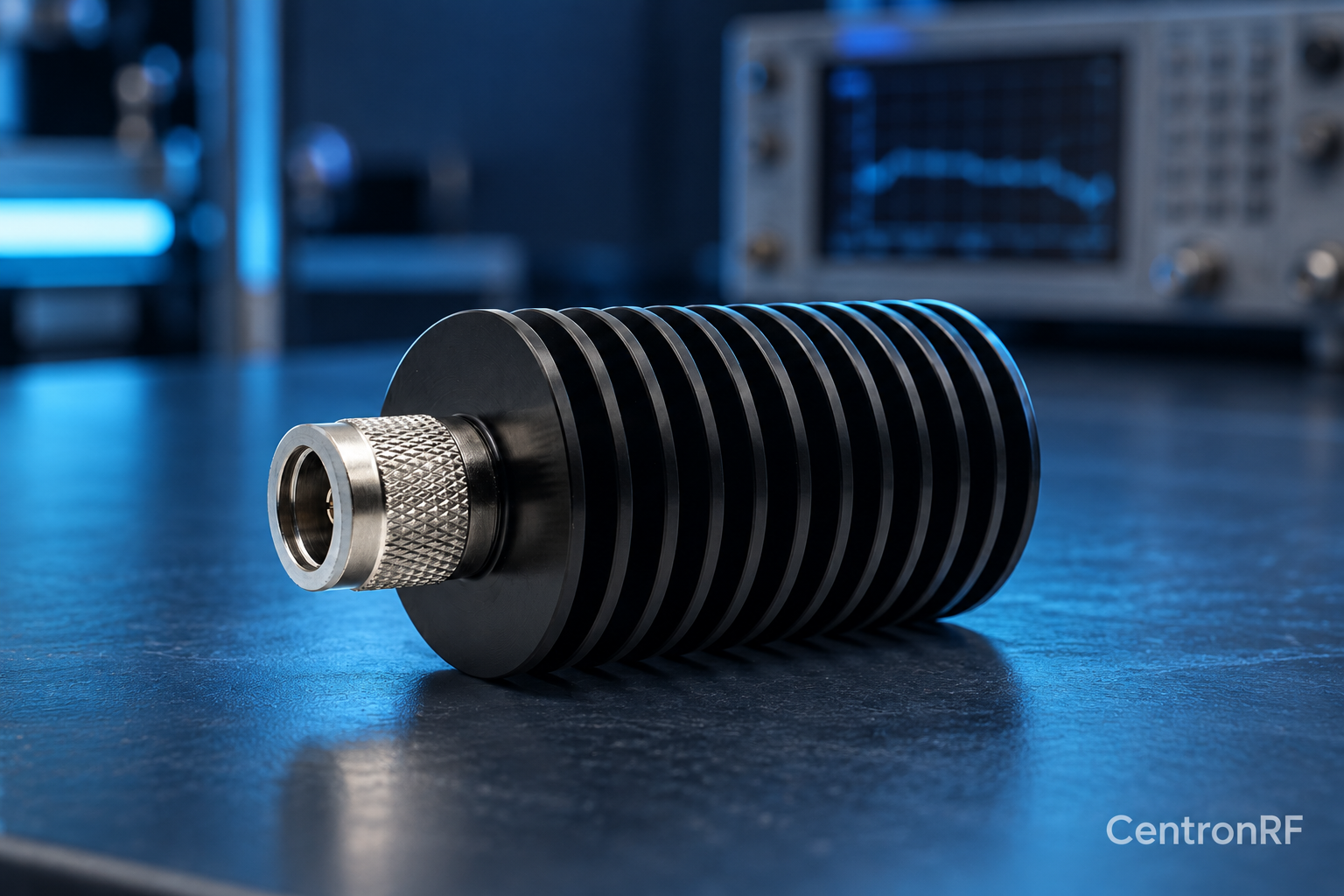
An RF dummy load is a termination that absorbs RF power instead of intentionally radiating it through an antenna. It presents a specified impedance over a defined band.
How it works in practice
A load lets a transmitter or amplifier operate into a controlled test termination. Its power rating depends on thermal conditions, and its match changes with frequency. Unlike an attenuator, a one-port load has no intended RF output for a receiver.
Example and interpretation
A 50-ohm load can terminate a compatible transmitter during bench testing, provided the frequency and power are within its ratings.
Checks before use
- Check impedance
- Check frequency
- Check continuous and peak power
- Provide the required cooling
Important limit
A dummy load is not automatically a precision power sensor.
Related Centron RF product
N-type 50 W 6 GHz dummy load. The linked N-type load is a starting point for comparing impedance, bandwidth, power and mechanical fit. Confirm the exact connector option and current thermal conditions before using any load near its rated power.
Further reading
Rohde & Schwarz: VSWR and Return Loss. This background reference explains general principles; the selected Centron RF model’s datasheet governs its own ratings.
Related guides
Educational guide. Numerical examples use the stated assumptions and are not test results for a supplied unit.