


For a purely resistive matched condition, RMS voltage is the square root of power times resistance, and RMS current is the square root of power divided by resistance.
How it works in practice
These calculations estimate steady sinusoidal stress. Peak voltage is higher than RMS for a sine wave, and mismatches or modulation can increase peaks. Check the resistor's voltage, current and pulse ratings as well as thermal capacity.
Example and interpretation
At 10 W in 50 ohms, voltage is about 22.36 V RMS and current about 0.447 A RMS; sine-wave voltage peak is about 31.62 V.
Checks before use
- State waveform assumptions
- Calculate RMS stress
- Calculate peaks
- Compare every applicable rating
Important limit
A thermal wattage rating does not automatically permit every voltage waveform.
Related Centron RF product
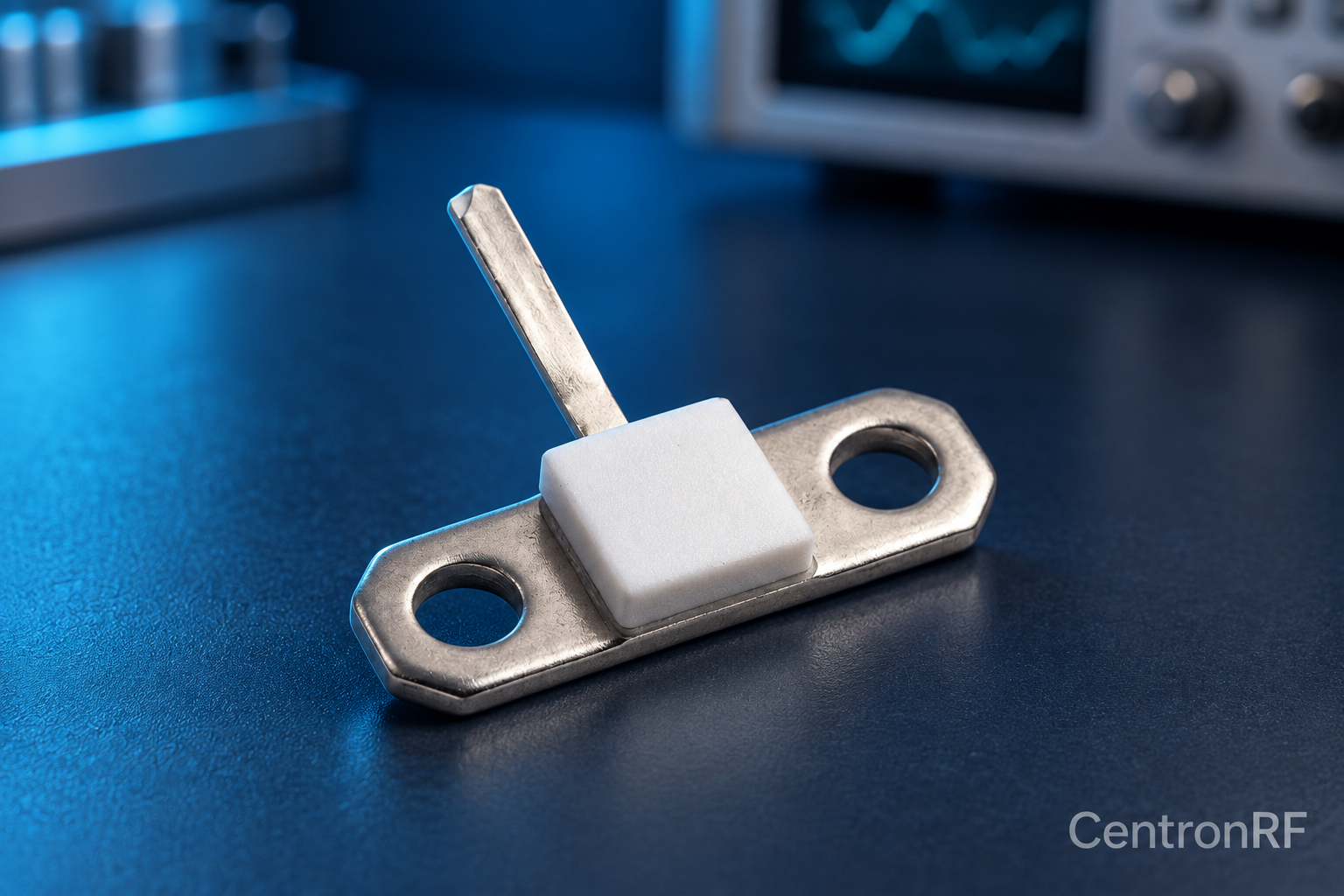
50-ohm 10 W thick-film RF resistor. The linked resistor is listed as 50 ohms, 10 W and 4 GHz. Request the recommended mounting, heatsink, derating, tolerance and pulse conditions; those determine whether it is suitable for the intended circuit.
Further reading
Vishay: Resistor Technical FAQ. This background reference explains general principles; the selected Centron RF model’s datasheet governs its own ratings.
Related guides
Educational guide. Numerical examples use the stated assumptions and are not test results for a supplied unit.