


Pulse capability depends on peak stress, pulse duration, repetition and the element's construction. Average power alone cannot qualify a pulsed application.
How it works in practice
Obtain the manufacturer's pulse curves or specified envelope. Voltage and current limits may be reached before average thermal limits. Repeated pulses can create a different temperature cycle from a single pulse. Include startup and fault events in the requirement.
Example and interpretation
A 100 W pulse at 1% duty averages 1 W but is not automatically safe for a 1 W continuous resistor.
Checks before use
- Define pulse shape
- Calculate peak and average stress
- Check duration and repetition
- Use model-specific pulse limits
Important limit
Do not infer pulse overload capability from continuous watts.
Related Centron RF product
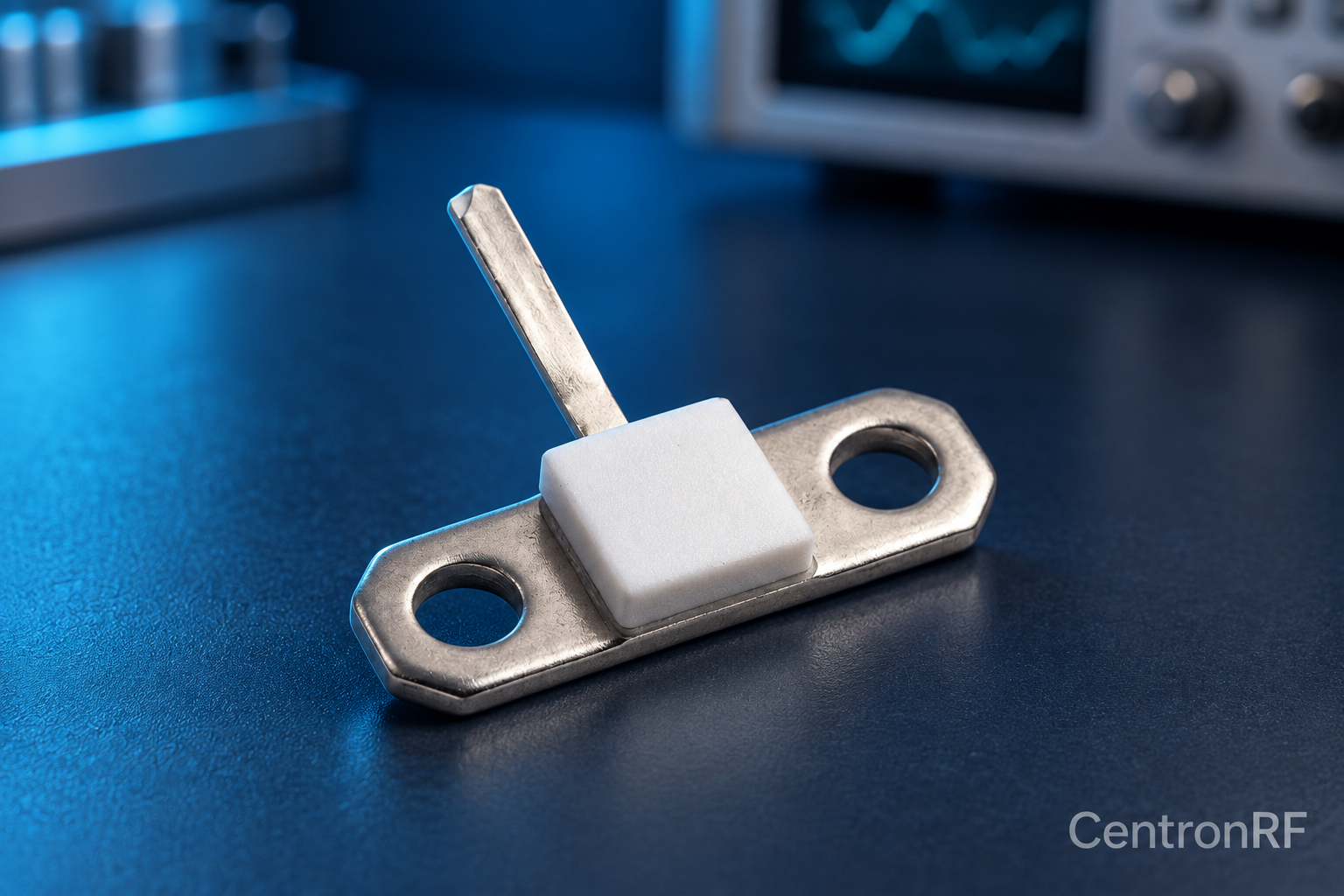
50-ohm 10 W thick-film RF resistor. The linked resistor is listed as 50 ohms, 10 W and 4 GHz. Request the recommended mounting, heatsink, derating, tolerance and pulse conditions; those determine whether it is suitable for the intended circuit.
Further reading
Vishay: Resistor Technical FAQ. This background reference explains general principles; the selected Centron RF model’s datasheet governs its own ratings.
Related guides
Educational guide. Numerical examples use the stated assumptions and are not test results for a supplied unit.