


Select power capacity using maximum continuous input, pulse conditions and the manufacturer's cooling requirements. Include an appropriate operating margin for the real environment.
How it works in practice
A label such as 100 W does not tell you whether the rating requires airflow, a mounting surface or a specified ambient temperature. Check duty cycle and run duration as well as the source's possible fault output. Avoid assuming the enclosure can dissipate rated power in any orientation.
Example and interpretation
A transmitter delivering 50 W continuously puts approximately that power into a well-matched load, which must release it as heat.
Checks before use
- Determine worst-case source output
- Check thermal conditions
- Check peak and duty-cycle limits
- Monitor the initial temperature rise
Important limit
Do not infer a pulse rating from average watts alone.
Related Centron RF product
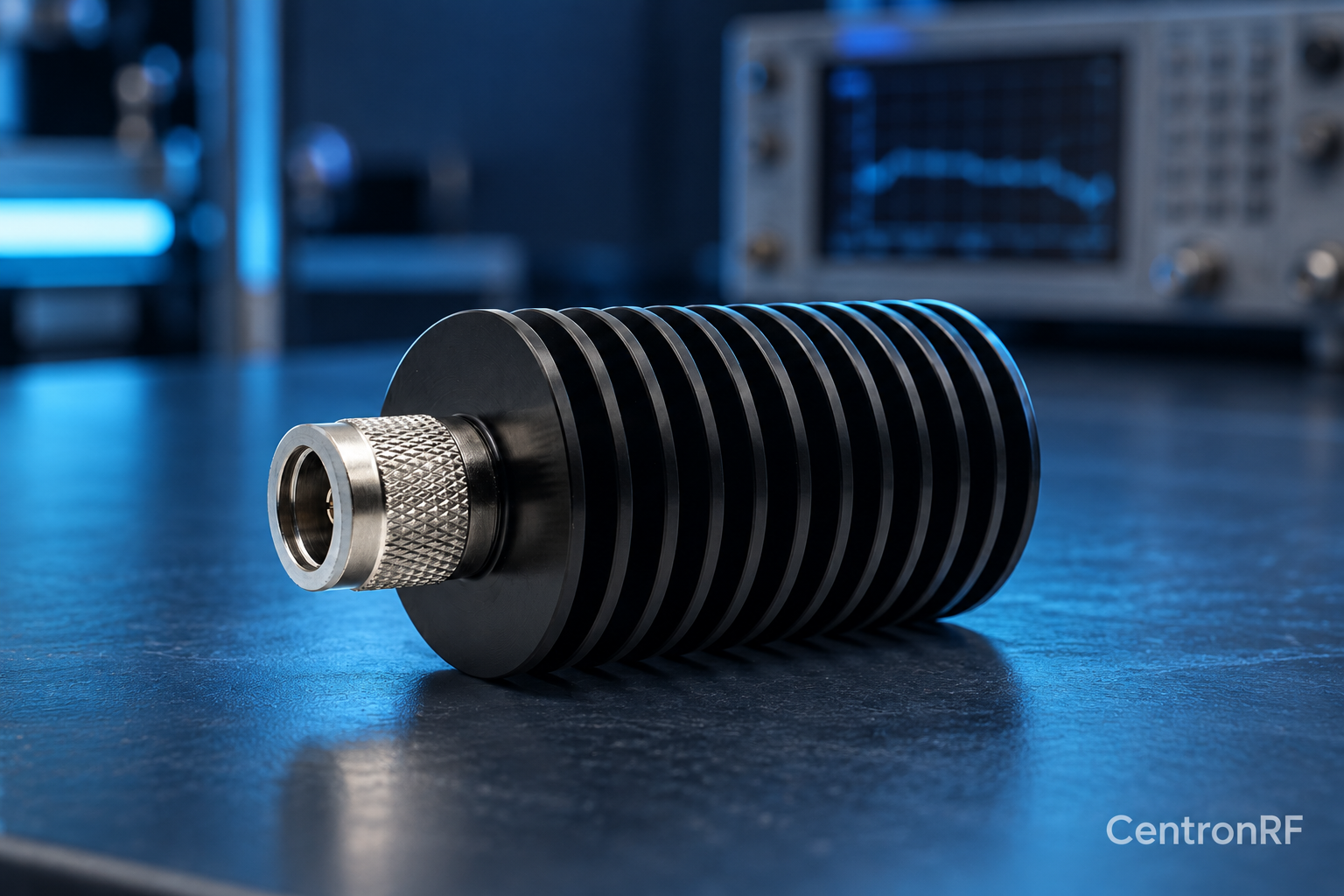
N-type 50 W 6 GHz dummy load. The linked N-type load is a starting point for comparing impedance, bandwidth, power and mechanical fit. Confirm the exact connector option and current thermal conditions before using any load near its rated power.
Further reading
Rohde & Schwarz: VSWR and Return Loss. This background reference explains general principles; the selected Centron RF model’s datasheet governs its own ratings.
Related guides
Educational guide. Numerical examples use the stated assumptions and are not test results for a supplied unit.