


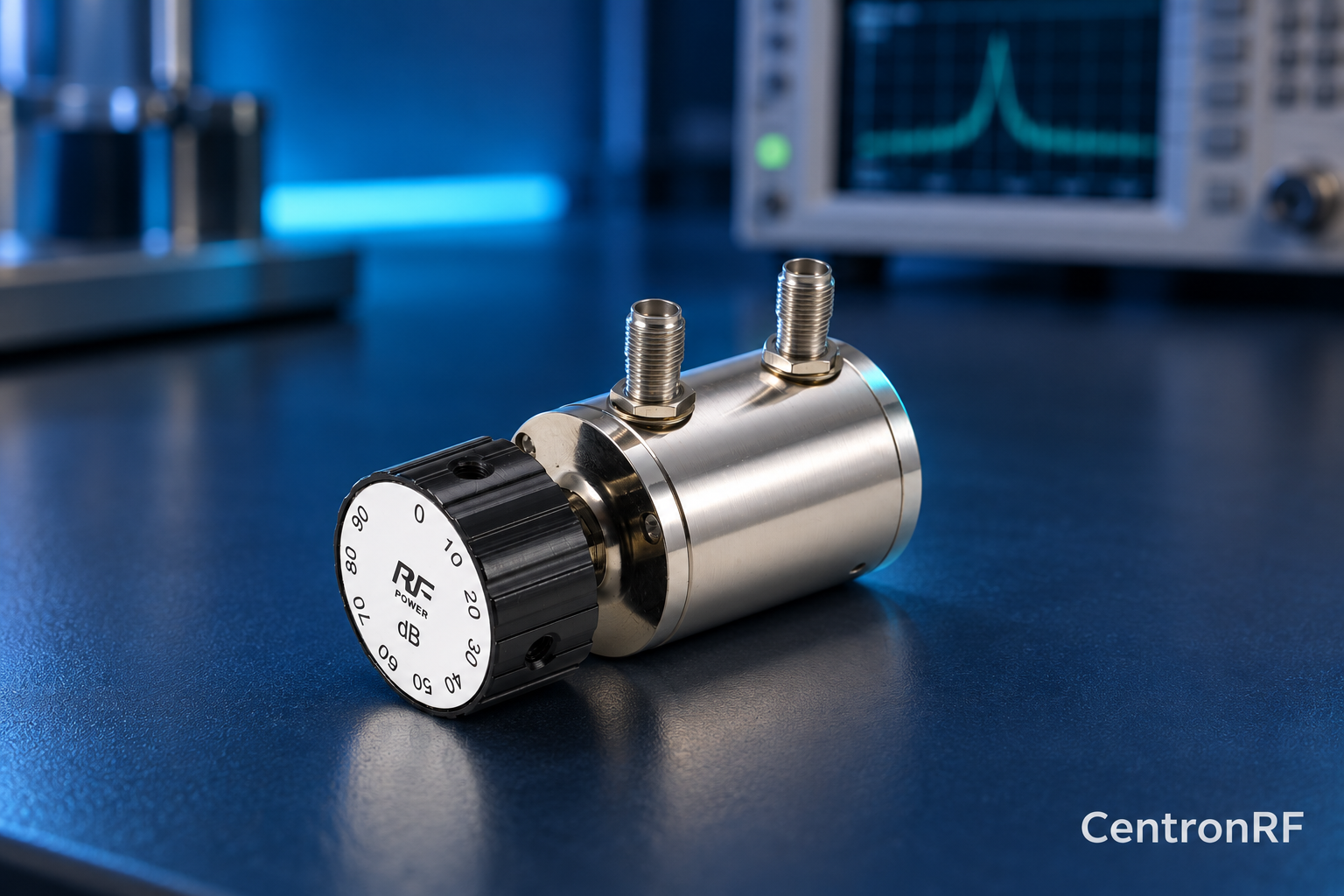
A manual step attenuator suits direct bench adjustment; a programmable attenuator suits automated sequences when its control and RF specifications meet the task.
How it works in practice
Compare range, increments, insertion loss, power handling and switching behavior before choosing an interface. Automation improves sequence consistency but does not automatically improve RF accuracy. Manual controls can be practical for setup and troubleshooting, while repeated production sweeps may benefit from logged electronic control.
Example and interpretation
A daily test with hundreds of level changes may justify programmable control; occasional exploratory measurements may suit a rotary dial.
Checks before use
- Estimate switching volume
- Define RF requirements
- Assess logging needs
- Compare calibration and maintenance requirements
Important limit
Do not choose solely by whether a device has digital control.
Related Centron RF product
SMA rotary attenuator with 10 dB steps. The linked rotary model lists 0–90 dB adjustment in 10 dB steps, 50-ohm impedance and a DC–6 GHz band. Its listed continuous input is 2 W; obtain explicit switching and pulse limits before applying those stresses.
Further reading
Keysight: Accurate Network Measurements. This background reference explains general principles; the selected Centron RF model’s datasheet governs its own ratings.
Related guides
Educational guide. Numerical examples use the stated assumptions and are not test results for a supplied unit.