


Continuous rating addresses sustained dissipation under stated conditions. Short-term overload requires separate limits and cannot be presumed from the continuous rating.
How it works in practice
Check pulse curves, overload tests and permissible repetition. Repeated 'short' events may create a high average temperature. Component damage can result from peak voltage or current before thermal equilibrium occurs. Ask for missing data when the application intentionally exceeds continuous power.
Example and interpretation
A brief 20 W event in a nominal 10 W resistor is neither automatically safe nor automatically forbidden without its overload specification.
Checks before use
- Define duration
- Define repetition
- Check peak limits
- Check average thermal load
Important limit
Do not advertise an unsupported overload factor.
Related Centron RF product
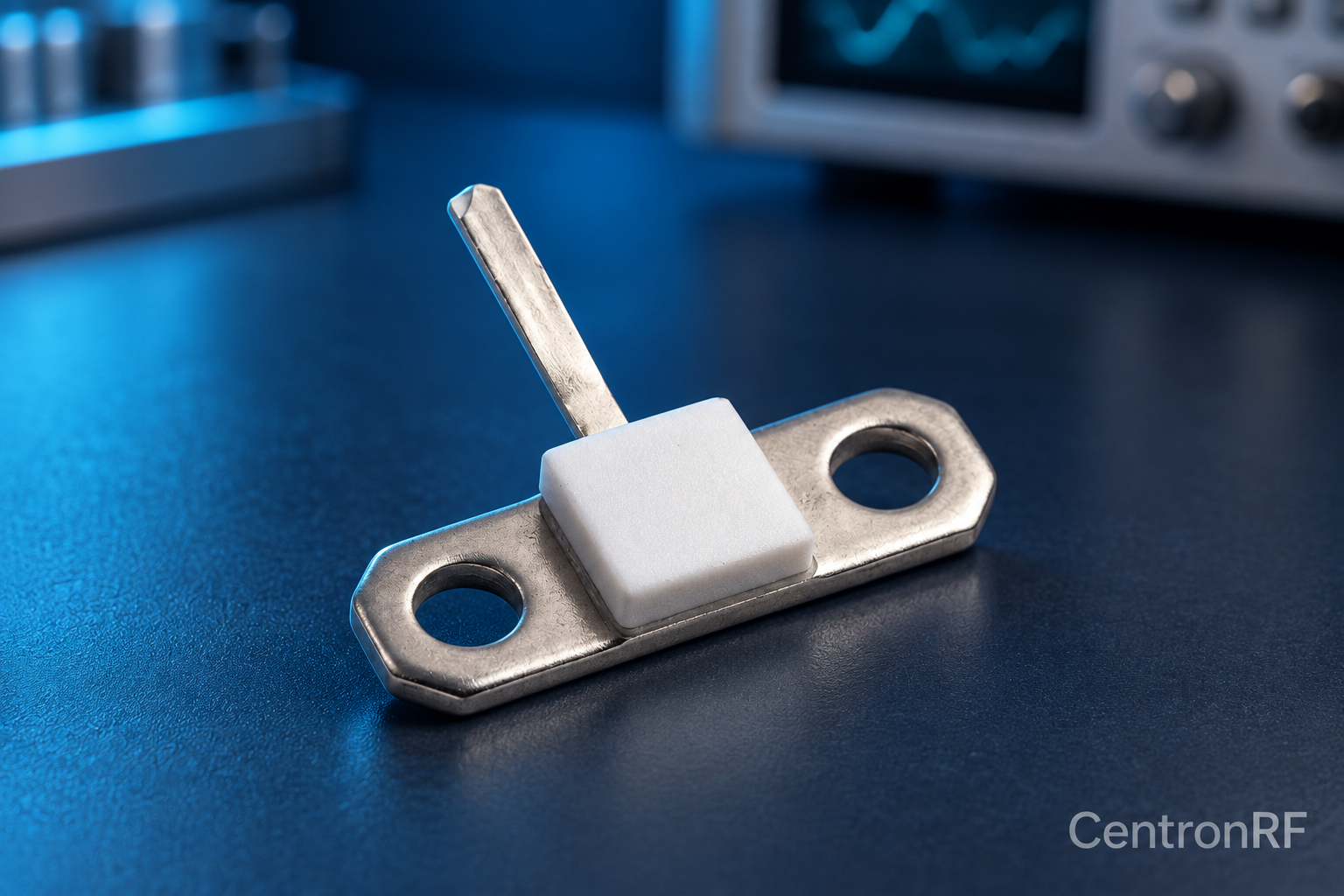
50-ohm 10 W thick-film RF resistor. The linked resistor is listed as 50 ohms, 10 W and 4 GHz. Request the recommended mounting, heatsink, derating, tolerance and pulse conditions; those determine whether it is suitable for the intended circuit.
Further reading
Vishay: Resistor Technical FAQ. This background reference explains general principles; the selected Centron RF model’s datasheet governs its own ratings.
Related guides
Educational guide. Numerical examples use the stated assumptions and are not test results for a supplied unit.