


Moving a cable can change its phase, loss or connector stress. This can alter the calibrated path or introduce repeatability error.
How it works in practice
Use stable routing for precision comparisons and select cables suited to repeated flexing where needed. If movement is unavoidable, characterize its effect or recalibrate under the new conditions. A visual inspection alone cannot quantify phase stability. Keep mechanical support consistent.
Example and interpretation
Repositioning a VNA test cable after calibration can shift a reflection measurement even when the device is unchanged.
Checks before use
- Fix cable routing
- Avoid connector strain
- Assess flex sensitivity
- Verify after movement
Important limit
Do not attribute every changed trace to the device under test.
Related Centron RF product
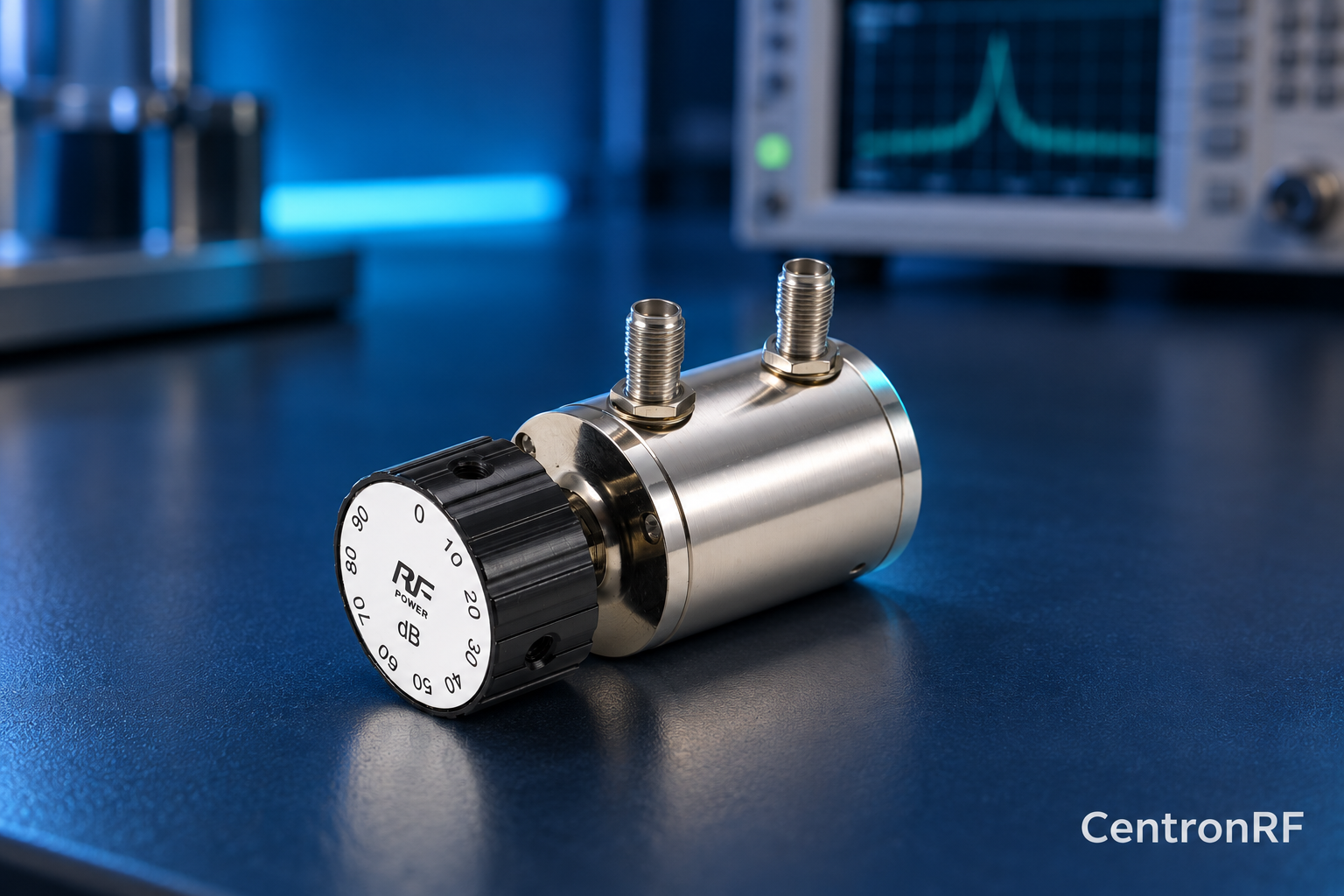
SMA rotary attenuator with 1 dB steps. The linked fine-step unit lists 0–10 dB in 1 dB increments. It can be considered for controlled level changes within its ratings. Dial resolution does not establish traceable accuracy; calibrate the assembled path as required.
Further reading
Keysight: Fundamentals of RF and Microwave Power Measurements. This background reference explains general principles; the selected Centron RF model’s datasheet governs its own ratings.
Related guides
Educational guide. Numerical examples use the stated assumptions and are not test results for a supplied unit.