


Measurement uncertainty accounts for imperfect knowledge of the result, including instrument calibration, path corrections, mismatch and repeatability. It differs from a component's nominal tolerance.
How it works in practice
Build the budget from the actual method and applicable data. Separate corrections from their remaining uncertainty. Combine contributions using a justified statistical model rather than blindly adding every number or assuming independence. Report conditions and coverage conventions with important results.
Example and interpretation
A cable correction of 0.8 dB can have its own uncertainty; applying the correction does not eliminate that uncertainty.
Checks before use
- List error sources
- Apply known corrections
- Use a justified combination method
- State the reported convention
Important limit
More decimal places do not imply lower uncertainty.
Related Centron RF product
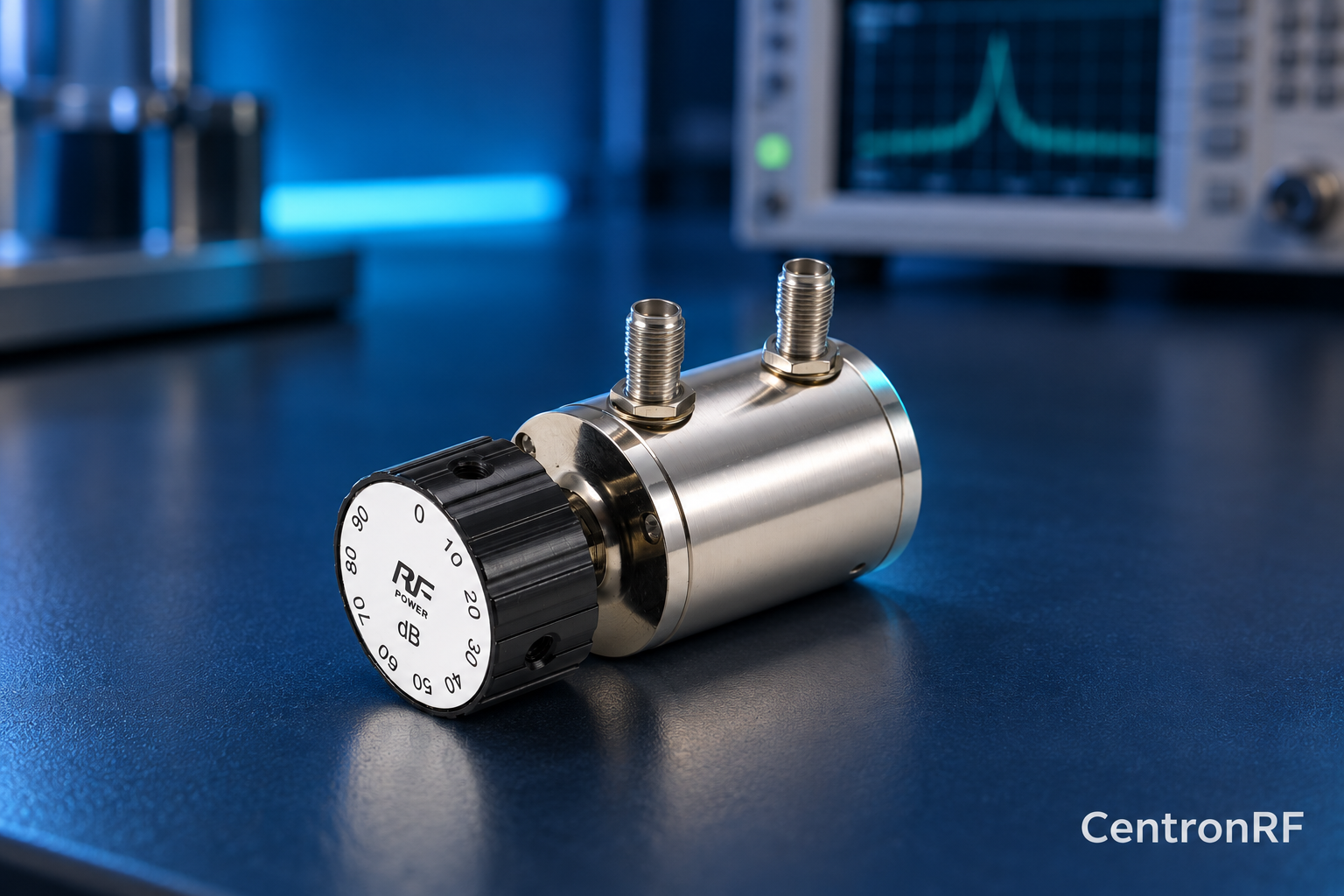
SMA rotary attenuator with 1 dB steps. The linked fine-step unit lists 0–10 dB in 1 dB increments. It can be considered for controlled level changes within its ratings. Dial resolution does not establish traceable accuracy; calibrate the assembled path as required.
Further reading
Keysight: Fundamentals of RF and Microwave Power Measurements. This background reference explains general principles; the selected Centron RF model’s datasheet governs its own ratings.
Related guides
Educational guide. Numerical examples use the stated assumptions and are not test results for a supplied unit.