


Record enough detail to reproduce the signal path, instrument conditions and decision criteria. Include actual component identities and corrections.
How it works in practice
State frequencies, waveform, levels, reference planes, cable routing, selected attenuator states and calibration method. Keep raw results with the interpreted conclusion. Define acceptance criteria before examining the data where appropriate. Distinguish a demonstration from formal product qualification.
Example and interpretation
A reproducible note says which 20 dB pad was used and its measured correction, not simply 'attenuation added'.
Checks before use
- Draw the setup
- Record settings and identities
- Store calibration data
- Document the decision rule
Important limit
Do not present an undocumented bench observation as a universal product claim.
Related Centron RF product
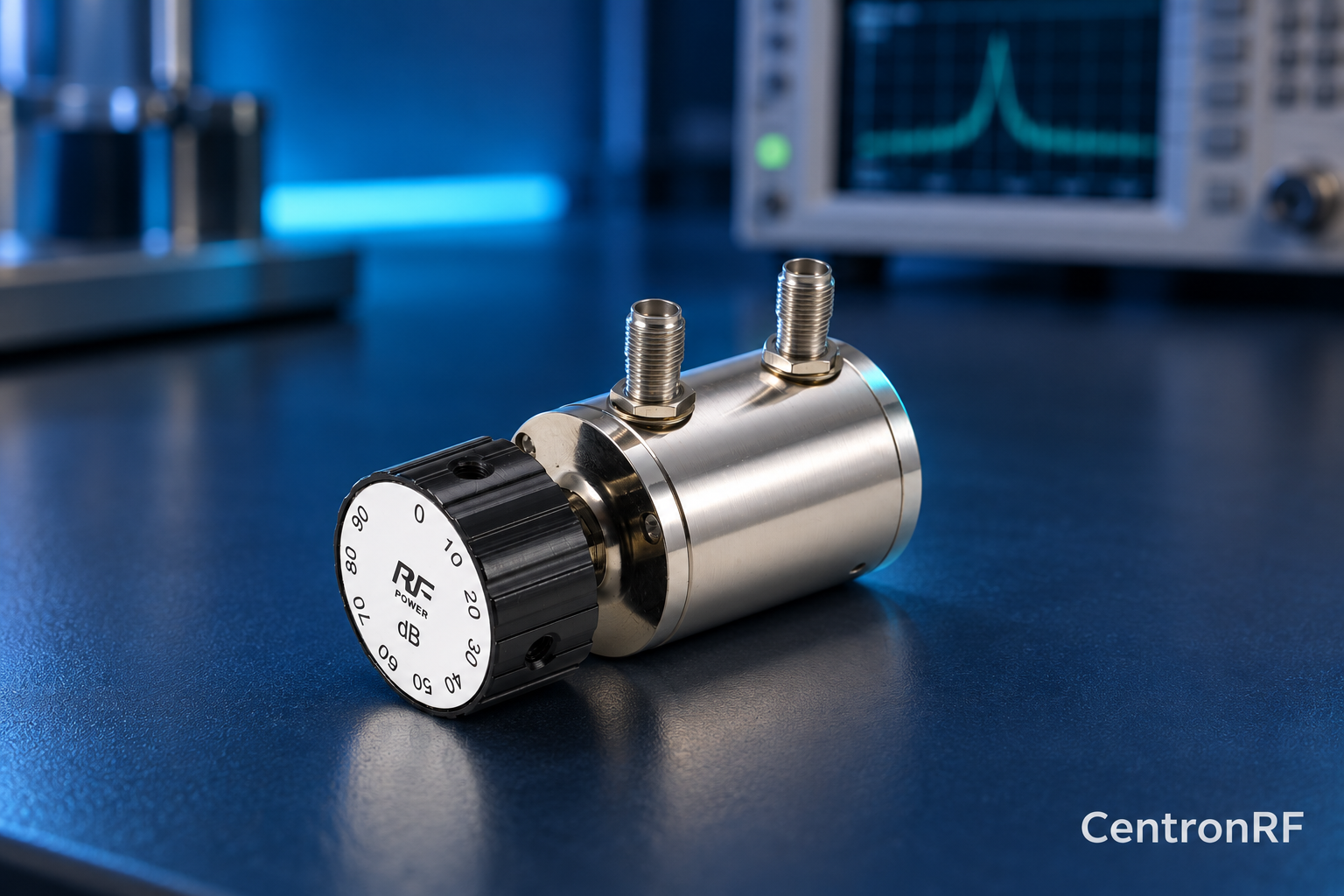
SMA rotary attenuator with 1 dB steps. The linked fine-step unit lists 0–10 dB in 1 dB increments. It can be considered for controlled level changes within its ratings. Dial resolution does not establish traceable accuracy; calibrate the assembled path as required.
Further reading
Keysight: Fundamentals of RF and Microwave Power Measurements. This background reference explains general principles; the selected Centron RF model’s datasheet governs its own ratings.
Related guides
Educational guide. Numerical examples use the stated assumptions and are not test results for a supplied unit.