


An attenuator reduces signal level, whereas an RF filter selects frequencies. Choose according to whether the problem is excessive amplitude or unwanted spectral content.
How it works in practice
A broadband pad reduces wanted and unwanted signals within its operating band together. A suitable filter can reject specific out-of-band content while passing the wanted band, but its rejection and power limits must cover the application. Some setups use both, with each component serving a different purpose.
Example and interpretation
A 10 dB pad lowers both a carrier and its harmonic by approximately 10 dB if its loss is the same at both frequencies; their relative level is then largely unchanged.
Checks before use
- Identify excessive level or unwanted frequency
- Specify the wanted band
- Budget filter and pad losses
- Validate the receiver or analyzer input
Important limit
Do not expect a broadband attenuator to selectively remove a harmonic.
Related Centron RF product
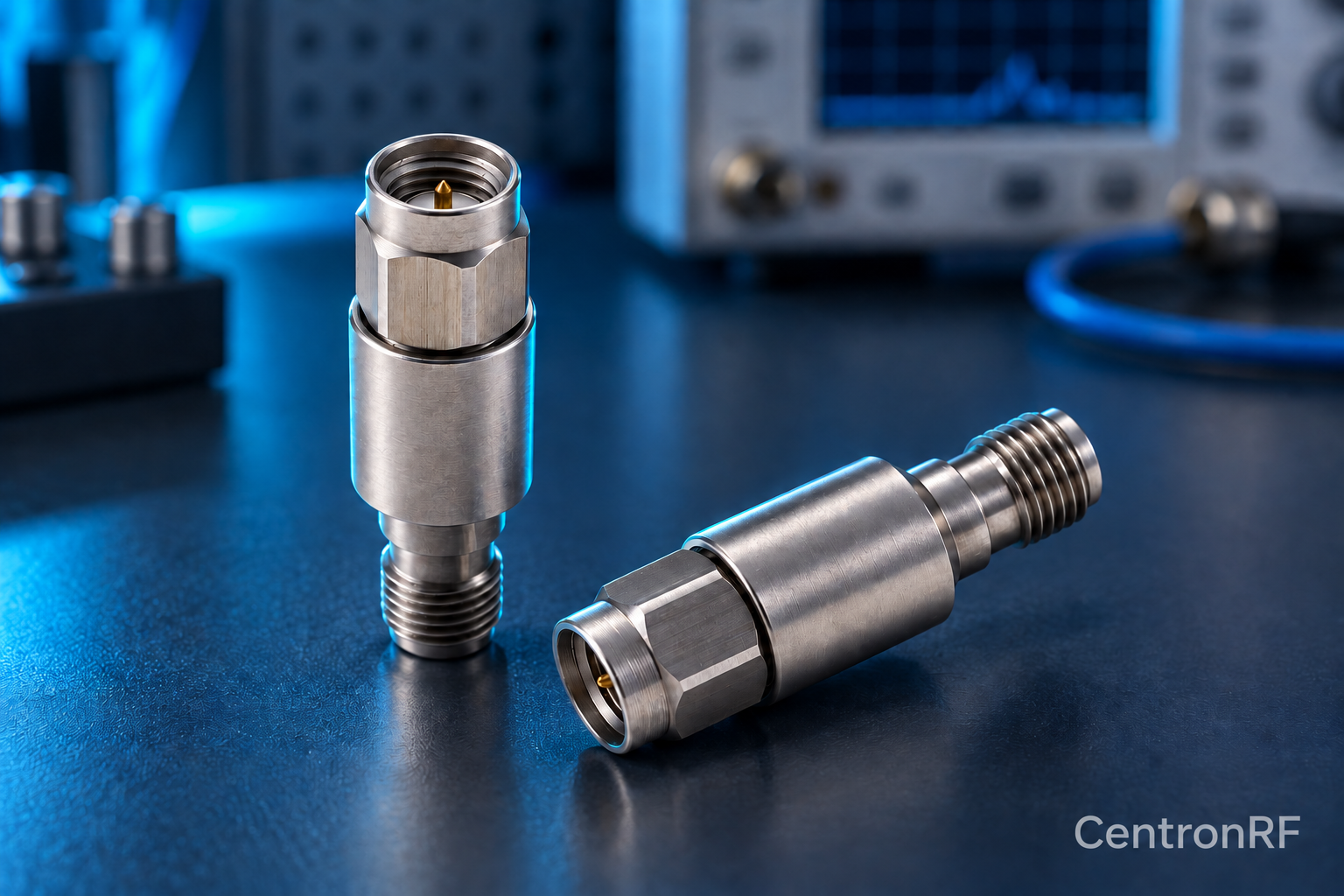
SMA 5 W 6 GHz fixed attenuator. The SMA 5 W model is listed as a 50-ohm fixed attenuator with a DC–6 GHz range. Select an available attenuation option and verify the current tolerance, cooling conditions and pulse limits for your application.
Further reading
Keysight: Spectrum Analysis Basics. This background reference explains general principles; the selected Centron RF model’s datasheet governs its own ratings.
Related guides
- External Versus Internal Spectrum Analyzer Attenuation
- RF Attenuator Power Rating Versus Dissipated Power
Educational guide. Numerical examples use the stated assumptions and are not test results for a supplied unit.