


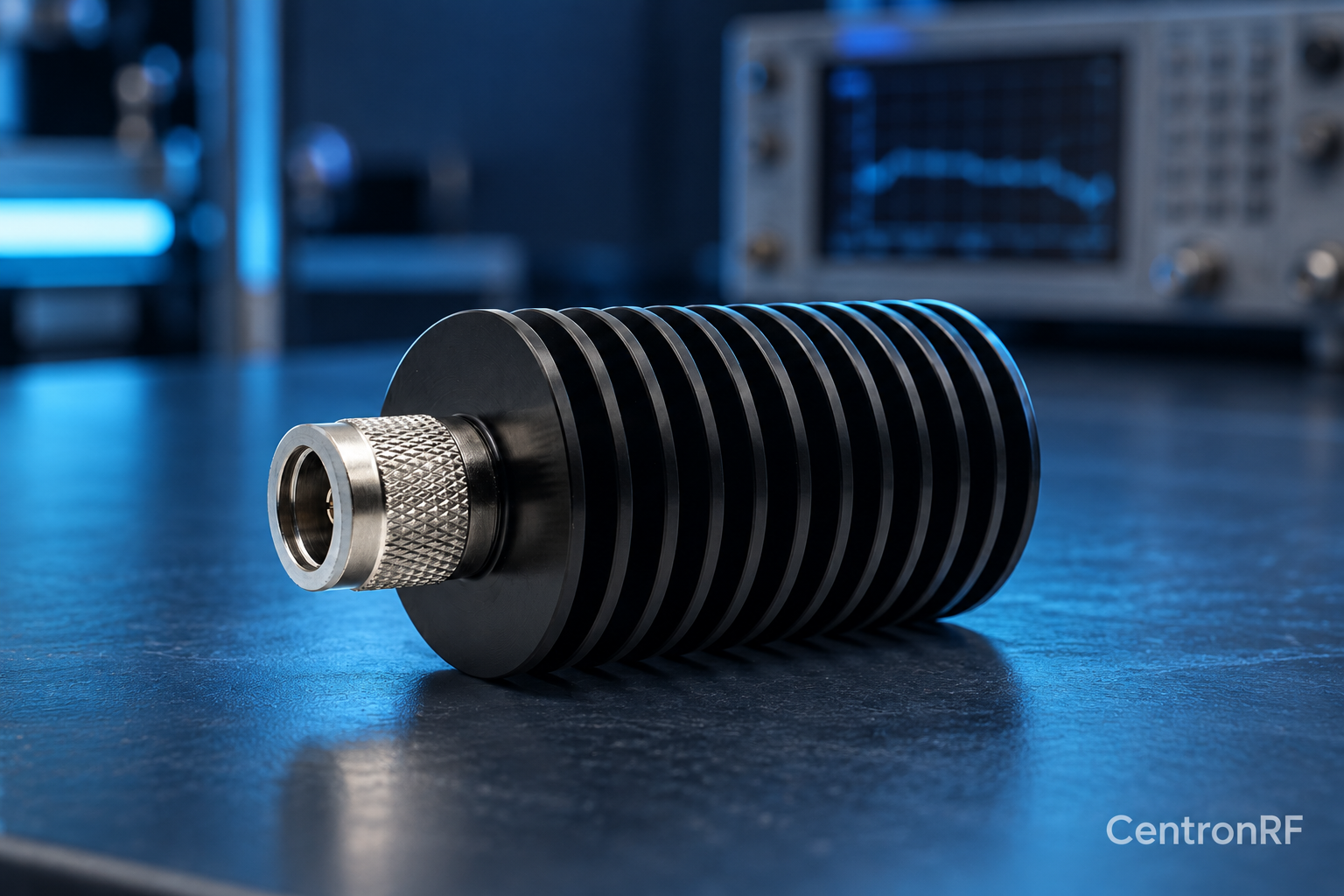
Follow the load's specified mounting and cooling arrangement because the power rating may rely on heat transfer to its environment.
How it works in practice
Some loads are self-contained finned units; others require a heatsink or mounting plate. Contact flatness, thermal interface material and fastening method can affect heat transfer. Use only the specified installation method, and account for elevated ambient temperature or enclosed cabinets.
Example and interpretation
A load qualified on a cooled plate may need derating when installed in still air; the amount must come from its thermal data.
Checks before use
- Read the mounting requirements
- Provide the required heat path
- Verify ventilation
- Check operating temperature limits
Important limit
Do not assume every finned housing is rated for full power in a sealed enclosure.
Related Centron RF product
N-type 50 W 6 GHz dummy load. The linked N-type load is a starting point for comparing impedance, bandwidth, power and mechanical fit. Confirm the exact connector option and current thermal conditions before using any load near its rated power.
Further reading
Rohde & Schwarz: VSWR and Return Loss. This background reference explains general principles; the selected Centron RF model’s datasheet governs its own ratings.
Related guides
Educational guide. Numerical examples use the stated assumptions and are not test results for a supplied unit.