


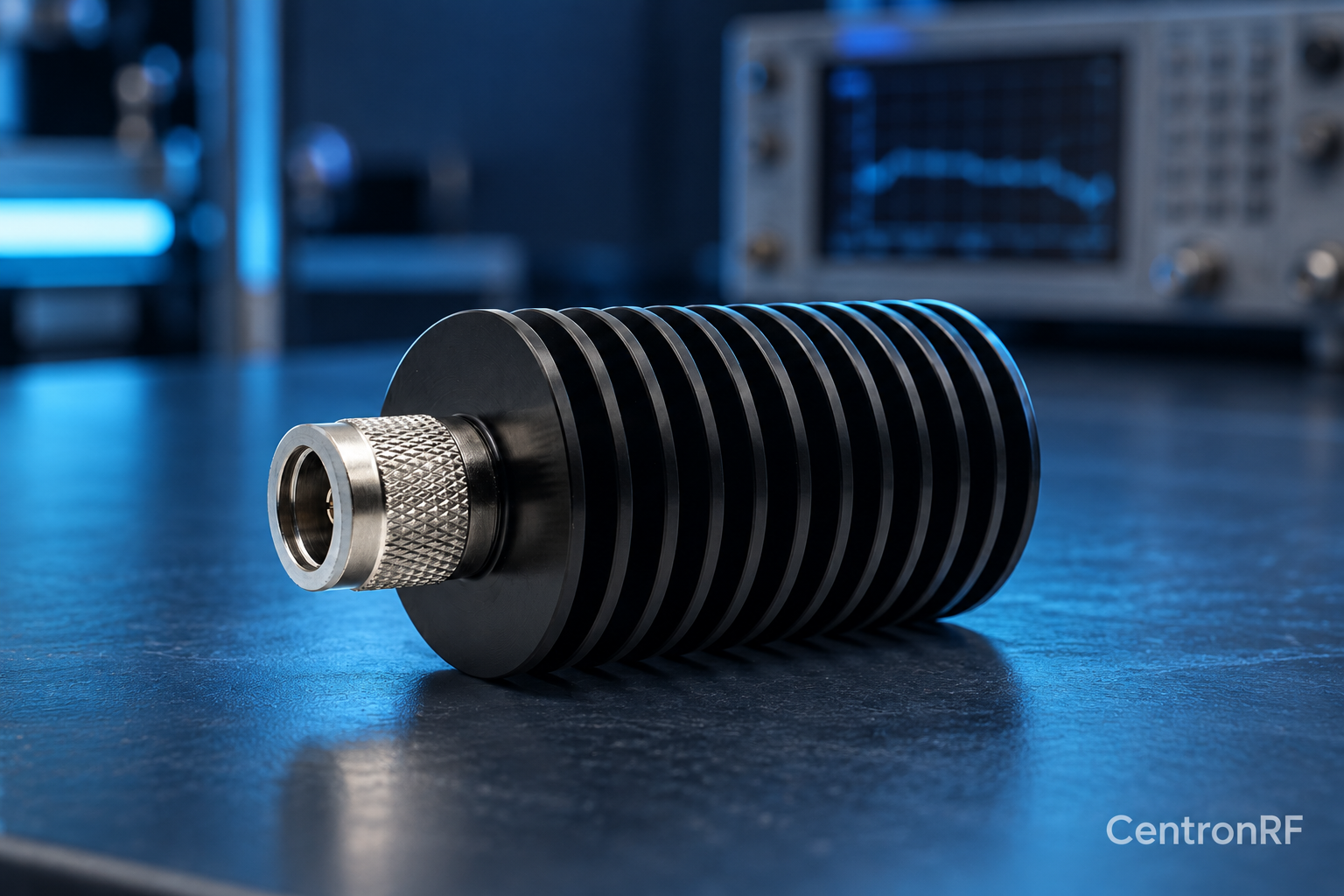
A dummy load provides a terminating impedance and dissipates power. A power meter measures power using a sensor with its own range and calibration.
How it works in practice
Some instruments integrate a load and measurement element, but a standalone load generally has no calibrated readout. To measure high-power output, use an appropriate directional coupler and sensor or a purpose-built terminating sensor. Rate every element, including the measurement tap and its protection.
Example and interpretation
A 50 W load can absorb a transmitter signal without telling you whether the actual delivered power is 42 W or 48 W.
Checks before use
- Define the measurement plane
- Select a rated sensor arrangement
- Check coupling and losses
- Use calibration corrections
Important limit
Do not estimate output power from housing temperature without a validated measurement method.
Related Centron RF product
N-type 50 W 6 GHz dummy load. The linked N-type load is a starting point for comparing impedance, bandwidth, power and mechanical fit. Confirm the exact connector option and current thermal conditions before using any load near its rated power.
Further reading
Rohde & Schwarz: VSWR and Return Loss. This background reference explains general principles; the selected Centron RF model’s datasheet governs its own ratings.
Related guides
Educational guide. Numerical examples use the stated assumptions and are not test results for a supplied unit.