


Scalar measurements describe magnitude or power; vector measurements also include phase. Choose the method that answers the actual engineering question.
How it works in practice
A source and power sensor can measure insertion loss under controlled conditions, while a calibrated VNA can characterize complex reflection and transmission. Phase-sensitive networks require more than power balance. Different methods have different uncertainty and calibration requirements.
Example and interpretation
Equal output powers from a divider do not prove equal output phase; that requires a vector or other coherent measurement.
Checks before use
- Define required quantities
- Choose scalar or vector instrumentation
- Calibrate appropriately
- Report the method
Important limit
Do not infer complex impedance from an amplitude-only result.
Related Centron RF product
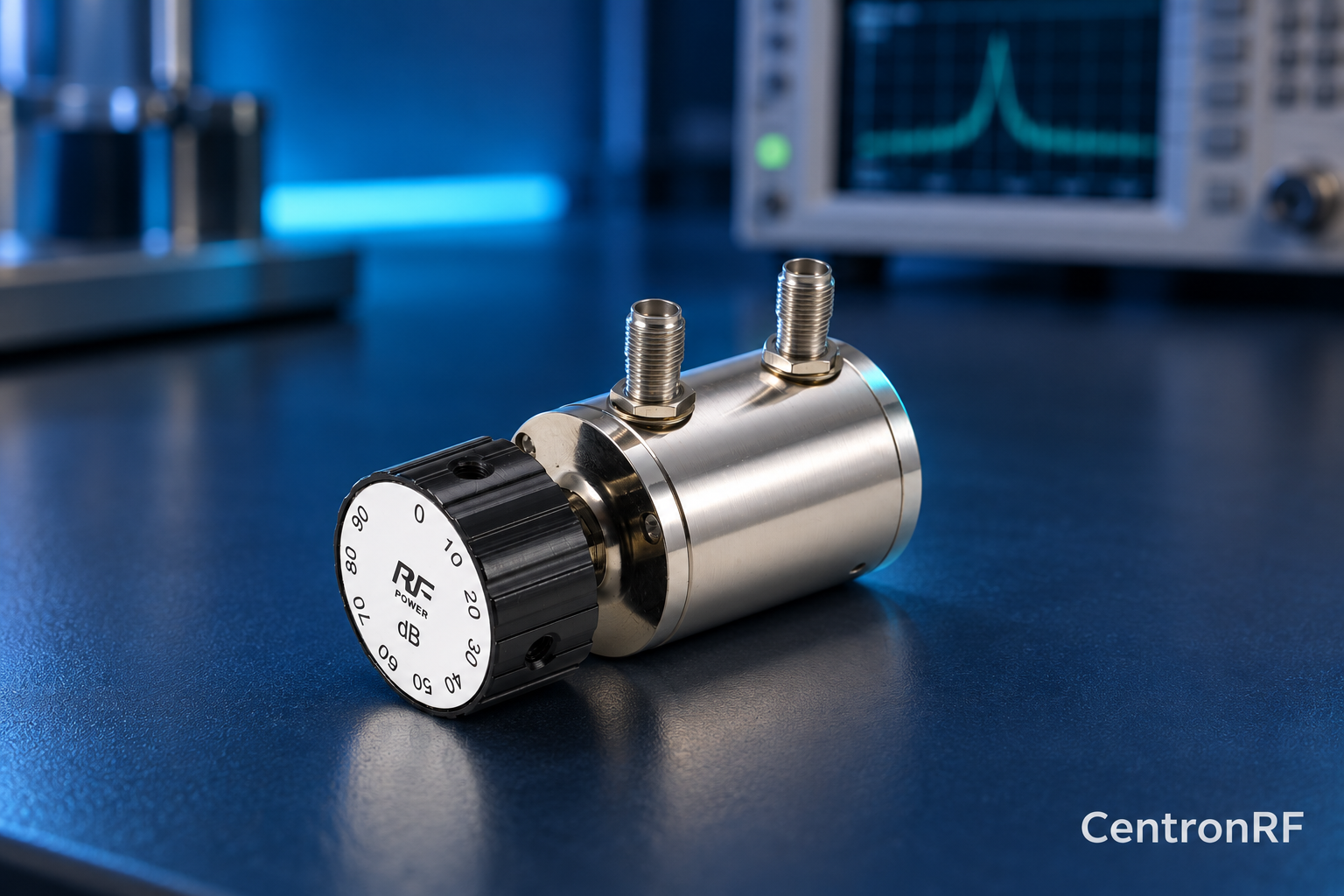
SMA rotary attenuator with 1 dB steps. The linked fine-step unit lists 0–10 dB in 1 dB increments. It can be considered for controlled level changes within its ratings. Dial resolution does not establish traceable accuracy; calibrate the assembled path as required.
Further reading
Keysight: Fundamentals of RF and Microwave Power Measurements. This background reference explains general principles; the selected Centron RF model’s datasheet governs its own ratings.
Related guides
Educational guide. Numerical examples use the stated assumptions and are not test results for a supplied unit.