


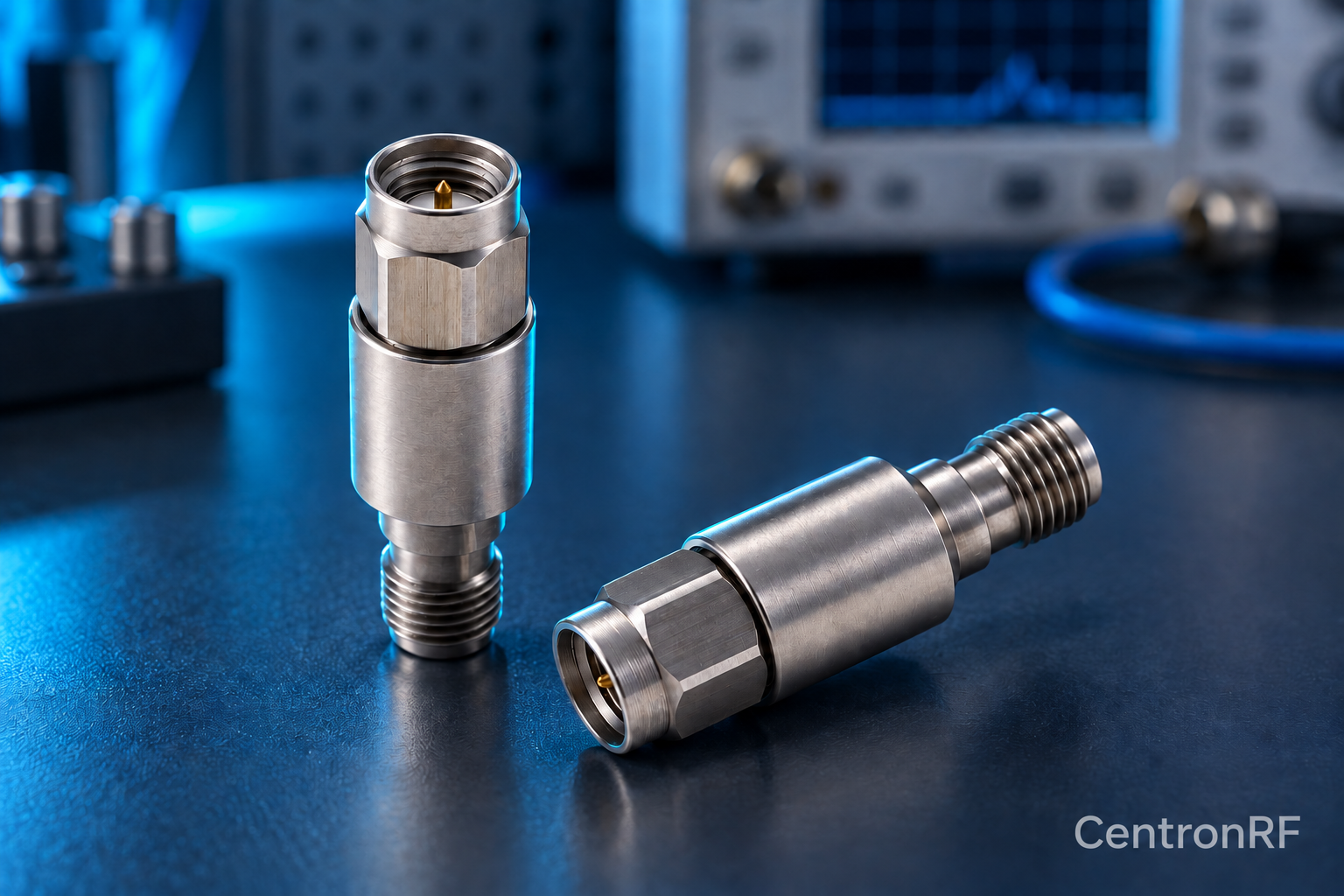
Support heavy accessories and cables so their weight does not bend or strain the instrument interface. Mechanical stress can damage precision connectors.
How it works in practice
Use suitable fixtures or flexible rated cables rather than long unsupported rigid chains. Keep the reference plane and added loss documented. Follow manufacturer connection guidance. If the interface has been struck or strained, inspect and verify it before further critical measurements.
Example and interpretation
A large finned load should not hang unsupported from a small instrument connector through several rigid adapters.
Checks before use
- Assess component weight
- Provide support
- Avoid lever-arm chains
- Inspect stressed interfaces
Important limit
Do not use the instrument connector as a structural mounting point.
Related Centron RF product
N-type fixed attenuator for a compatible RF path. Use a product page to check both connector interfaces, nominal impedance and model-specific band and power requirements. The connector family alone cannot establish a component’s total RF capability.
Further reading
Rohde & Schwarz: Impedance, VSWR and Return Loss. This background reference explains general principles; the selected Centron RF model’s datasheet governs its own ratings.
Related guides
- Connector Frequency Ratings in a Complete Assembly
- RF Connector Power Handling: More Than Connector Size
Educational guide. Numerical examples use the stated assumptions and are not test results for a supplied unit.