


Match resistance, tolerance, package, RF behavior, mounting and all applicable stress limits. A same-watt replacement can still be unsuitable.
How it works in practice
Compare the original circuit's role and operating conditions with the replacement datasheet. Lead arrangement and flange geometry can change both impedance and heat flow. Use the manufacturer's qualified replacement where required. Recheck the circuit after installation, including imbalance conditions.
Example and interpretation
Two 10 W, 50-ohm parts may require different heatsinks or have different high-frequency parasitics.
Checks before use
- Identify the original model
- Compare electrical and thermal conditions
- Check package compatibility
- Requalify the assembly
Important limit
Do not approve equivalence from resistance and wattage alone.
Related Centron RF product
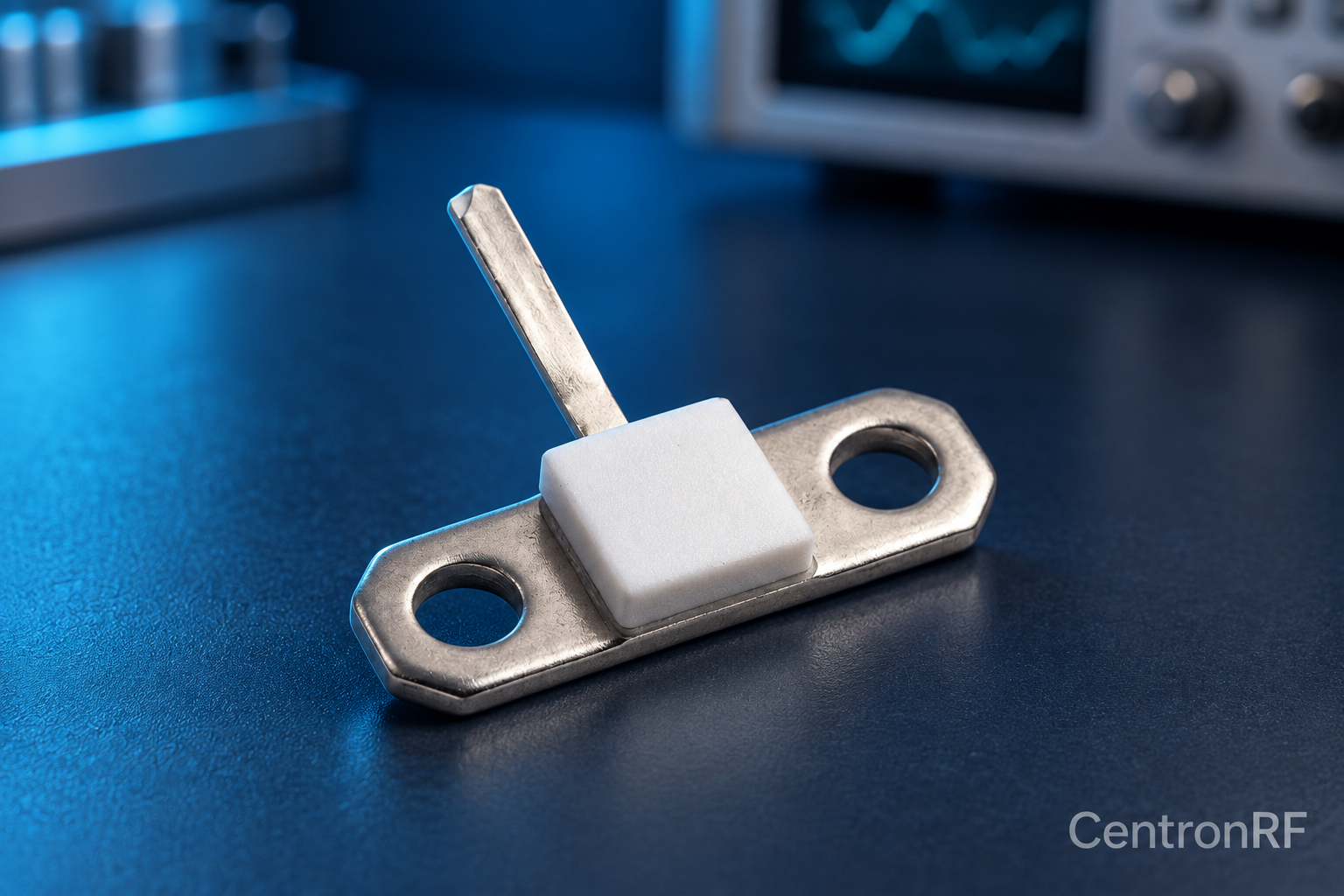
50-ohm 10 W thick-film RF resistor. The linked resistor is listed as 50 ohms, 10 W and 4 GHz. Request the recommended mounting, heatsink, derating, tolerance and pulse conditions; those determine whether it is suitable for the intended circuit.
Further reading
Vishay: Resistor Technical FAQ. This background reference explains general principles; the selected Centron RF model’s datasheet governs its own ratings.
Related guides
Educational guide. Numerical examples use the stated assumptions and are not test results for a supplied unit.