


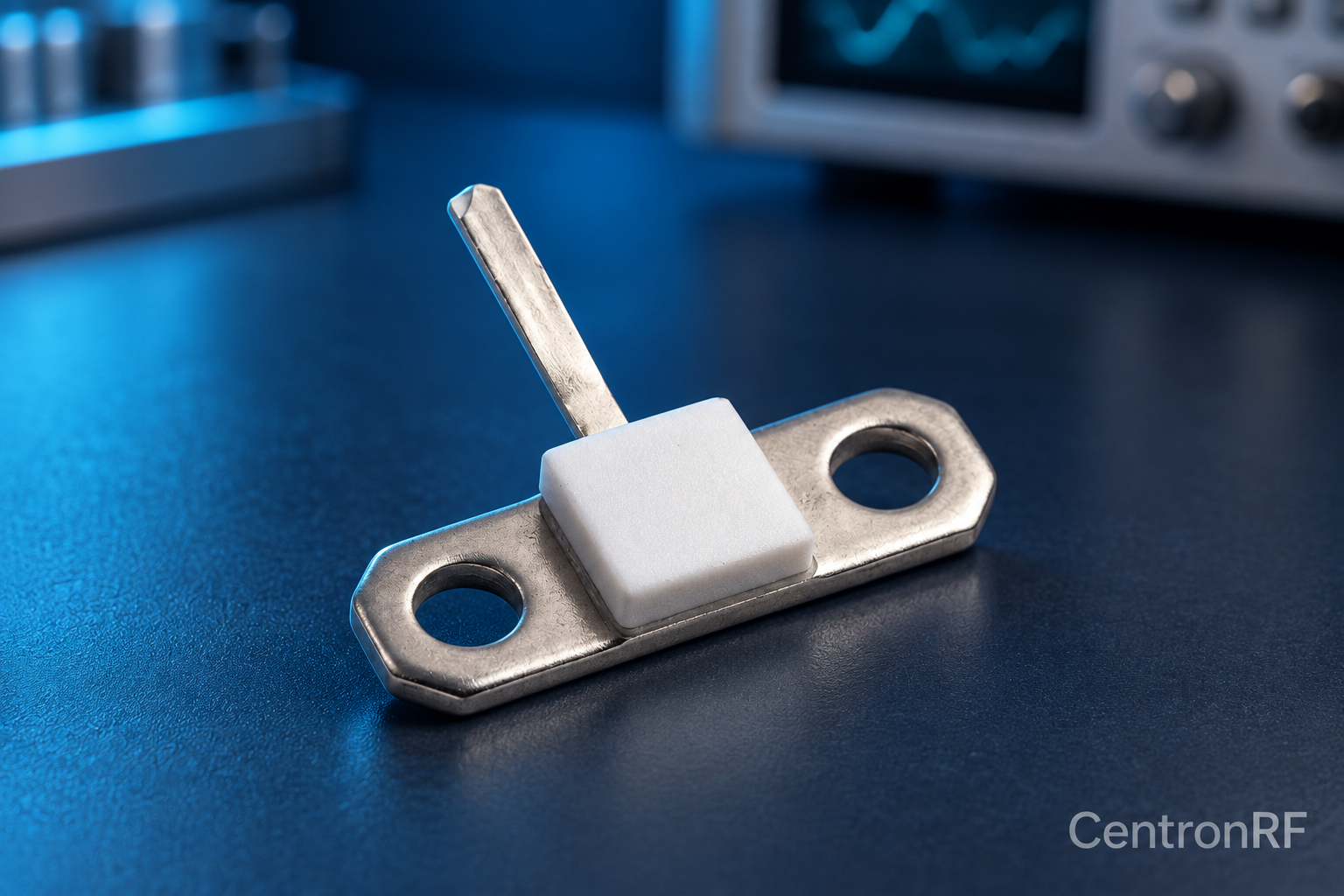
Lead length adds inductance and changes the electrical transition into the resistor. At high frequency, small physical changes can affect impedance.
How it works in practice
Keep connections within the manufacturer's intended layout and avoid unnecessary loops. The return-current path matters as much as the signal lead. A low DC resistance joint may still be a poor RF connection. Use measurement or suitable modeling for critical layouts.
Example and interpretation
An added nanohenry has about 6.28 ohms of reactance at 1 GHz, illustrating why short RF connections matter.
Checks before use
- Follow the recommended geometry
- Control return paths
- Avoid excess lead length
- Measure the installed match
Important limit
Do not evaluate an RF joint only by its DC continuity.
Related Centron RF product
50-ohm 10 W thick-film RF resistor. The linked resistor is listed as 50 ohms, 10 W and 4 GHz. Request the recommended mounting, heatsink, derating, tolerance and pulse conditions; those determine whether it is suitable for the intended circuit.
Further reading
Vishay: Resistor Technical FAQ. This background reference explains general principles; the selected Centron RF model’s datasheet governs its own ratings.
Related guides
Educational guide. Numerical examples use the stated assumptions and are not test results for a supplied unit.