


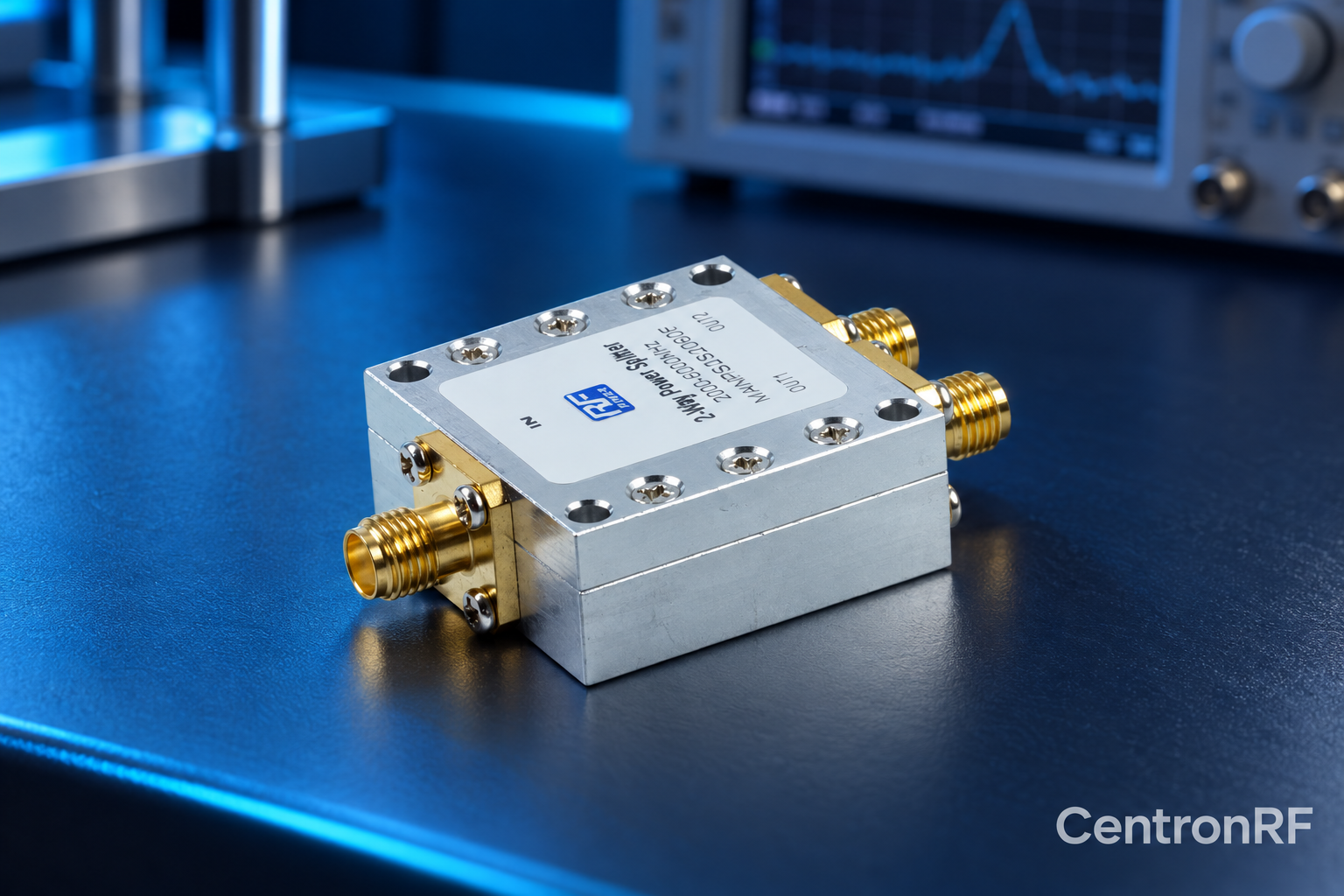
An antenna feed network needs the required division ratio, power handling, bandwidth, matching and phase relationships. Include cables and antenna loads in the design.
How it works in practice
Equal dividers can support multiple feeds, but beam behavior depends on the complete amplitude and phase distribution. Outdoor installation also needs appropriate environmental protection and mechanical support. A standalone divider specification cannot predict the radiation pattern of the finished array.
Example and interpretation
Two equal divider outputs can reach antennas at unequal phases if cable lengths differ.
Checks before use
- Define branch amplitudes and phases
- Budget losses
- Rate power and mismatch
- Verify the complete feed network
Important limit
Do not promise antenna gain or coverage from a divider alone.
Related Centron RF product
RF power divider range. Compare the exact divider model, port count and current datasheet. Some catalog titles show inconsistent frequency ranges, so confirm the supplied model’s full passband, loss, isolation and power limits before selection.
Further reading
Mini-Circuits: Understanding Power Splitters. This background reference explains general principles; the selected Centron RF model’s datasheet governs its own ratings.
Related guides
Educational guide. Numerical examples use the stated assumptions and are not test results for a supplied unit.