


A burn-in load must handle the planned continuous operation under the actual thermal conditions. Define monitoring and stop limits before starting a prolonged run.
How it works in practice
Consider amplifier output drift, harmonics, ventilation and possible fault states. Use a rated cable and connector chain, and monitor relevant temperatures and reflected power. A short bench test does not demonstrate suitability for hours of operation. Follow the amplifier and load documentation for sustained testing.
Example and interpretation
A 30 W amplifier running for several hours requires a load arrangement qualified for sustained 30 W under the specified environment.
Checks before use
- Specify duration and output
- Confirm continuous ratings
- Monitor thermal and RF behavior
- Set shutdown thresholds
Important limit
Do not leave a new high-power setup unattended before its stable behavior is established.
Related Centron RF product
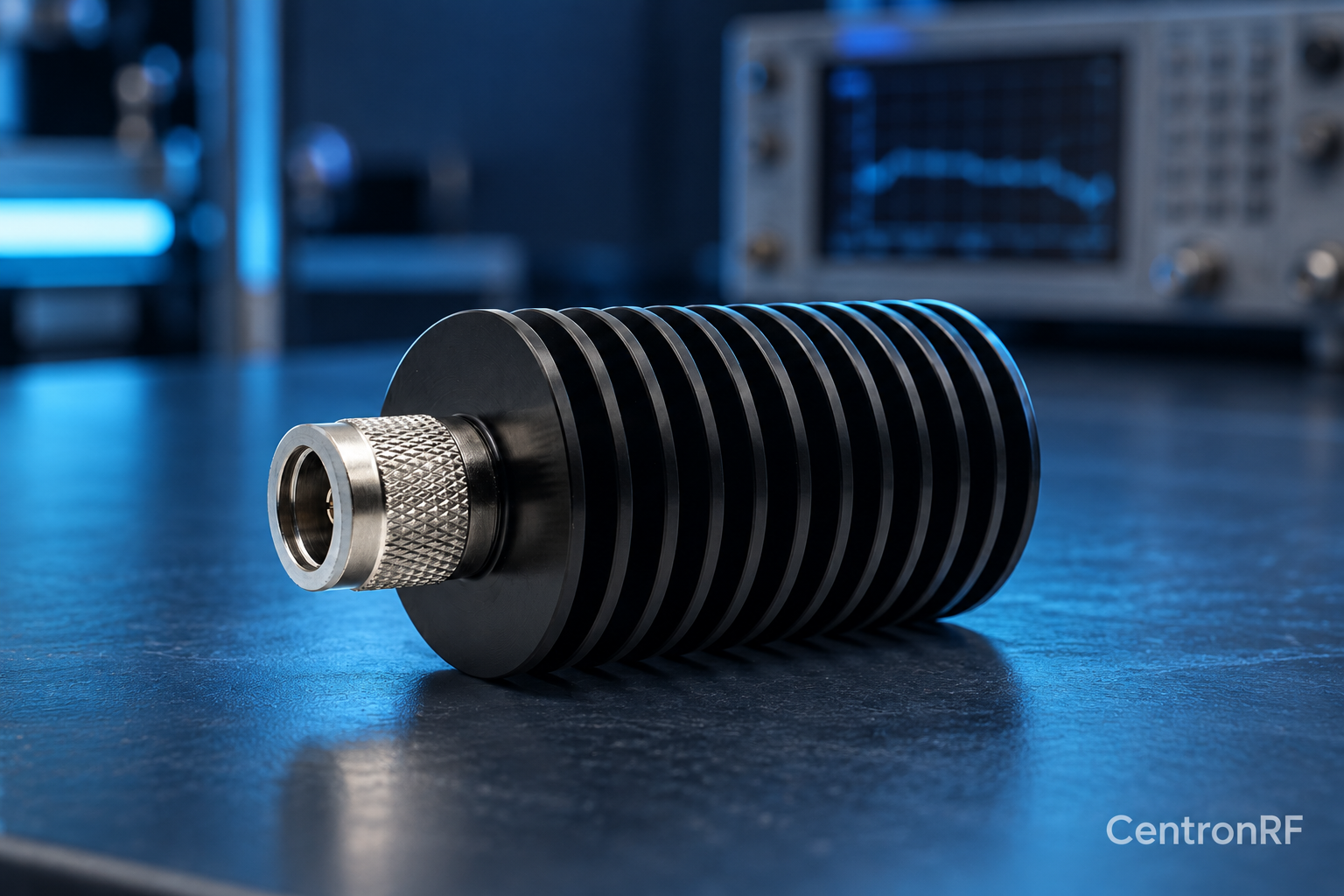
N-type 50 W 6 GHz dummy load. The linked N-type load is a starting point for comparing impedance, bandwidth, power and mechanical fit. Confirm the exact connector option and current thermal conditions before using any load near its rated power.
Further reading
Rohde & Schwarz: VSWR and Return Loss. This background reference explains general principles; the selected Centron RF model’s datasheet governs its own ratings.
Related guides
Educational guide. Numerical examples use the stated assumptions and are not test results for a supplied unit.