


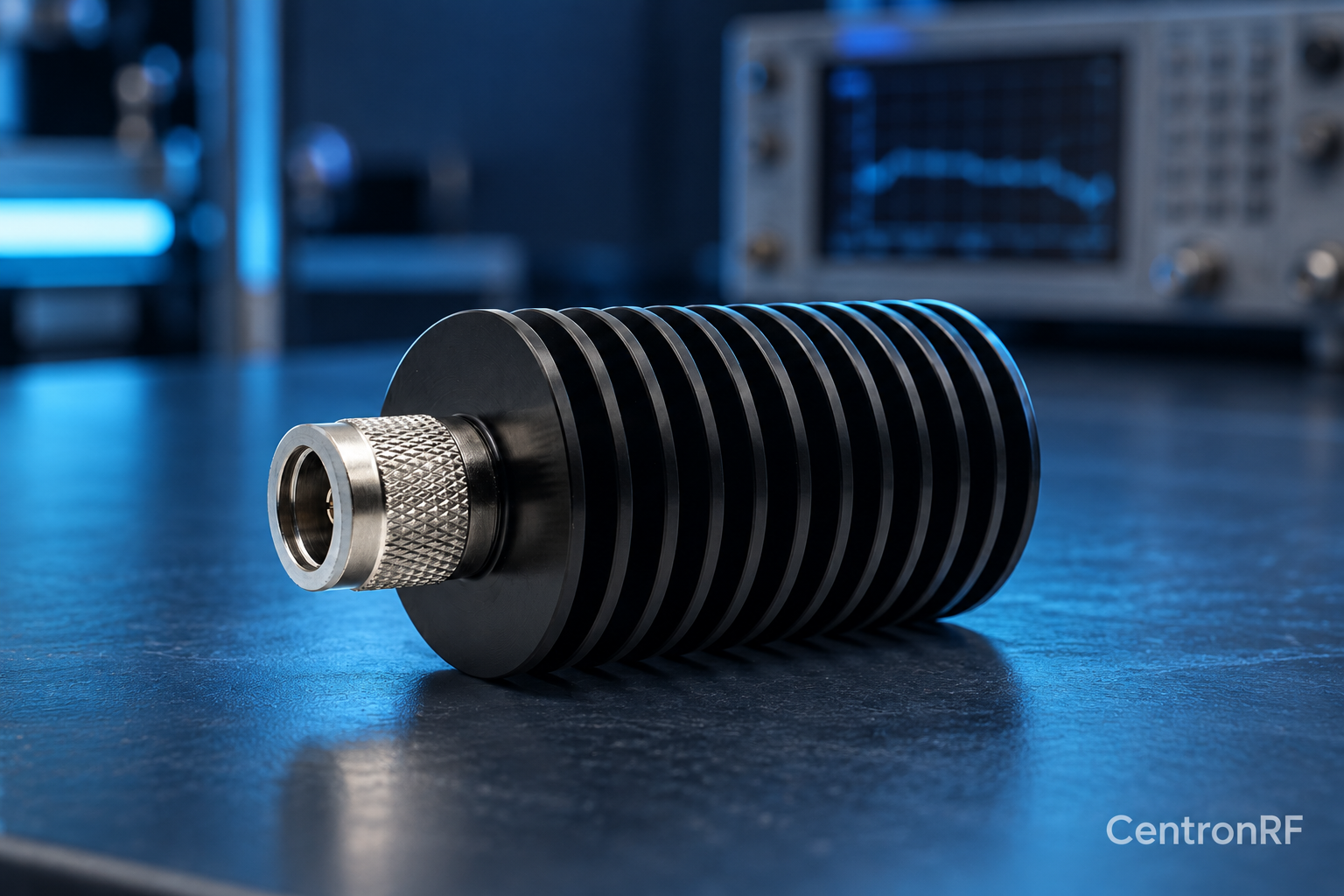
A portable kit needs loads suited to the likely power and frequencies, plus protection for connectors and a practical cooling arrangement.
How it works in practice
Separate small low-power terminations from transmitter loads so they are not confused. Label ratings clearly and retain datasheets with the kit. Portable operation may expose loads to high ambient temperature, restricted airflow and cable strain. Inspect components after transport.
Example and interpretation
A pocket-sized VNA termination should not be substituted for a transmitter load simply because both are 50 ohms.
Checks before use
- Label power classes
- Protect connector faces
- Check ambient and airflow
- Verify ratings before each connection
Important limit
Physical size or connector type alone is an unsafe basis for power selection.
Related Centron RF product
N-type 50 W 6 GHz dummy load. The linked N-type load is a starting point for comparing impedance, bandwidth, power and mechanical fit. Confirm the exact connector option and current thermal conditions before using any load near its rated power.
Further reading
Rohde & Schwarz: VSWR and Return Loss. This background reference explains general principles; the selected Centron RF model’s datasheet governs its own ratings.
Related guides
Educational guide. Numerical examples use the stated assumptions and are not test results for a supplied unit.