


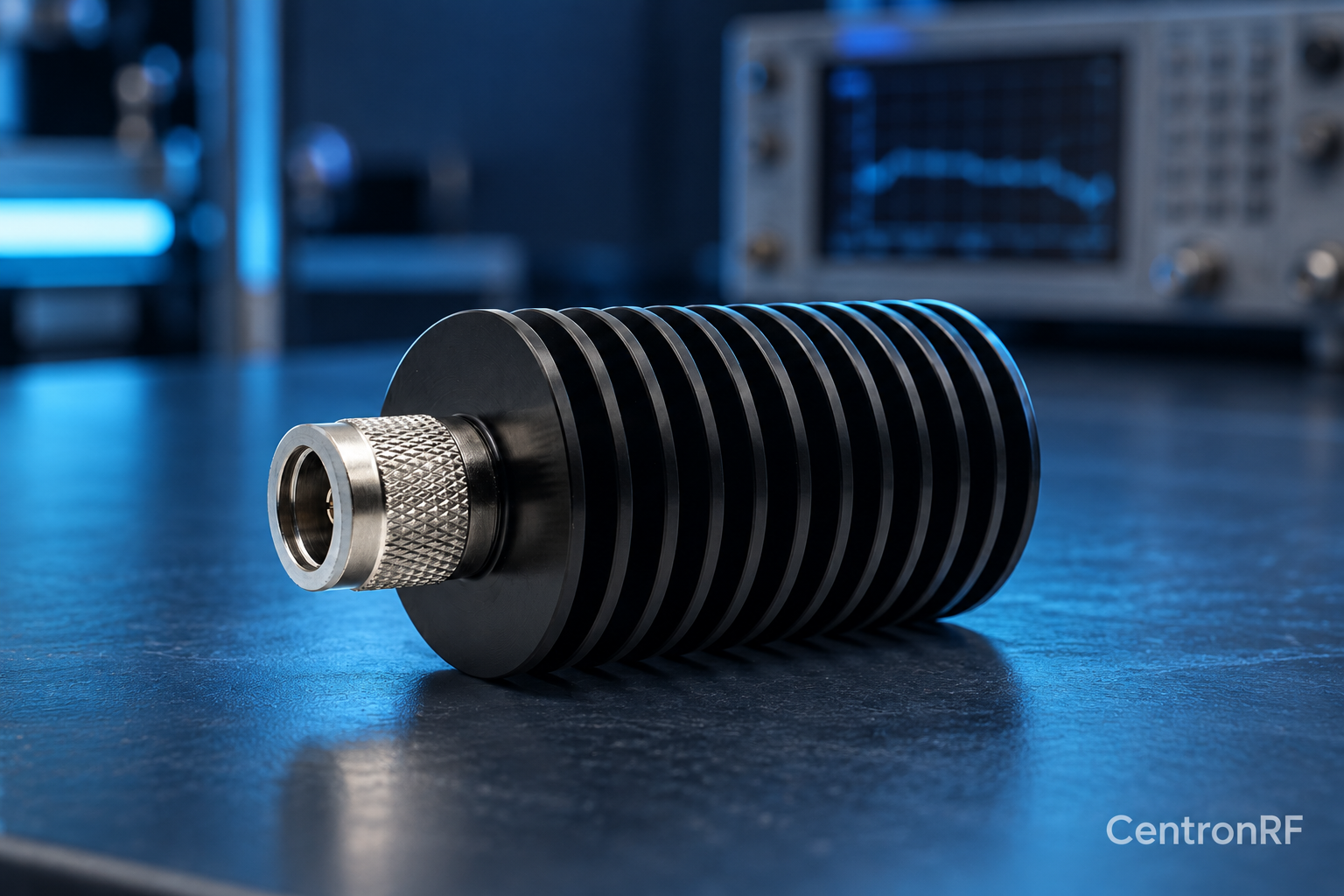
Terminate unused splitter outputs with suitable matched loads when required by the divider design and measurement configuration. An open port can change matching and output behavior.
How it works in practice
Choose terminations for the relevant impedance, frequency and possible power. The power at an unused branch is not always negligible, especially during combining or abnormal operation. Check the splitter's documented port requirements rather than assuming every topology behaves identically.
Example and interpretation
For an ideal equal two-way split, each matched branch receives half the input power before excess loss, so the unused branch's load must be rated accordingly.
Checks before use
- Identify unused ports
- Estimate branch power
- Select matching terminations
- Verify the completed network
Important limit
A small calibration load may be under-rated for a powered splitter branch.
Related Centron RF product
N-type 50 W 6 GHz dummy load. The linked N-type load is a starting point for comparing impedance, bandwidth, power and mechanical fit. Confirm the exact connector option and current thermal conditions before using any load near its rated power.
Further reading
Rohde & Schwarz: VSWR and Return Loss. This background reference explains general principles; the selected Centron RF model’s datasheet governs its own ratings.
Related guides
Educational guide. Numerical examples use the stated assumptions and are not test results for a supplied unit.