


Duty cycle links pulse duration and repetition to average power, but both average and peak limits must be satisfied. The load's pulse specification remains essential.
How it works in practice
For rectangular pulses, average power equals peak power multiplied by duty cycle. Real waveform shape, pulse length and thermal recovery can change stress. Internal voltage and current limits may be exceeded even if the average is low. Obtain an explicit pulse envelope when operating outside steady continuous conditions.
Example and interpretation
A 100 W rectangular pulse train at 10% duty has 10 W average power, but a 10 W continuous load is not automatically qualified for it.
Checks before use
- Calculate duty cycle
- Calculate average power
- Check pulse duration and peak limits
- Check repetition and cooling
Important limit
Average-power arithmetic alone cannot certify pulse handling.
Related Centron RF product
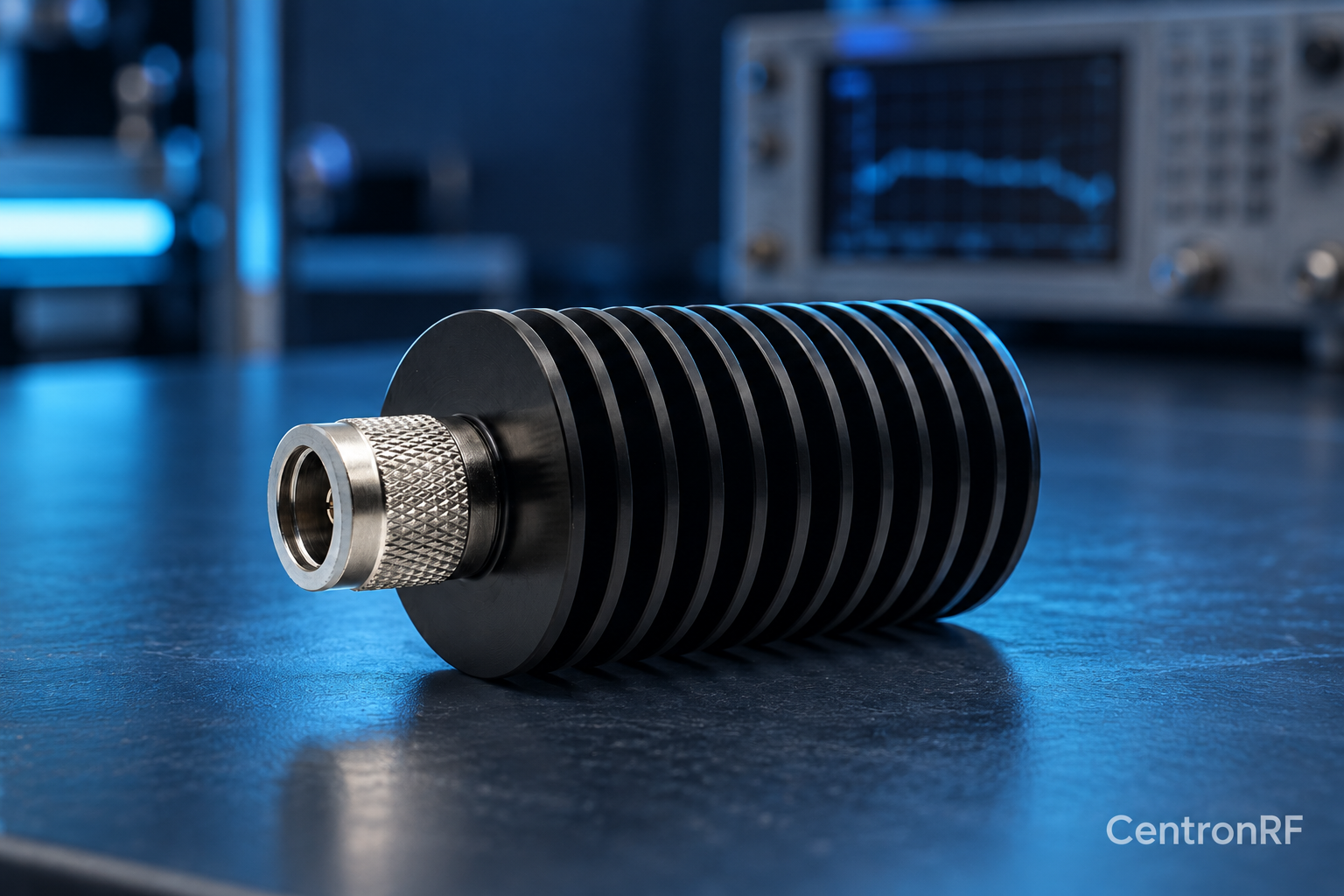
N-type 50 W 6 GHz dummy load. The linked N-type load is a starting point for comparing impedance, bandwidth, power and mechanical fit. Confirm the exact connector option and current thermal conditions before using any load near its rated power.
Further reading
Rohde & Schwarz: VSWR and Return Loss. This background reference explains general principles; the selected Centron RF model’s datasheet governs its own ratings.
Related guides
Educational guide. Numerical examples use the stated assumptions and are not test results for a supplied unit.