


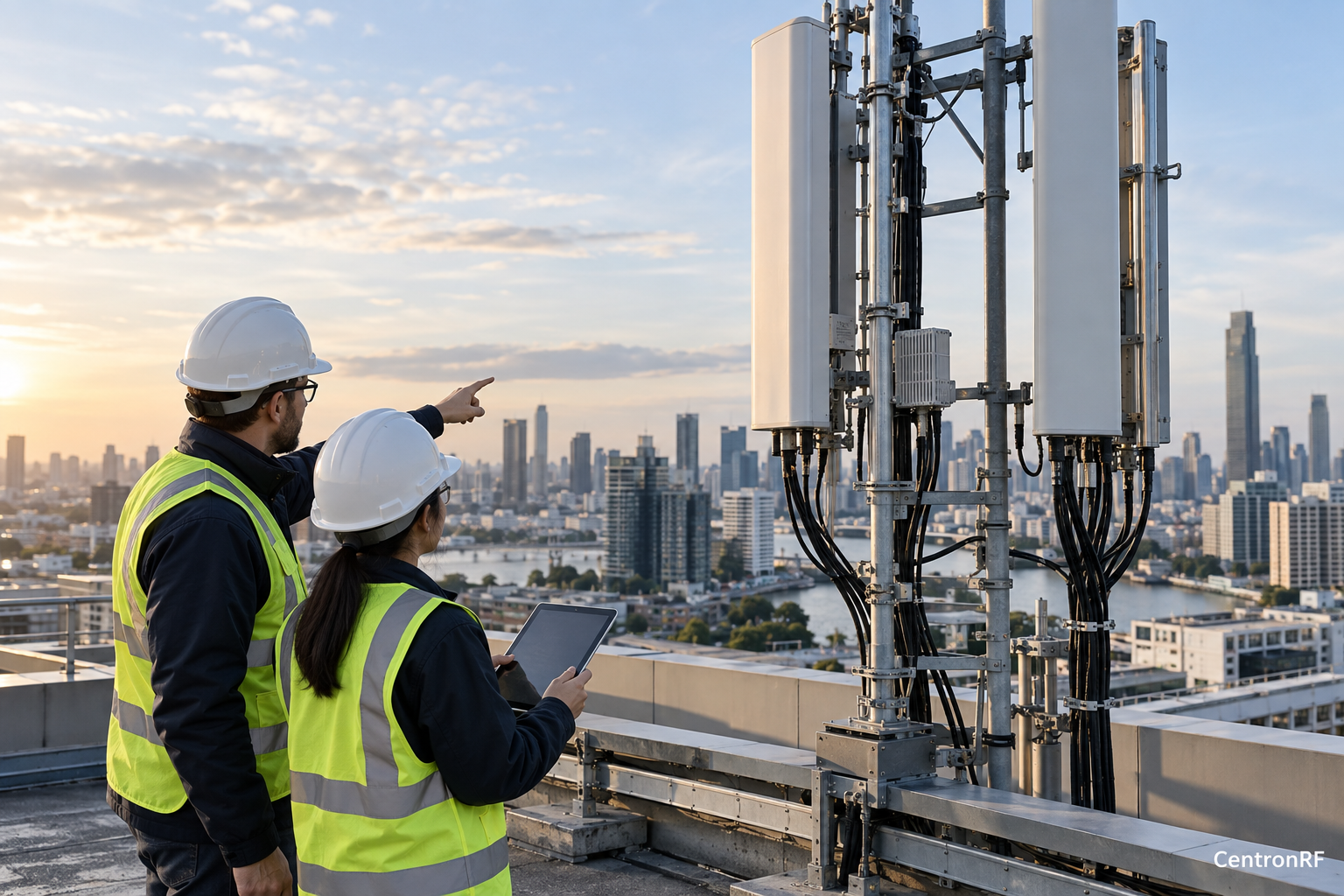
Fixed wireless access modem tests need controlled signal level, consistent cabling and realistic traffic conditions. Attenuation helps isolate RF margin from other variables.
Why this matters in the industry
A modem's user experience depends on more than a static power level. Engineers should separate radio sensitivity questions from network loading, application throughput and antenna placement.
The technical reasoning
Fixed wireless access evaluation includes radio performance and installation conditions such as antenna alignment, building placement and network configuration. Conducted tests can establish a controlled baseline but omit those deployment effects. Separate receiver-level questions from throughput or service-availability questions and define the method needed for each.
A controlled link is not a complete propagation environment
Static attenuation changes signal level but does not reproduce all channel impairments. A real wireless link can include time-varying fading, multipath, Doppler, interference and changing antenna geometry. Receiver behavior also depends on acquisition, tracking and adaptation loops. A conducted experiment is valuable because it isolates selected variables, but its controlled simplicity must remain visible when interpreting a result for a deployment or moving platform.
How to structure the investigation
Use a defined conducted setup where the device supports it. Measure loss to the modem input, sweep wanted level and log the chosen throughput or error metric. Hold network configuration and traffic conditions constant, then evaluate antenna and installation effects separately.
State which impairment is deliberately varied and which conditions stay fixed. Define the observed outcome, sample duration and receiver state, then repeat the experiment under relevant configurations. Use a channel emulator or field observations when the question requires time variation or spatial effects. Tie bench findings to a stated deployment model rather than converting a laboratory loss value directly into a guaranteed distance or availability percentage.
Worked example or engineering scenario
A modem that maintains a laboratory data session at one loss setting can perform differently behind a window or with a changed antenna orientation, even when its conducted radio is unchanged.
Evidence to collect
| Record | Purpose |
|---|---|
| Confirm a supported RF interface | Defines the tested state and scope of the comparison. |
| Calibrate input level | Makes the stimulus or route condition reproducible. |
| Control traffic conditions | Supports interpretation of variation and possible confounding effects. |
| Log a defined metric | Connects the observation with the stated engineering decision. |
Trade-offs and common interpretation errors
A working static link may fail to acquire after an abrupt change, or may behave differently in interference than in noise. Report those experiments separately. A bench threshold is evidence about the defined test, while coverage and availability conclusions require additional assumptions and representative environmental evidence.
What the result can support
Use the bench baseline to inform deployment trials rather than substituting it for representative field evidence.
A conducted attenuation sweep does not establish an outdoor installation's coverage or antenna performance.
Further technical reading
- NIST: Wireless Systems in Industrial Environments
- Keysight: Cellular Base Station Performance Testing
Related industry knowledge
- Cellular Multi-Tone Bench Tests: Avoid Unspecified Combining
- RF Isolation Between Cellular Test Branches
Numerical scenarios are illustrative assumptions, not reported measurements of a supplied product or installation.