


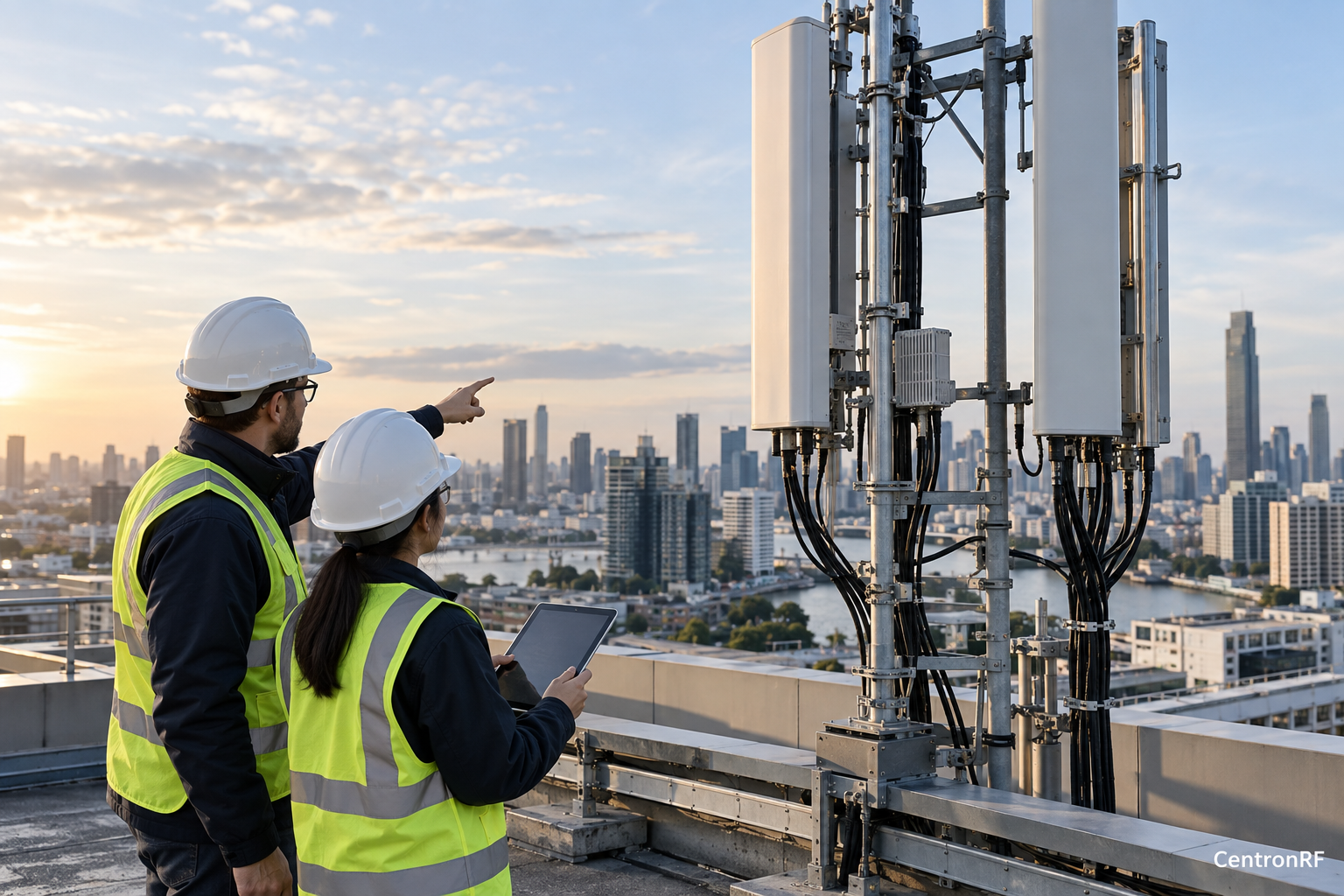
RF isolation between test branches determines how much one connected route can influence another. Treat isolation as a separate requirement from equal power splitting.
Why this matters in the industry
A shared stimulus network can couple device reflections or unintended outputs between branches. This can complicate comparisons, especially when one device's state changes.
The technical reasoning
Branch isolation should be assessed under the connected-device states that matter to the experiment. An inactive receiver can present a different load from an active one, and a network's finite coupling can make nominally independent measurements interact. Diagnose changes by varying one branch at a time while holding the common source condition stable.
Unintended signal paths and branch interaction
A wanted signal can reach a receiver through more than the drawn coaxial route. Leakage through shielding, cables, switches or nearby transmitters can become dominant when the intended path is highly attenuated. Multiport networks add interaction through imperfect isolation and changing loads. Independent incoherent powers add in linear units; coherent signals can add or cancel according to phase. The appropriate model depends on the signals and cannot be inferred from a single dB sum.
How to structure the investigation
Request isolation data across the actual band and review the recommended loading conditions. Terminate unused outputs properly. If branch interaction would invalidate the test, use a topology designed to meet that isolation requirement and verify the assembled network.
Check the route with an intentional reference condition: terminate or disconnect the intended stimulus using an approved method and observe what remains. Characterize each branch with its actual loading, and vary one route at a time to identify interaction. Record shielding state, cable placement and nearby transmit activity. Repeat low-level measurements after configuration changes that can create a bypass path.
Worked example or engineering scenario
If connecting a second receiver shifts the first receiver's observed level, compare the relevant terminated and connected states. The common-source setting alone does not explain the interaction.
Evidence to collect
| Record | Purpose |
|---|---|
| Request in-band isolation | Defines the tested state and scope of the comparison. |
| Use specified terminations | Makes the stimulus or route condition reproducible. |
| Check device interaction | Supports interpretation of variation and possible confounding effects. |
| Verify the assembled network | Connects the observation with the stated engineering decision. |
Trade-offs and common interpretation errors
More nominal attenuation does not guarantee a weaker delivered signal if leakage bypasses the attenuator. An isolated-port specification also does not describe the entire assembled network. Treat unexpected plateaus, branch-dependent shifts and phase-sensitive behavior as clues requiring controlled experiments rather than immediate device-failure conclusions.
What the result can support
Characterize installed branch behavior before assuming simultaneous tests are independent.
Nominal two-way splitting does not establish a particular isolation value between outputs.
Further technical reading
- NIST: Wireless Systems in Industrial Environments
- Keysight: Cellular Base Station Performance Testing
Related industry knowledge
- A Pre-Connection Checklist for Cellular RF Benches
- Planning Passive RF Hardware for an Open RAN Radio Bench
Numerical scenarios are illustrative assumptions, not reported measurements of a supplied product or installation.