


Choose 1 dB steps for fine threshold measurements and 10 dB steps for coarse level changes. The useful choice depends on required resolution and total range.
How it works in practice
A small increment is valuable near a receiver sensitivity threshold, but does not itself establish measurement accuracy. Fine and coarse units can be combined if both satisfy the input-power requirement. Characterize the complete assembled path because the extra connectors introduce loss and mismatch.
Example and interpretation
A 10 dB coarse setting followed by a 3 dB fine setting gives nominally 13 dB additional attenuation; measure the actual combined loss at the test frequency.
Checks before use
- Define the threshold precision
- Check total range
- Compare state accuracy
- Calibrate the assembled path
Important limit
Do not confuse dial resolution with calibrated uncertainty.
Related Centron RF product
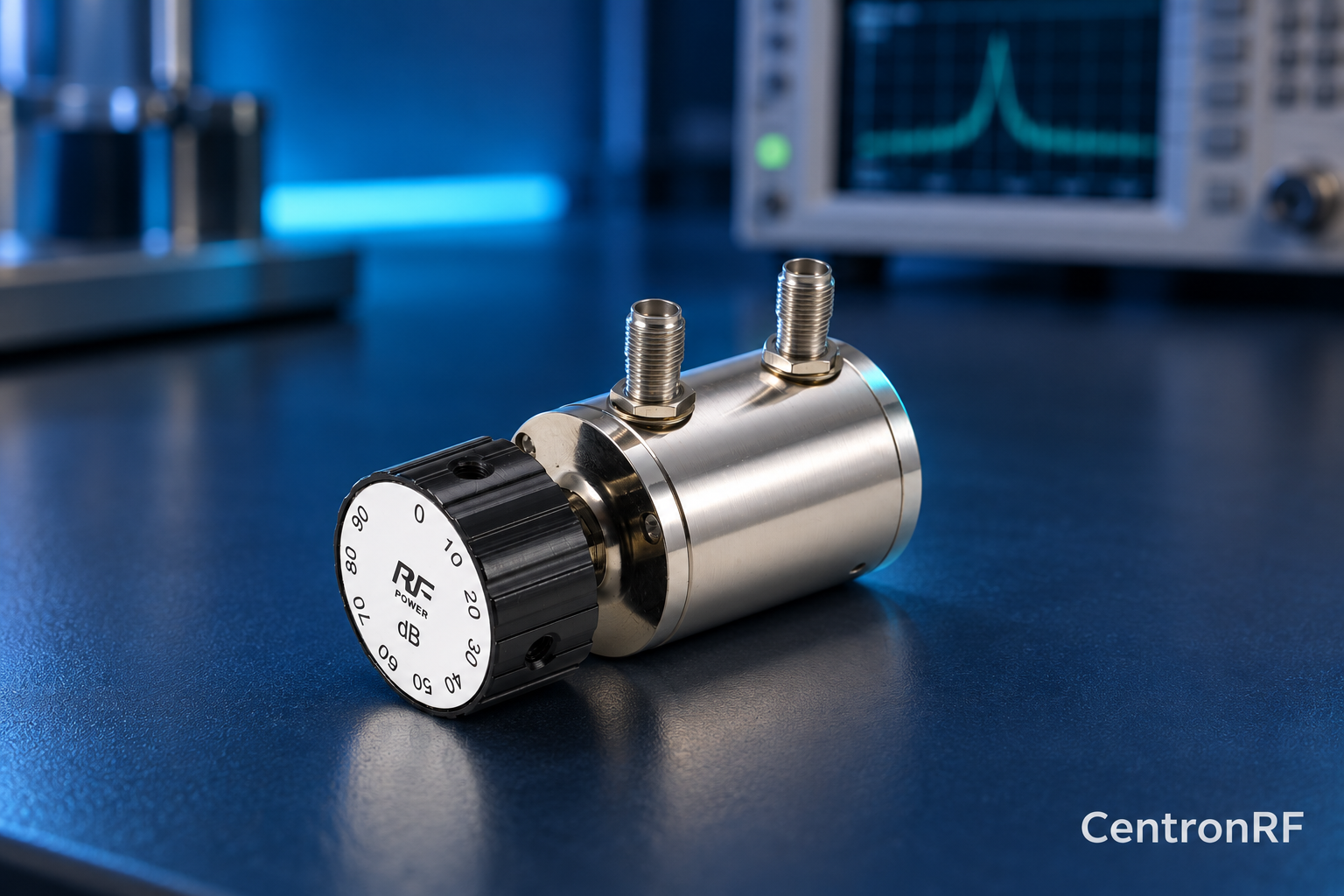
SMA rotary attenuator with 10 dB steps. The linked rotary model lists 0–90 dB adjustment in 10 dB steps, 50-ohm impedance and a DC–6 GHz band. Its listed continuous input is 2 W; obtain explicit switching and pulse limits before applying those stresses.
Further reading
Keysight: Accurate Network Measurements. This background reference explains general principles; the selected Centron RF model’s datasheet governs its own ratings.
Related guides
- How to Run a Receiver Sensitivity Sweep with a Step Attenuator
- Can You Switch a Rotary Attenuator with RF Power Applied?
Educational guide. Numerical examples use the stated assumptions and are not test results for a supplied unit.