


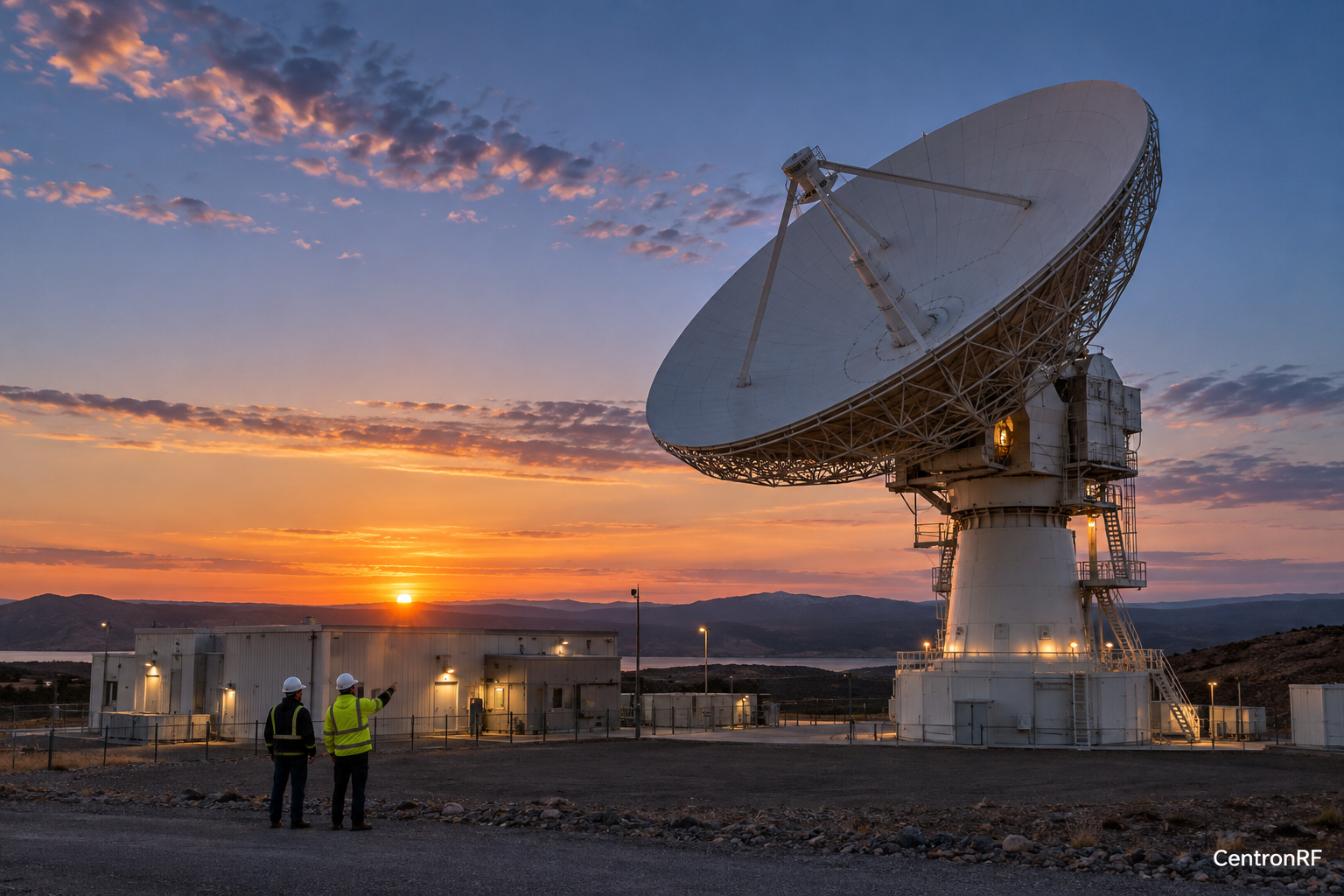
Satellite array ground calibration requires measured branch amplitude and, where relevant, phase. A divider's nominal equality is not enough to establish calibrated array paths.
Why this matters in the industry
A common stimulus network can include branch differences from cables, connectors and adapters. Those fixture differences should be separated from the array response being studied.
The technical reasoning
Array ground calibration may require amplitude and phase relationships at multiple paths. Characterizing branch level alone can support an amplitude comparison but not a full coherent-array calibration. Define timing references, connection states and the frequency range over which relationships matter, then maintain those conditions during repeated measurements.
Phase, delay and wideband signal integrity
A pure time delay produces phase change proportional to frequency, with phase equal to minus 360 times frequency times delay when expressed in degrees with consistent units. Group delay is related to the frequency derivative of phase. Constant delay shifts timing; delay variation across an occupied band can distort a waveform. Equal cable lengths alone do not establish equal electrical delay because materials, connectors, routing and other path elements contribute.
How to structure the investigation
Define reference planes at the relevant branch interfaces and characterize each route with suitable equipment. Retain frequency-dependent corrections and physical branch labels. Recheck after wiring changes, and follow the array calibration method for coherent phase requirements.
Define the measurement planes and phase-reference method before comparing paths. Sweep the relevant band and unwrap phase appropriately when calculating delay. Distinguish a scalar gain correction from a complex response correction; subtracting one dB value does not remove phase variation. Keep cable routing and connection states repeatable, and check whether a change in the timing reference explains a measured shift.
Worked example or engineering scenario
An assumed 0.5 dB amplitude mismatch and a phase offset are independent dimensions of the branch comparison. Correcting the first does not automatically remove the second.
Evidence to collect
| Record | Purpose |
|---|---|
| Label array branches | Defines the tested state and scope of the comparison. |
| Measure full routes | Makes the stimulus or route condition reproducible. |
| Retain frequency corrections | Supports interpretation of variation and possible confounding effects. |
| Follow the phase method | Connects the observation with the stated engineering decision. |
Trade-offs and common interpretation errors
A phase difference at one frequency does not uniquely identify delay across a band. Incorrect unwrapping or sparse frequency spacing can create misleading results. Report the frequency span and analysis method, and avoid interpreting path delay as the latency of an entire protocol or processing chain.
What the result can support
State which array-path parameters were measured and avoid labeling amplitude-only work as complete calibration.
A generic power divider is not a complete phased-array calibration system.
Further technical reading
Related industry knowledge
- Ground Antenna-Feed Equipment Tests: Define the Termination Boundary
- Satellite Ground Receiver Troubleshooting with a Reference Path
Numerical scenarios are illustrative assumptions, not reported measurements of a supplied product or installation.