


An input power rating and a dissipation rating describe different limits. Use the exact definition in the manufacturer's specification.
How it works in practice
An attenuator passes some power onward and dissipates the remainder. Input-rated products may incorporate attenuation-dependent restrictions and mounting assumptions. If only a resistor dissipation limit is known, it is insufficient to establish the whole assembly's allowable input. Connectors, mismatch and peak voltage can impose additional limits.
Example and interpretation
For an ideal 3 dB pad at 2 W input, transmitted power is about 1 W and dissipation is about 1 W. The assembly still needs a suitable input rating.
Checks before use
- Identify what the watts rating means
- Calculate transmitted and dissipated power
- Check attenuation-dependent limits
- Review cooling and connector restrictions
Important limit
Do not substitute a heat calculation for the manufacturer's assembly rating.
Related Centron RF product
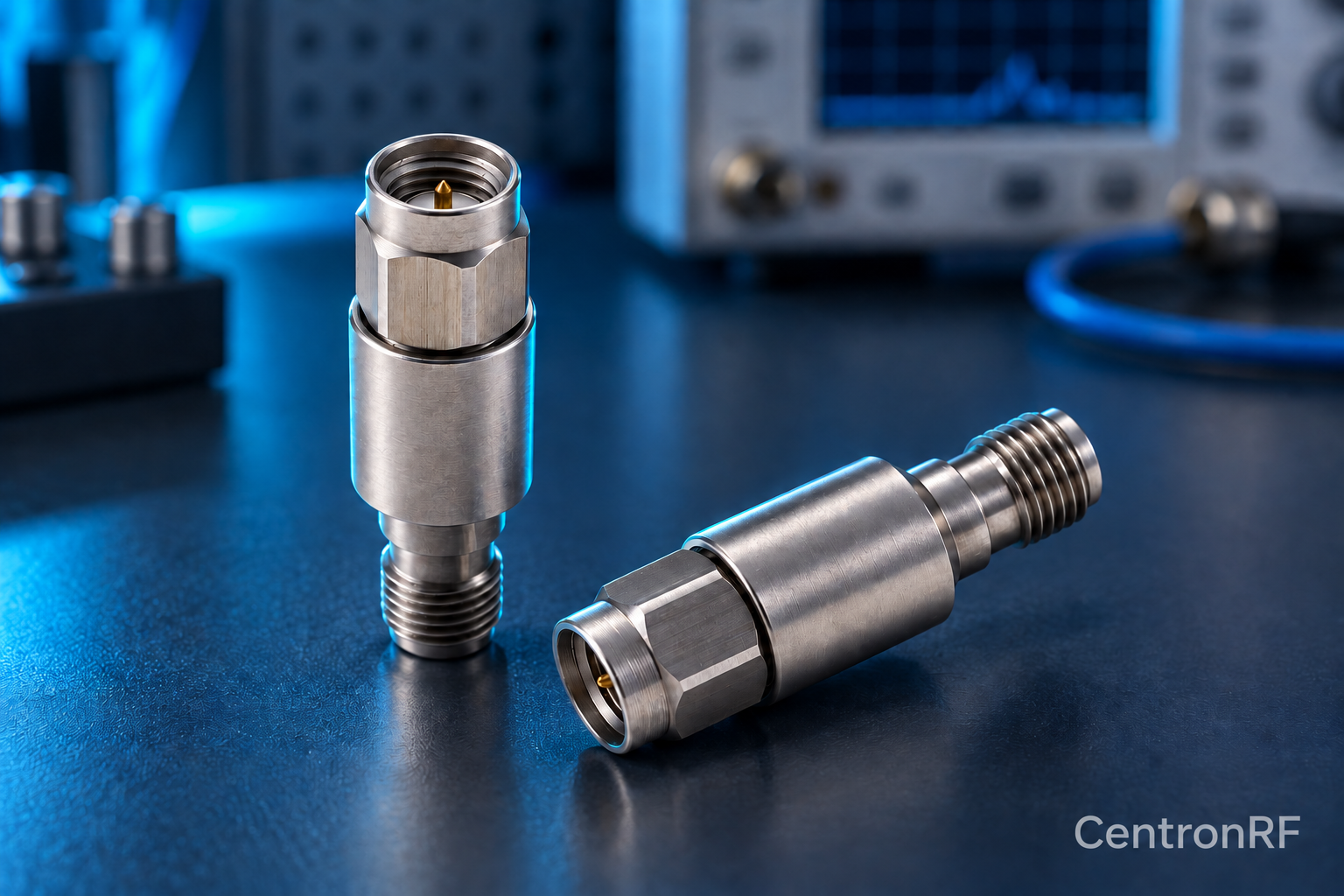
SMA 5 W 6 GHz fixed attenuator. The SMA 5 W model is listed as a 50-ohm fixed attenuator with a DC–6 GHz range. Select an available attenuation option and verify the current tolerance, cooling conditions and pulse limits for your application.
Further reading
Keysight: Spectrum Analysis Basics. This background reference explains general principles; the selected Centron RF model’s datasheet governs its own ratings.
Related guides
- Selecting Attenuation for a Sensitive RF Receiver
- How to Specify an RF Attenuator in a Purchase Request
Educational guide. Numerical examples use the stated assumptions and are not test results for a supplied unit.