


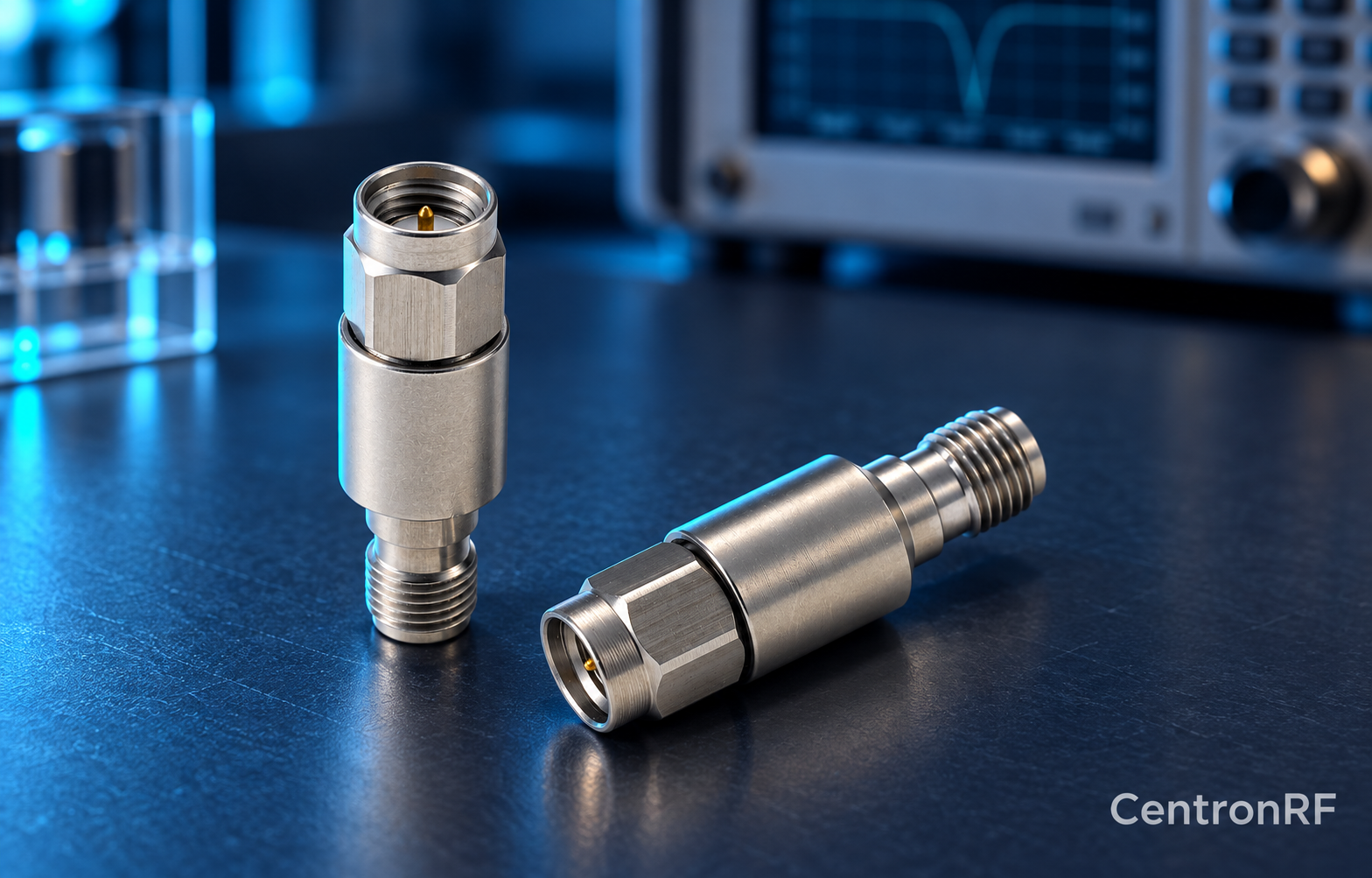
DC block power handling depends on capacitor voltage and current stress, frequency, losses and thermal conditions. A connector's power capability does not establish the whole component's rating.
How it works in practice
Check continuous power, peak conditions and permissible bias together. At some frequencies or waveforms, capacitor reactance and parasitics increase stress. Use the exact block's published rating and conditions. When no power specification is available, request it before placing the block in a transmitter path.
Example and interpretation
A block suitable for a low-level analyzer input may be unsuitable for the same connector carrying tens of watts.
Checks before use
- Find the component rating
- Check frequency and bias
- Check pulse stress
- Evaluate installed cooling
Important limit
Do not select a high-power block by connector size alone.
Related Centron RF product
SMA DC block listed for 8 GHz applications. The linked SMA block gives an upper-frequency reference. Confirm its lower passband limit, working voltage, RF power and whether it blocks the inner, outer or both conductors. A catalog range starting with DC should not be interpreted as DC transmission.
Further reading
Mini-Circuits: DC Block Specifications. This background reference explains general principles; the selected Centron RF model’s datasheet governs its own ratings.
Related guides
Educational guide. Numerical examples use the stated assumptions and are not test results for a supplied unit.