


Instrument and source stability can change during warm-up or with temperature. Follow documented warm-up guidance and verify drift for sensitive tests.
How it works in practice
Keep the environment and signal path stable. Use reference readings before and after long sweeps when appropriate. Drift can affect sequential branch comparisons or sensitivity thresholds. Do not assign an invented universal warm-up duration; use the actual equipment guidance.
Example and interpretation
A source drifting 0.4 dB during two sequential readings can look like a 0.4 dB branch imbalance.
Checks before use
- Follow equipment guidance
- Stabilize conditions
- Bracket long tests with references
- Include drift in uncertainty
Important limit
A stable-looking display over a few seconds does not prove a long sweep is drift-free.
Related Centron RF product
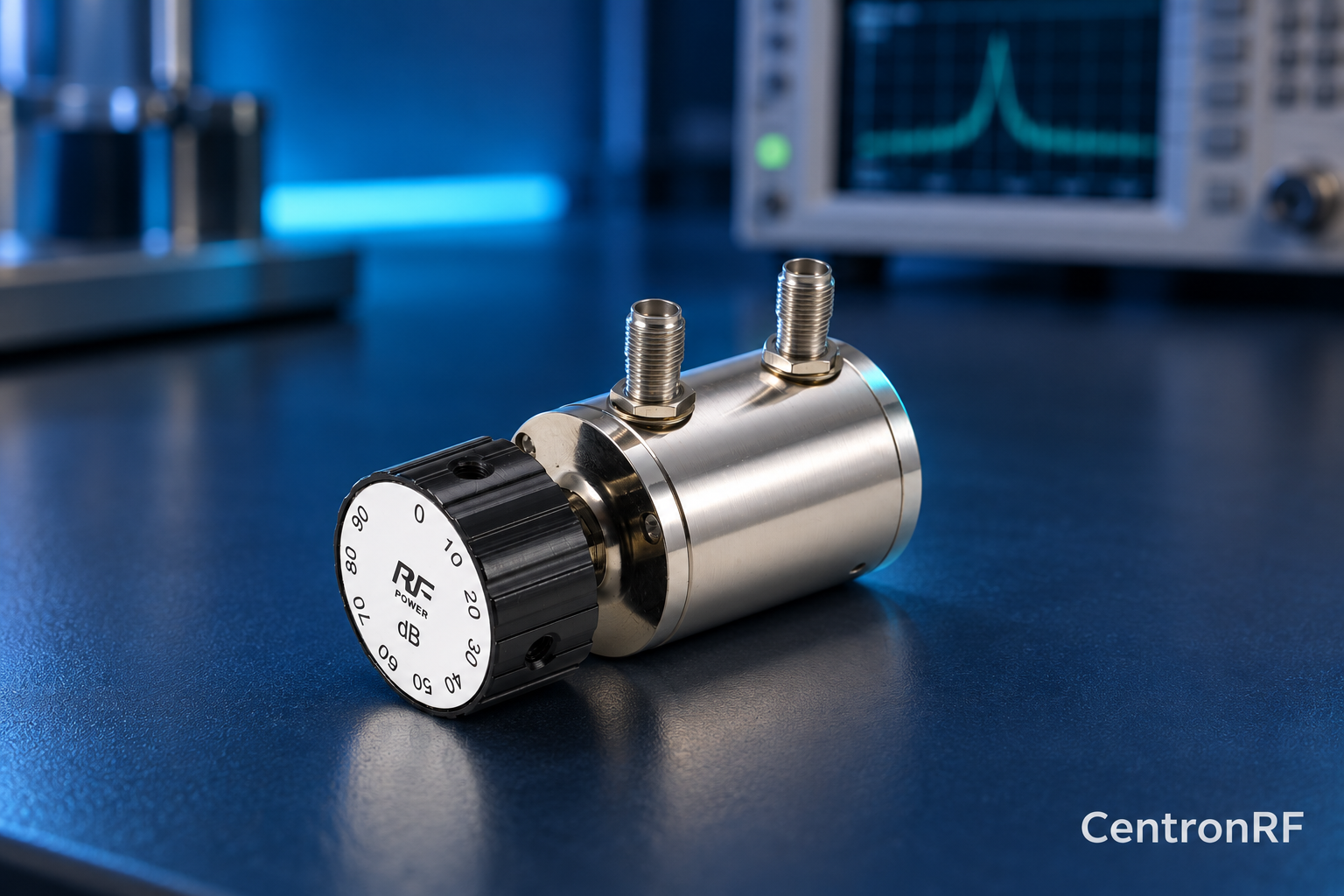
SMA rotary attenuator with 1 dB steps. The linked fine-step unit lists 0–10 dB in 1 dB increments. It can be considered for controlled level changes within its ratings. Dial resolution does not establish traceable accuracy; calibrate the assembled path as required.
Further reading
Keysight: Fundamentals of RF and Microwave Power Measurements. This background reference explains general principles; the selected Centron RF model’s datasheet governs its own ratings.
Related guides
Educational guide. Numerical examples use the stated assumptions and are not test results for a supplied unit.