


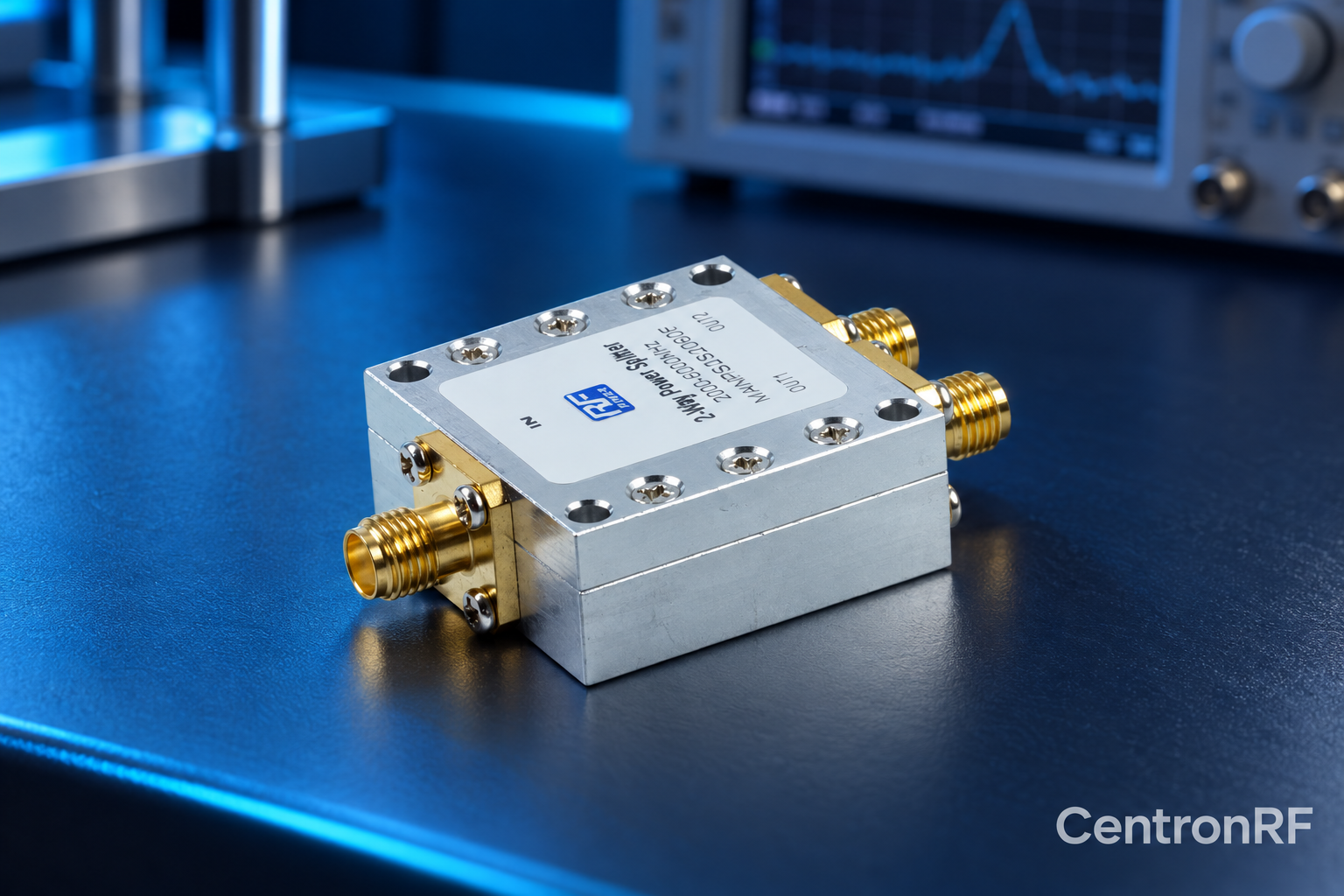
Coherent signals combine according to amplitude and phase, not just arithmetic power addition. Phase error can reduce useful output and increase dissipation elsewhere.
How it works in practice
Analyze the specified network and reference planes. Cable delays and source synchronization affect the phase at each input. A network designed for in-phase combining can behave very differently with opposite-phase inputs. Verify limits for imbalance and fault conditions.
Example and interpretation
Two equal signals arriving 180 degrees apart at a summing point can cancel there rather than produce the desired larger signal.
Checks before use
- Confirm source coherence
- Match phase at the combiner
- Measure amplitude balance
- Check imbalance dissipation
Important limit
Do not assume two equal watt readings guarantee efficient combination.
Related Centron RF product
RF power divider range. Compare the exact divider model, port count and current datasheet. Some catalog titles show inconsistent frequency ranges, so confirm the supplied model’s full passband, loss, isolation and power limits before selection.
Further reading
Mini-Circuits: Understanding Power Splitters. This background reference explains general principles; the selected Centron RF model’s datasheet governs its own ratings.
Related guides
Educational guide. Numerical examples use the stated assumptions and are not test results for a supplied unit.