


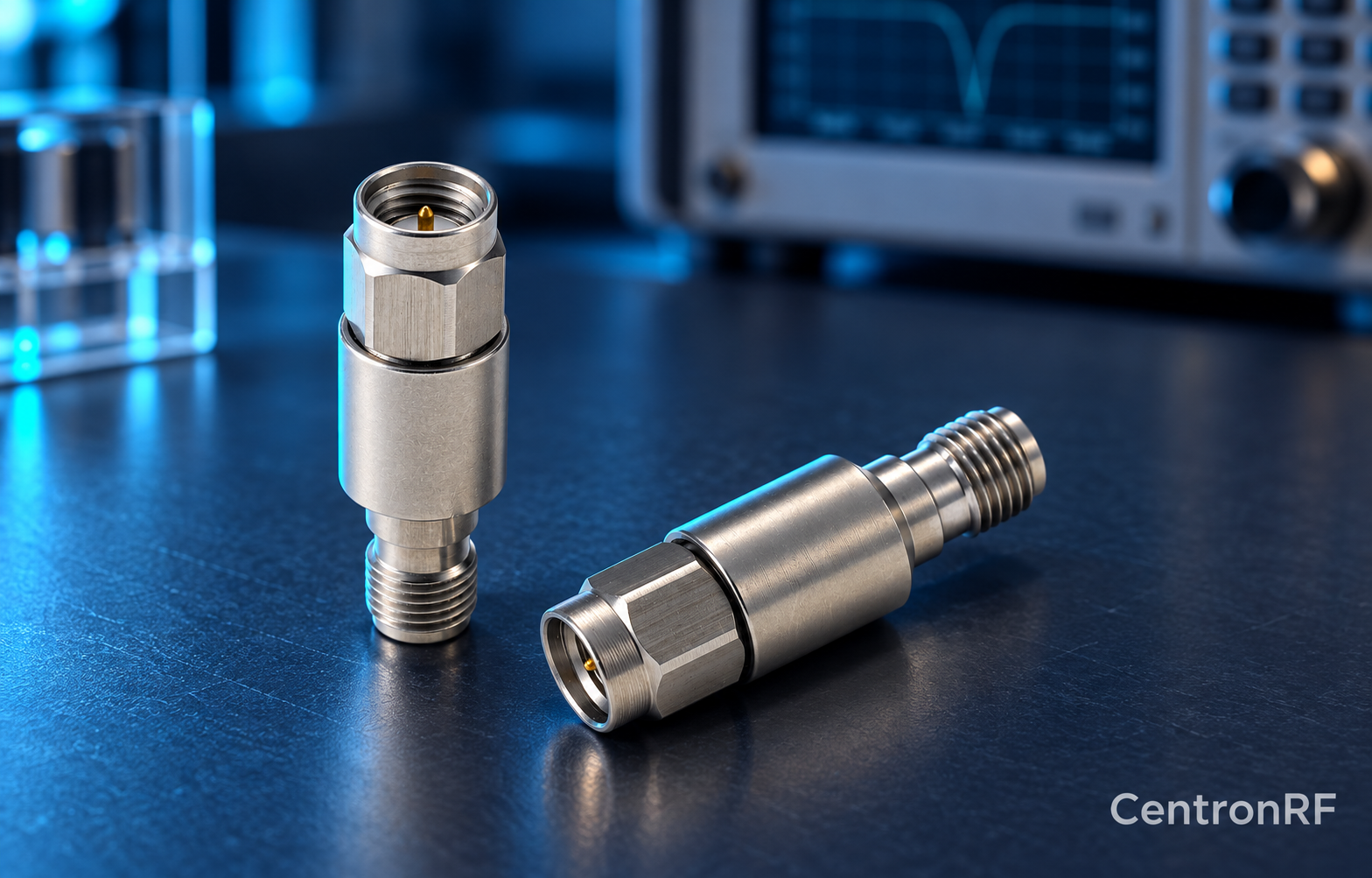
A DC block can affect phase as well as amplitude, especially near its band edges. Include it in calibration when phase-sensitive measurements require it.
How it works in practice
Group delay and phase response arise from the component's reactive structure. A scalar insertion-loss correction cannot remove phase error. For coherent or vector measurements, use suitable complex calibration data or place the calibration reference plane beyond the installed block when the method permits.
Example and interpretation
Correcting a 0.5 dB amplitude loss does not correct an associated phase rotation in an S-parameter measurement.
Checks before use
- Identify phase sensitivity
- Measure complex transmission
- Choose the reference plane
- Apply the appropriate calibration
Important limit
Do not use an amplitude-only correction as a complete vector correction.
Related Centron RF product
SMA DC block listed for 8 GHz applications. The linked SMA block gives an upper-frequency reference. Confirm its lower passband limit, working voltage, RF power and whether it blocks the inner, outer or both conductors. A catalog range starting with DC should not be interpreted as DC transmission.
Further reading
Mini-Circuits: DC Block Specifications. This background reference explains general principles; the selected Centron RF model’s datasheet governs its own ratings.
Related guides
Educational guide. Numerical examples use the stated assumptions and are not test results for a supplied unit.