


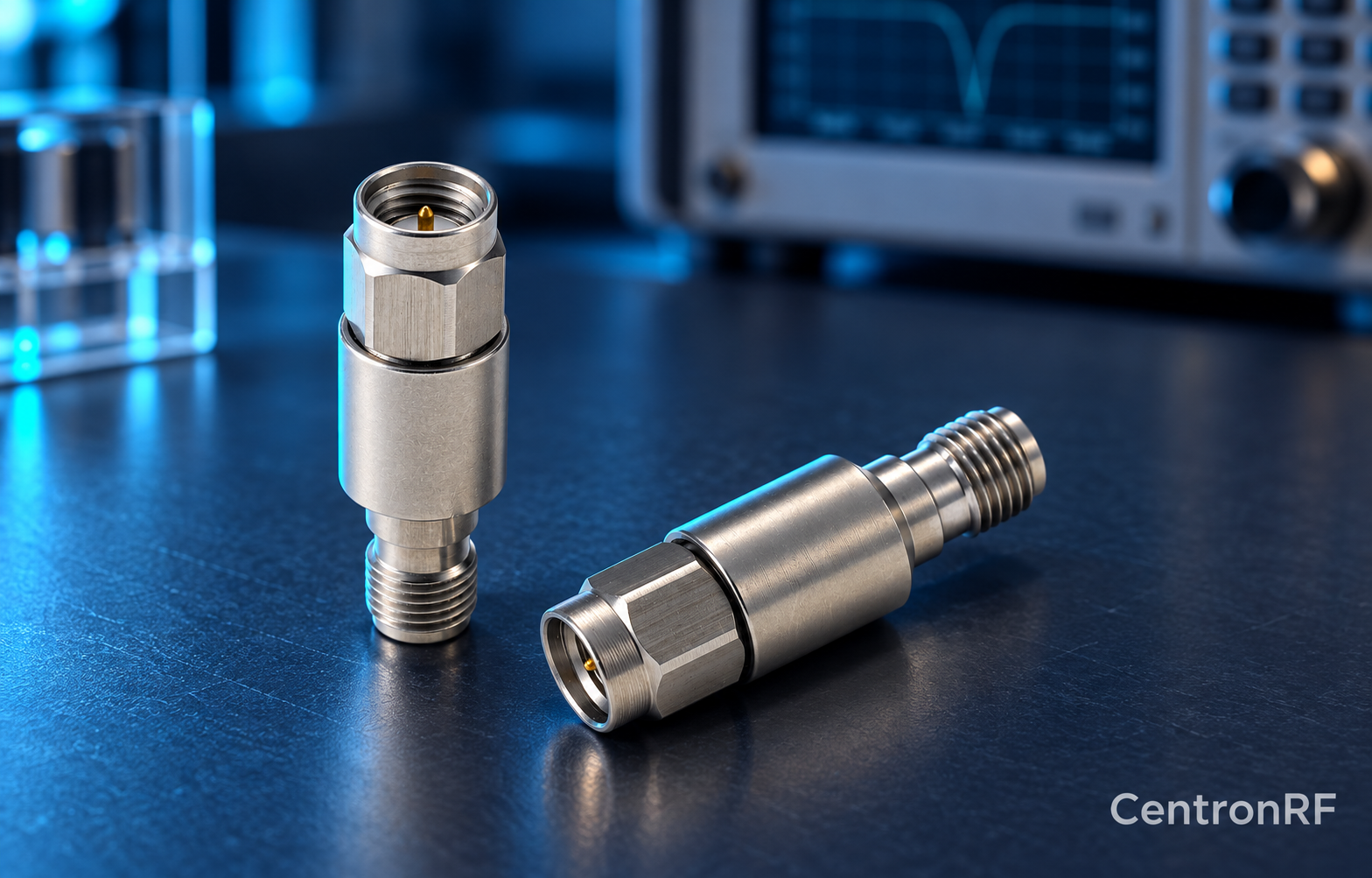
Inner blocks interrupt the center-conductor DC path; outer blocks interrupt the shield path; inner-outer blocks interrupt both. Verify the actual construction before choosing one.
How it works in practice
These designs address different current paths. Interrupting the shield can affect grounding and electrical safety arrangements, so select it within the equipment's documented installation requirements. A generic product photo or connector label does not reveal which conductors are blocked.
Example and interpretation
An inner-only block can stop center-conductor bias while retaining shield continuity; it does not isolate every possible ground current.
Checks before use
- Identify the unwanted DC path
- Confirm the construction
- Review grounding requirements
- Check voltage and bandwidth
Important limit
Do not assume every coaxial DC block provides complete galvanic isolation.
Related Centron RF product
SMA DC block listed for 8 GHz applications. The linked SMA block gives an upper-frequency reference. Confirm its lower passband limit, working voltage, RF power and whether it blocks the inner, outer or both conductors. A catalog range starting with DC should not be interpreted as DC transmission.
Further reading
Mini-Circuits: DC Block Specifications. This background reference explains general principles; the selected Centron RF model’s datasheet governs its own ratings.
Related guides
Educational guide. Numerical examples use the stated assumptions and are not test results for a supplied unit.