


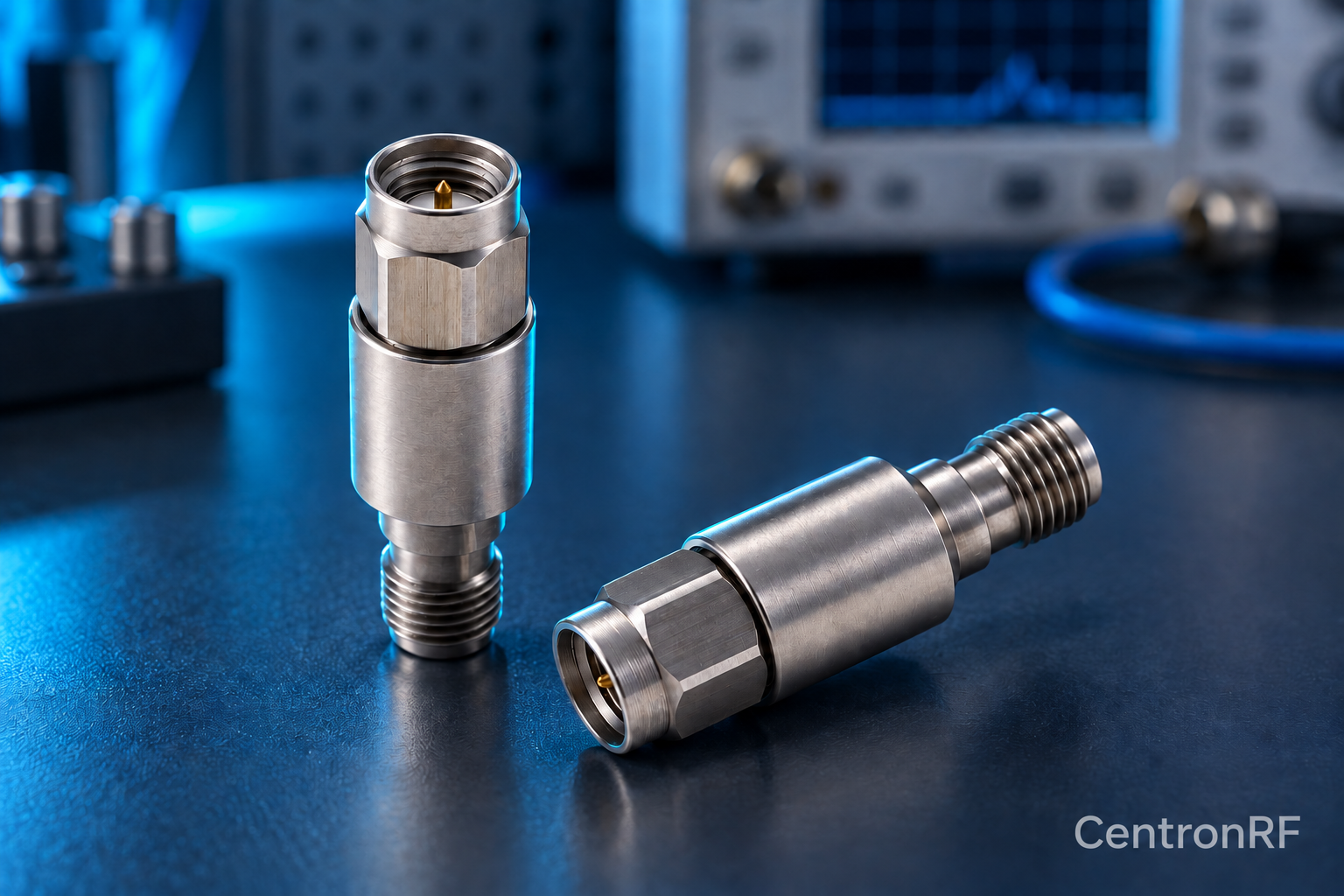
Attenuation tolerance describes how far actual loss may differ from the specified nominal value under stated conditions. It matters when the receiving level must be known accurately.
How it works in practice
A label such as 20 dB is a target rather than a calibration result. Request the tolerance over the intended frequency band and temperature range. Where tight accuracy is needed, measure the individual component and record the correction. Keep measurement uncertainty separate from the manufacturer's component tolerance.
Example and interpretation
If a nominal 20 dB pad measures 20.4 dB at your frequency, correcting a 0 dBm reading requires adding 20.4 dB, plus separately characterized cable losses.
Checks before use
- Obtain the tolerance definition
- Measure at the actual frequency
- Record the correction value
- Include measurement uncertainty in the result
Important limit
Do not present nominal attenuation as a traceable calibration value.
Related Centron RF product
SMA 5 W 6 GHz fixed attenuator. The SMA 5 W model is listed as a 50-ohm fixed attenuator with a DC–6 GHz range. Select an available attenuation option and verify the current tolerance, cooling conditions and pulse limits for your application.
Further reading
Keysight: Spectrum Analysis Basics. This background reference explains general principles; the selected Centron RF model’s datasheet governs its own ratings.
Related guides
Educational guide. Numerical examples use the stated assumptions and are not test results for a supplied unit.