


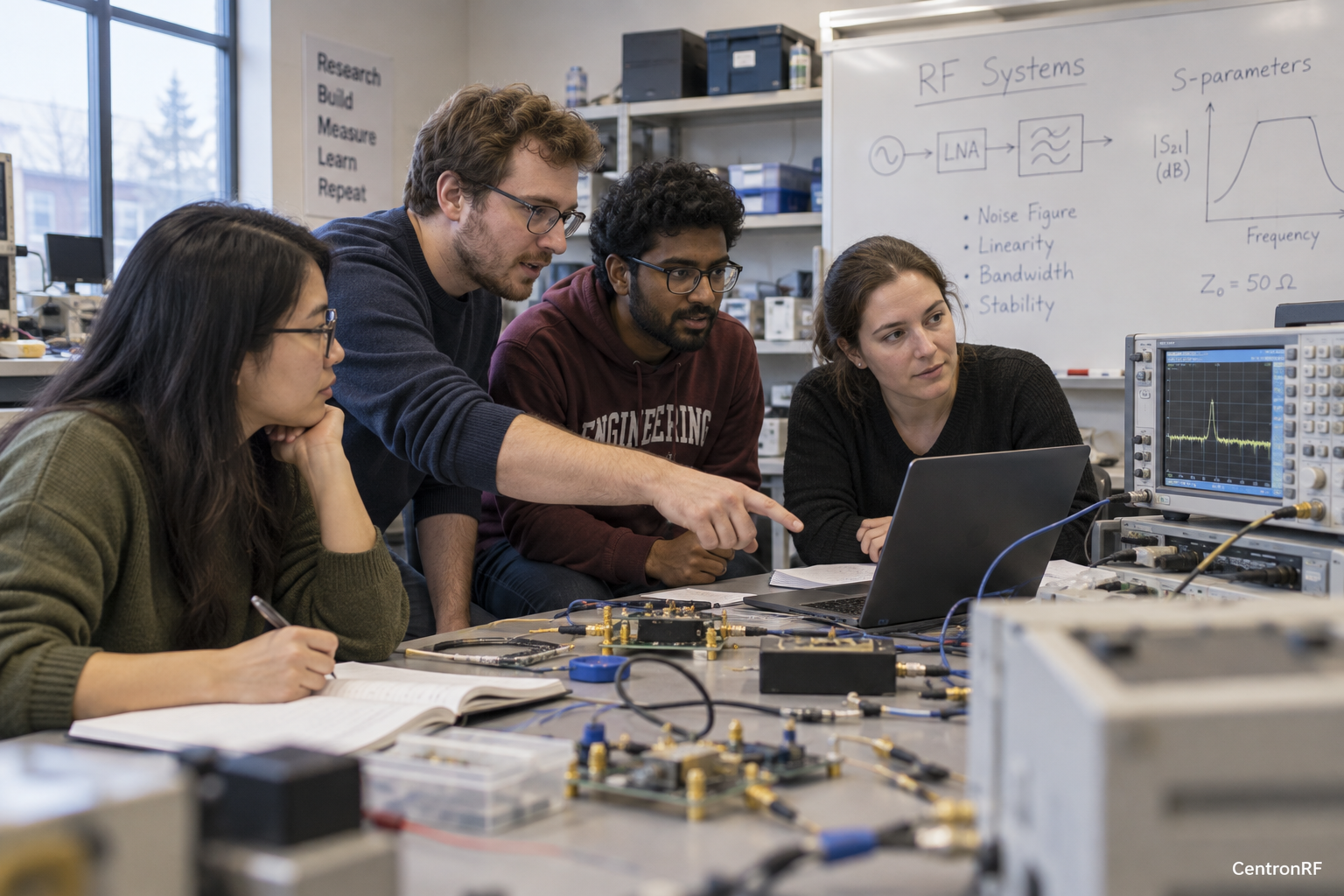
Publication-ready RF results need clear quantities, units, methods and conditions linked to the underlying observations.
Why this matters in the industry
Researchers want readers to assess the work and reproduce the relevant comparison.
The technical reasoning
Publication-ready RF results should preserve the definition of the measurand, reference planes, operating states and analysis method. Clear axes and captions cannot compensate for missing correction or uncertainty information. Distinguish illustrative calculations, simulated predictions and empirical observations so readers can evaluate the actual evidence.
Connecting engineering requirements with adequate evidence
An engineering requirement needs a stated quantity, operating conditions and a decision method. A descriptive label such as broadband, precision or rugged leaves those details unresolved. The evidence needed also depends on context: a laboratory demonstration, production screen, environmental evaluation and system qualification answer different questions. Documentation is useful when it identifies the actual method and conditions, rather than merely repeating a desired capability.
How to structure the investigation
Define axes and reference planes, state correction and uncertainty methods, and identify hardware and software revisions. Separate measured data from illustrative calculations. Preserve raw records and explain omitted points or limitations that affect interpretation.
Translate the engineering question into measurable parameters and a scope of valid use. Identify which limits are established, which assumptions are made and which questions remain open. Link evidence to the exact configuration and revisions involved. Review exceptions before release and distinguish a requested document or planned test from evidence that has actually been supplied or completed.
Worked example or engineering scenario
A plot labeled output power without its plane or averaging window leaves open whether it reports device burst power, full-cycle average or an instrument-plane reading.
Evidence to collect
| Record | Purpose |
|---|---|
| Units and axes | Defines the tested state and scope of the comparison. |
| Reference plane | Makes the stimulus or route condition reproducible. |
| Method details | Supports interpretation of variation and possible confounding effects. |
| Data provenance | Connects the observation with the stated engineering decision. |
Trade-offs and common interpretation errors
Do not promote a successful demonstration into a broad qualification claim. Likewise, paperwork cannot resolve a missing measurement model. A useful conclusion states what the evidence supports, what decision it informs and what additional observation would be needed to extend that conclusion to another configuration or environment.
What the result can support
Report the conditions and processing needed to interpret and reproduce each figure, with uncertainty appropriate to the conclusion.
Polished graphics cannot compensate for missing measurement conditions.
Further technical reading
Related industry knowledge
- SDR Teaching Experiments: Signal Range, Sampling and Interpretation
- How to Teach Power-Splitter Loss Versus Ideal Division
Numerical scenarios are illustrative assumptions, not reported measurements of a supplied product or installation.