


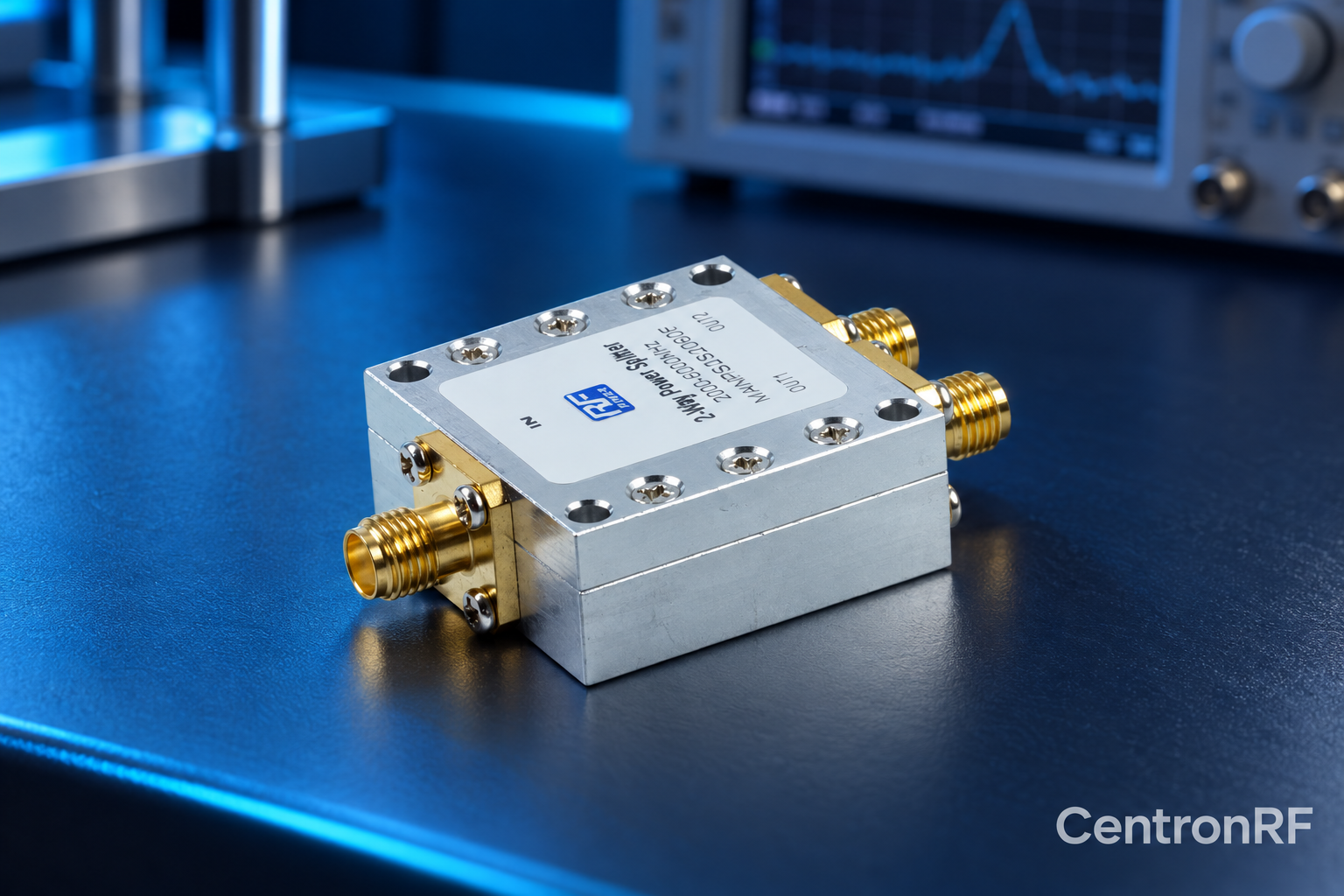
A divider can feed two receivers from one source if each receives enough signal and the system handles loss, impedance and receiver interaction.
How it works in practice
Check whether either receiver sends bias or leakage into the shared path. Use the appropriate DC isolation and protection when needed. Account for division loss, cables and each receiver's sensitivity. If one branch is disconnected, use the termination arrangement required by the divider.
Example and interpretation
A signal near one receiver's sensitivity limit may fail after adding the approximately 3 dB ideal loss of an equal two-way split.
Checks before use
- Budget both input levels
- Check receiver DC behavior
- Check isolation
- Terminate a removed branch
Important limit
Do not expect passive splitting to preserve the original power at both outputs.
Related Centron RF product
RF power divider range. Compare the exact divider model, port count and current datasheet. Some catalog titles show inconsistent frequency ranges, so confirm the supplied model’s full passband, loss, isolation and power limits before selection.
Further reading
Mini-Circuits: Understanding Power Splitters. This background reference explains general principles; the selected Centron RF model’s datasheet governs its own ratings.
Related guides
Educational guide. Numerical examples use the stated assumptions and are not test results for a supplied unit.