


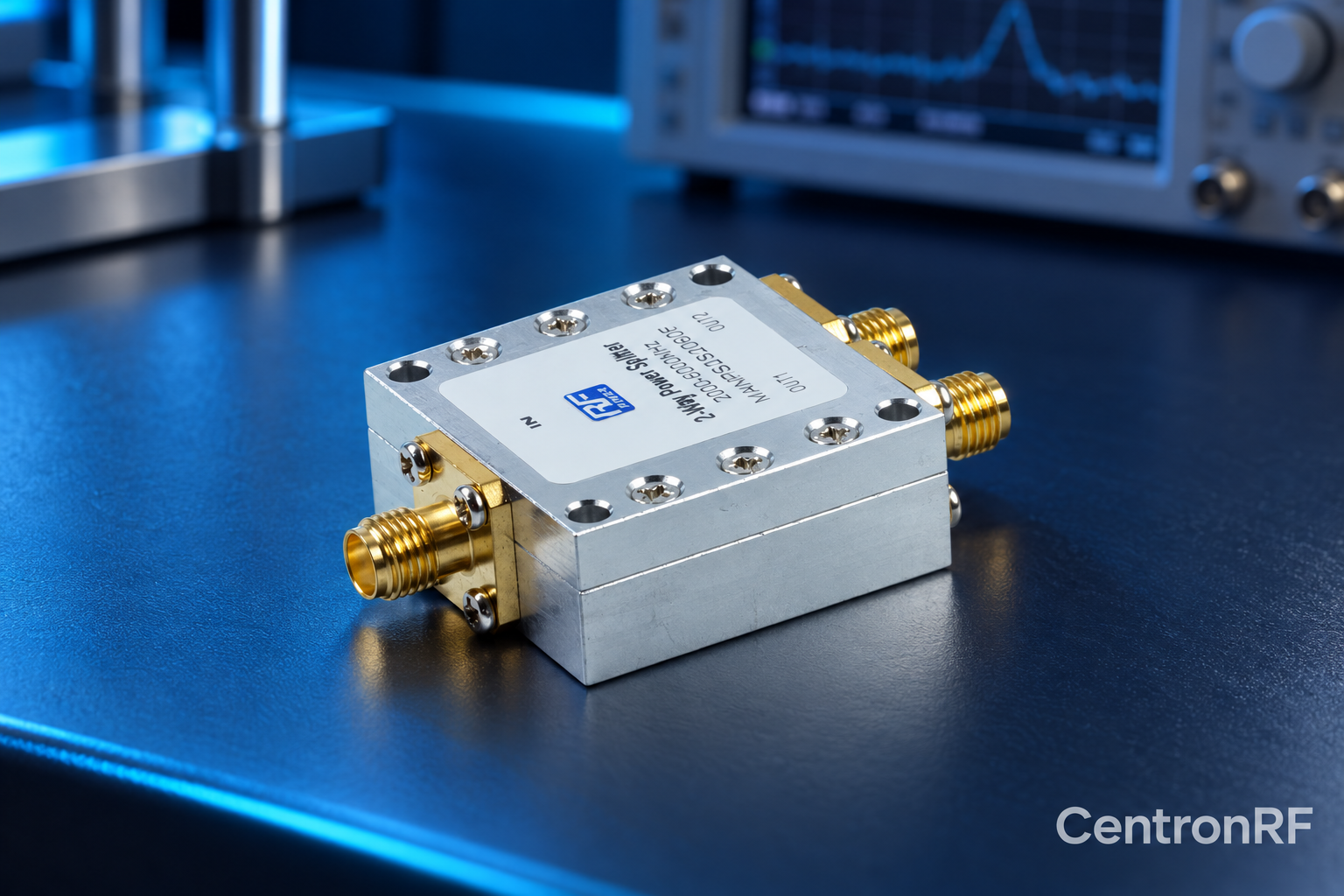
More equal outputs mean less power per branch before excess losses. Choose output count from both distribution needs and available signal margin.
How it works in practice
An ideal equal N-way divider has 10 log10(N) dB division loss per branch. Real loss and isolation depend on the design. Cascading two-way dividers may create unequal path depths unless the tree is balanced. Check each branch rather than assuming identical delivery.
Example and interpretation
Ideal equal division is about 3.01 dB for two outputs and 6.02 dB for four outputs.
Checks before use
- List branch requirements
- Calculate ideal loss
- Add excess loss
- Check balance and isolation
Important limit
Do not compare port counts without considering receiver sensitivity.
Related Centron RF product
RF power divider range. Compare the exact divider model, port count and current datasheet. Some catalog titles show inconsistent frequency ranges, so confirm the supplied model’s full passband, loss, isolation and power limits before selection.
Further reading
Mini-Circuits: Understanding Power Splitters. This background reference explains general principles; the selected Centron RF model’s datasheet governs its own ratings.
Related guides
Educational guide. Numerical examples use the stated assumptions and are not test results for a supplied unit.