


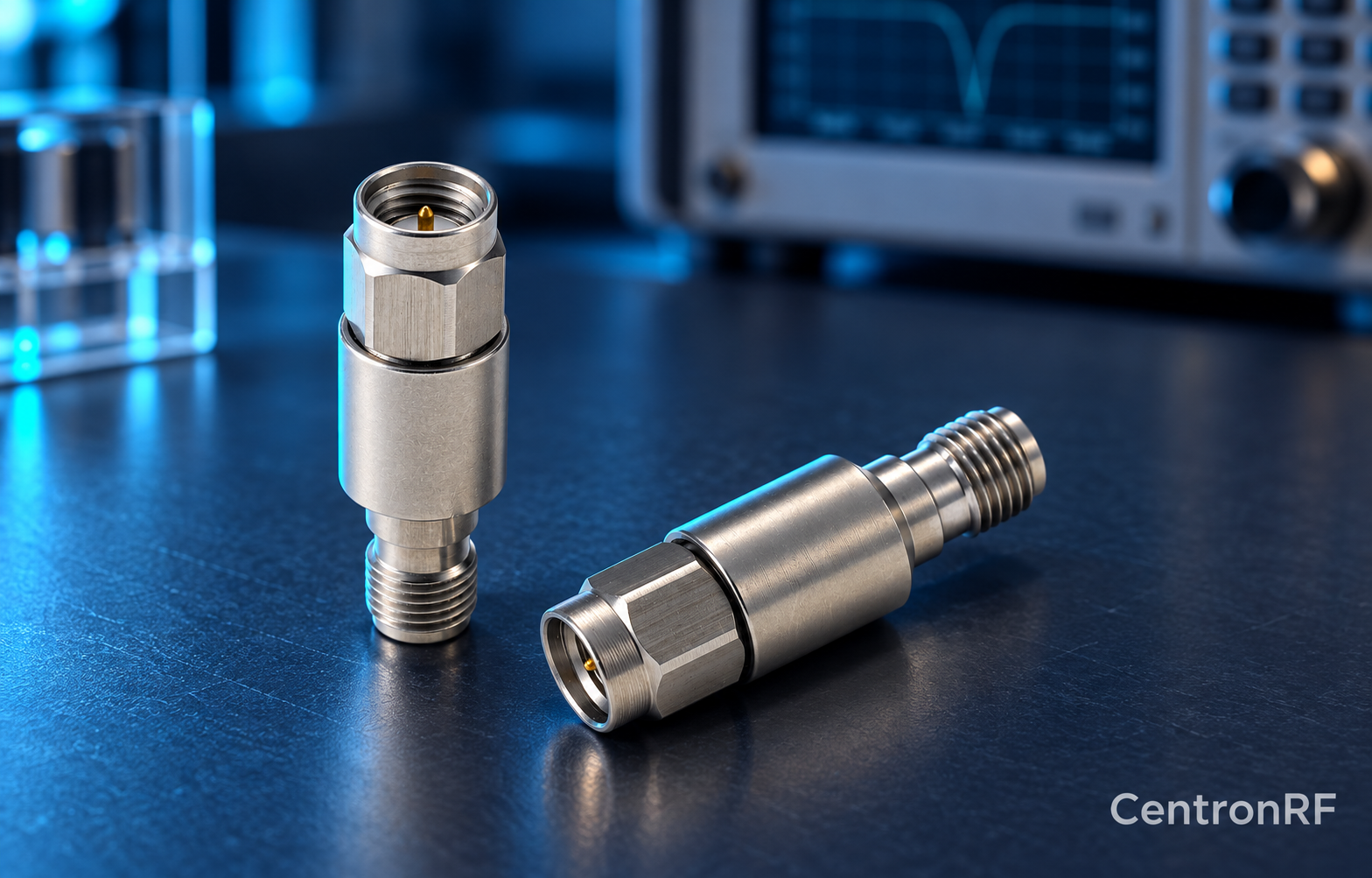
A coaxial DC block may attenuate or distort signals near or below its lower operating frequency. Verify bandwidth when working with low-frequency RF or broad pulses.
How it works in practice
High-pass behavior can cause amplitude loss, phase shift and pulse droop. The specified GHz upper limit says little about the low end. A simple capacitor calculation can illustrate the trend, but actual component measurements determine suitability.
Example and interpretation
A block intended for microwave use cannot be assumed suitable at 100 kHz unless its lower-band specification supports that frequency.
Checks before use
- Find the low-end specification
- Check amplitude and phase needs
- Measure at the required frequency
- Assess pulse droop where relevant
Important limit
Do not equate 'RF' with unlimited low-frequency response.
Related Centron RF product
SMA DC block listed for 8 GHz applications. The linked SMA block gives an upper-frequency reference. Confirm its lower passband limit, working voltage, RF power and whether it blocks the inner, outer or both conductors. A catalog range starting with DC should not be interpreted as DC transmission.
Further reading
Mini-Circuits: DC Block Specifications. This background reference explains general principles; the selected Centron RF model’s datasheet governs its own ratings.
Related guides
Educational guide. Numerical examples use the stated assumptions and are not test results for a supplied unit.