


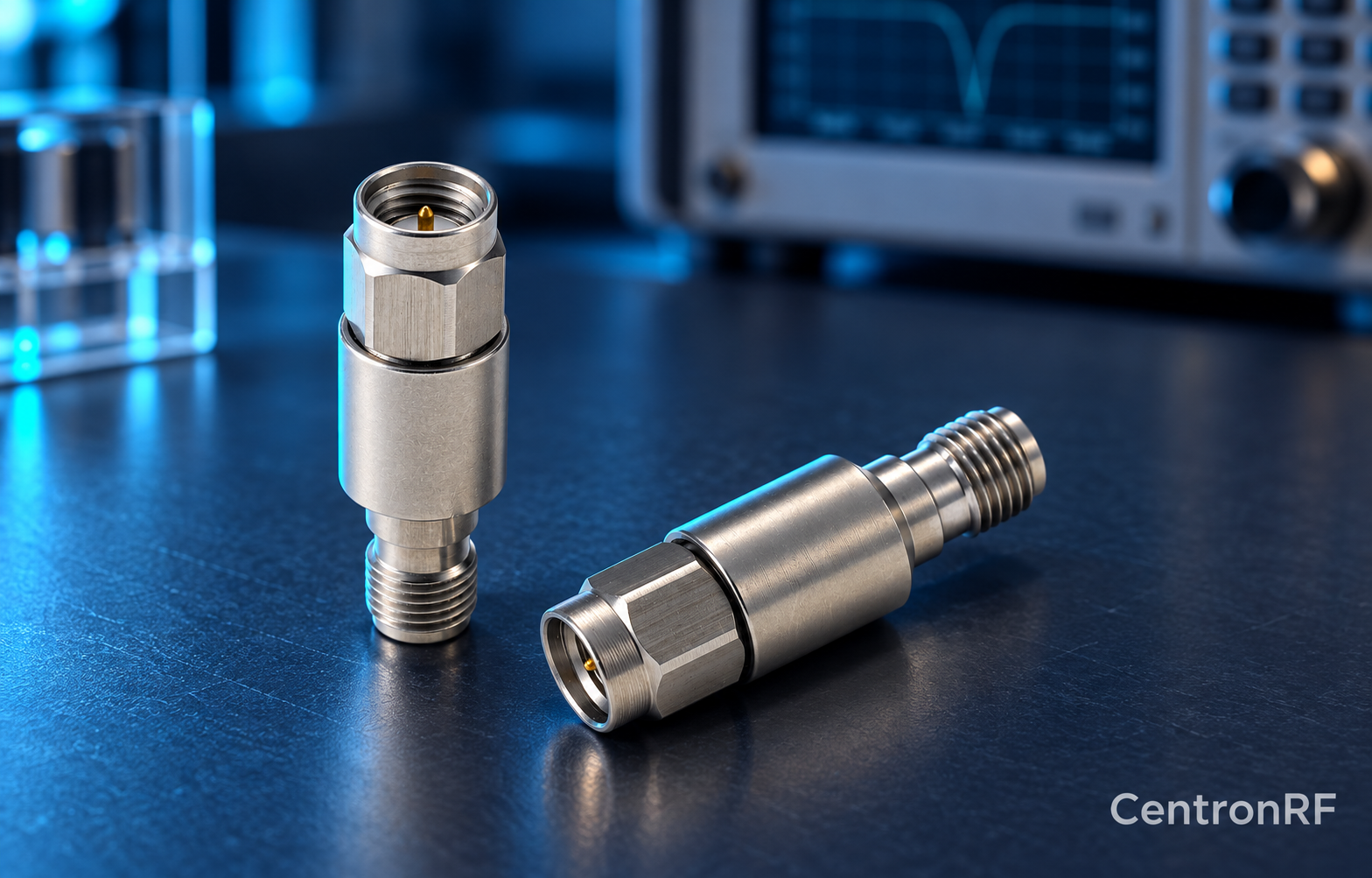
Choose SMA or N-type interfaces to match the system mechanically and electrically. The connector choice does not replace checking the block's band and voltage rating.
How it works in practice
SMA can suit compact instrument paths, while N-type may fit larger coaxial installations. Verify connector genders, impedance and cable support. Avoid adding unnecessary adapters; each can introduce loss and mismatch. Request exact model data when different connector versions have different ratings.
Example and interpretation
A compatible SMA block can reduce adapter count at an SMA instrument port, but still needs adequate bias and RF ratings.
Checks before use
- Check the existing interfaces
- Confirm impedance
- Compare model-specific ratings
- Minimize unnecessary adapters
Important limit
Do not assume all connector versions share the same internal capacitor.
Related Centron RF product
SMA DC block listed for 8 GHz applications. The linked SMA block gives an upper-frequency reference. Confirm its lower passband limit, working voltage, RF power and whether it blocks the inner, outer or both conductors. A catalog range starting with DC should not be interpreted as DC transmission.
Further reading
Mini-Circuits: DC Block Specifications. This background reference explains general principles; the selected Centron RF model’s datasheet governs its own ratings.
Related guides
- DC Block Troubleshooting: No Signal After Installation
- Attenuator and DC Block Together: What Each Adds
Educational guide. Numerical examples use the stated assumptions and are not test results for a supplied unit.