


A useful calibration record identifies the unit and reports measured attenuation under defined conditions. It should make corrections and uncertainty traceable to the test setup.
How it works in practice
Include serial number when present, frequencies, states, reference planes, temperature where relevant and calibration date. Record baseline insertion loss separately if the procedure uses it as a reference. Keep the method and acceptance criteria with the results so a later operator can apply the correct convention.
Example and interpretation
A correction of +0.4 dB for one state at 3 GHz should not automatically be applied to every state or frequency.
Checks before use
- Identify the exact unit
- List frequencies and states
- Record corrections and uncertainty
- Define the next review interval
Important limit
A generic product datasheet is not a calibration certificate for an individual unit.
Related Centron RF product
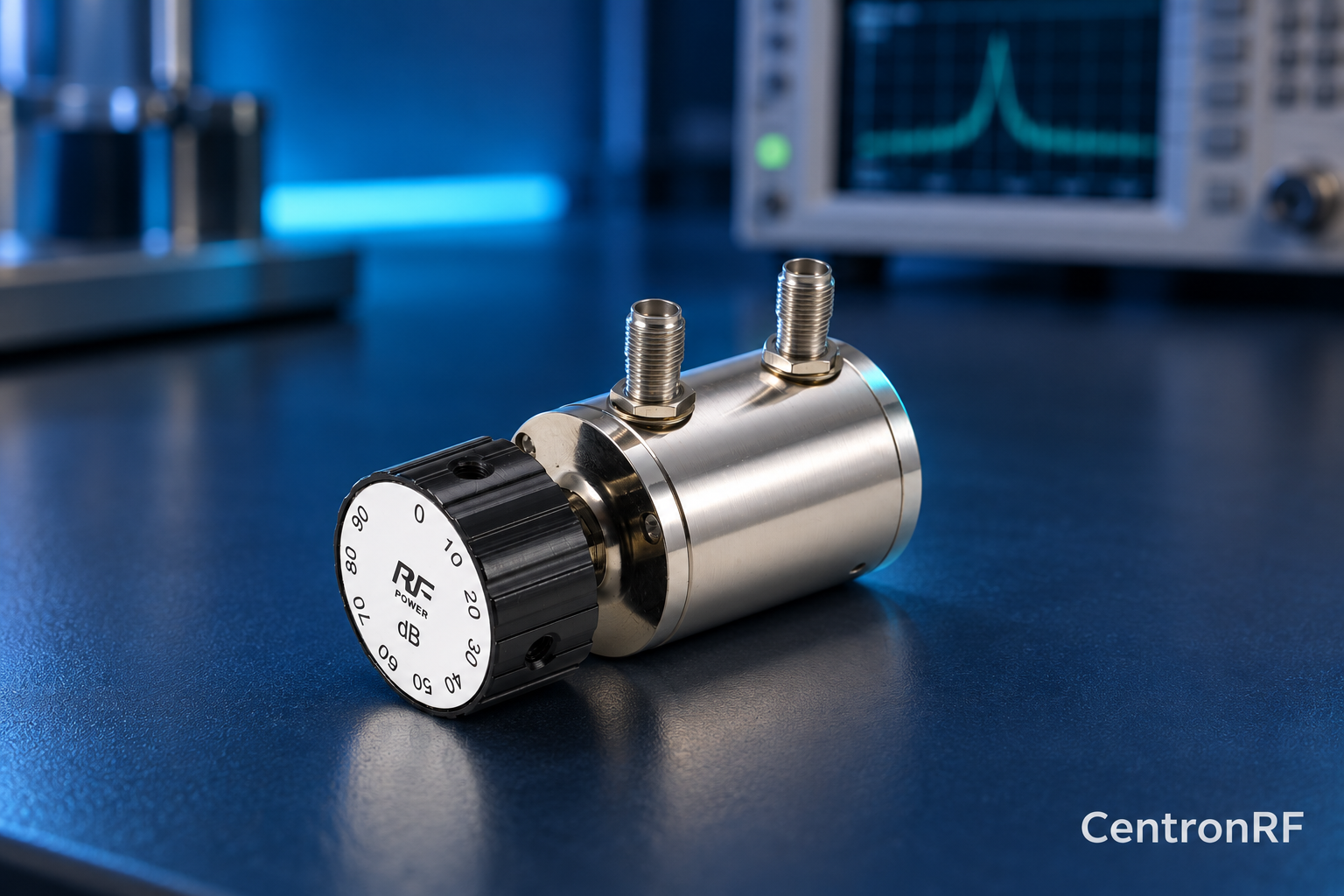
SMA rotary attenuator with 10 dB steps. The linked rotary model lists 0–90 dB adjustment in 10 dB steps, 50-ohm impedance and a DC–6 GHz band. Its listed continuous input is 2 W; obtain explicit switching and pulse limits before applying those stresses.
Further reading
Keysight: Accurate Network Measurements. This background reference explains general principles; the selected Centron RF model’s datasheet governs its own ratings.
Related guides
Educational guide. Numerical examples use the stated assumptions and are not test results for a supplied unit.