


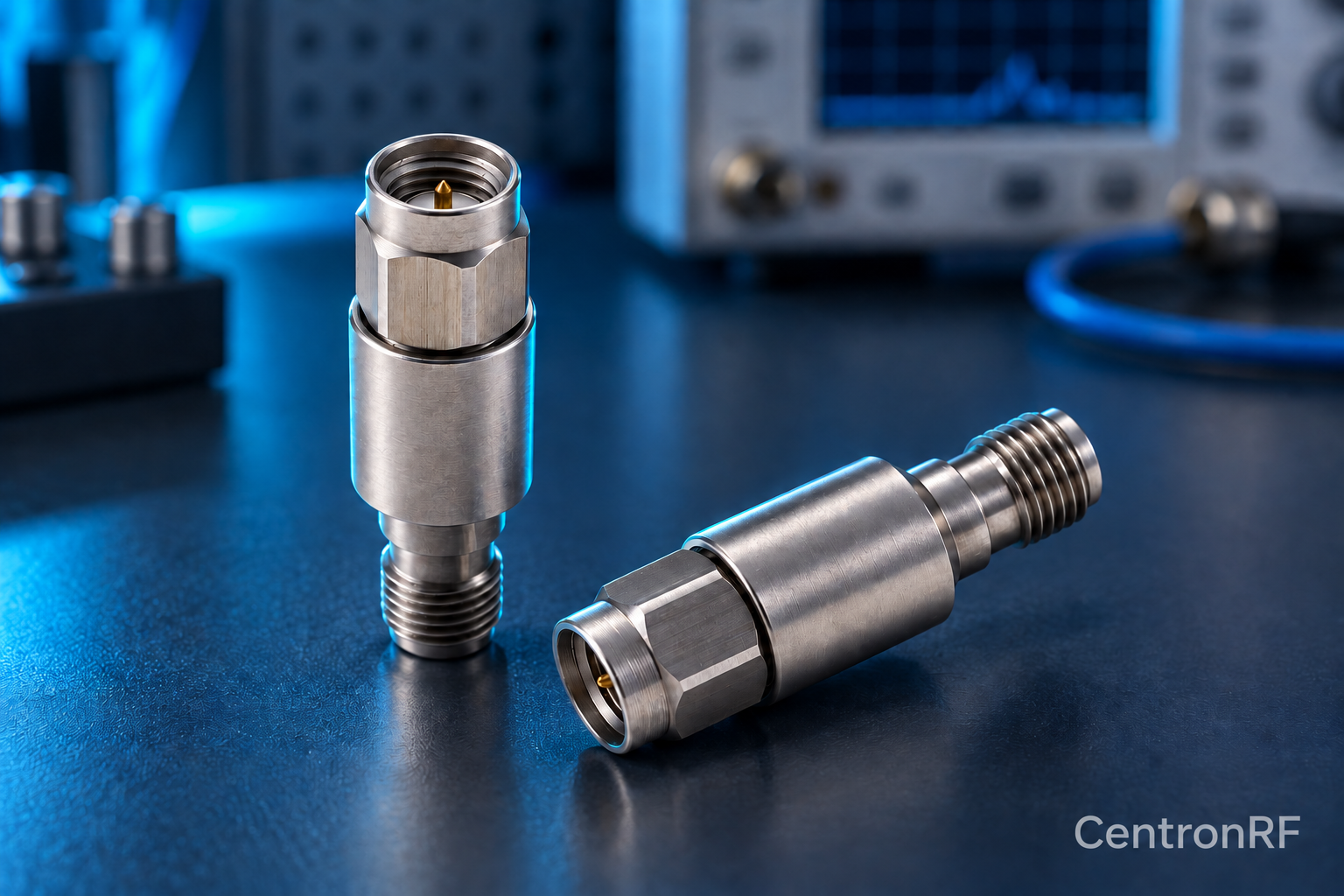
An RF attenuator purchase request should state the electrical, mechanical and environmental requirements needed to identify a suitable exact model.
How it works in practice
Specify nominal loss and tolerance, operating band, nominal impedance, average and peak input conditions, connector family and gender, and required return loss or VSWR. Add mounting, temperature and documentation needs where relevant. A complete request reduces the risk of selecting a visually similar but electrically different unit.
Example and interpretation
Instead of requesting a 20 dB adapter, request a 50-ohm coaxial attenuator with 20 dB nominal loss, stated band, input conditions and exact connectors.
Checks before use
- Write the operating frequency range
- State power and waveform
- Define connectors and loss tolerance
- Request the current datasheet and drawings
Important limit
Do not rely on a product photograph to define connector gender or power qualification.
Related Centron RF product
SMA 5 W 6 GHz fixed attenuator. The SMA 5 W model is listed as a 50-ohm fixed attenuator with a DC–6 GHz range. Select an available attenuation option and verify the current tolerance, cooling conditions and pulse limits for your application.
Further reading
Keysight: Spectrum Analysis Basics. This background reference explains general principles; the selected Centron RF model’s datasheet governs its own ratings.
Related guides
- Troubleshooting Unexpected Loss Through an RF Attenuator
- RF Attenuator Inspection and Care Before Connection
Educational guide. Numerical examples use the stated assumptions and are not test results for a supplied unit.