


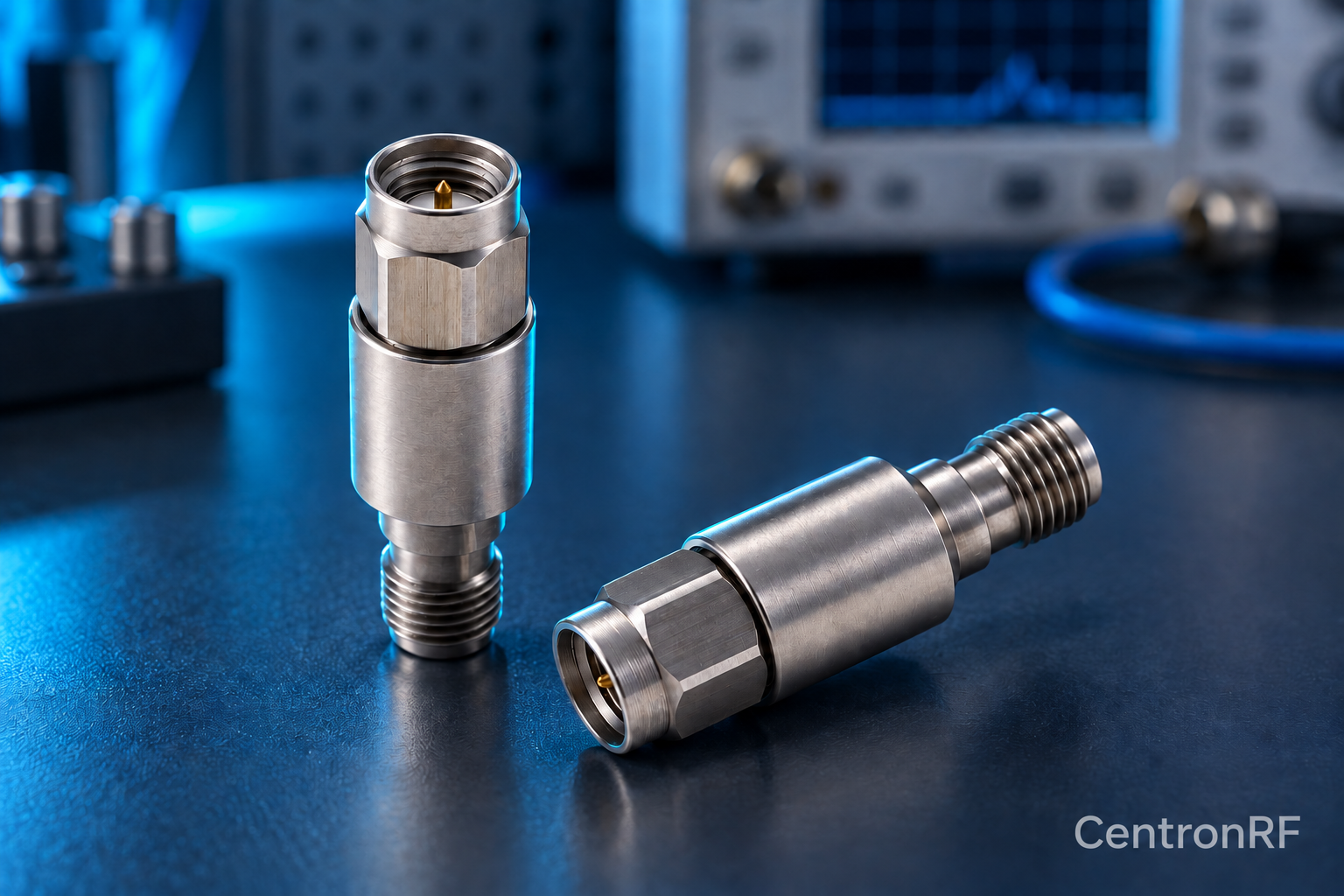
An N-type attenuator makes sense when the existing RF path uses N connectors and the selected model covers the required power and frequency range.
How it works in practice
Keeping the connector family consistent reduces adapters and mechanical stress. N-type bodies can accommodate different power levels, but their appearance is not a rating. Compare the specific model's allowable input, cooling conditions and VSWR. Larger housings may need independent support near an instrument input.
Example and interpretation
Connecting an N-type source directly to an N-type pad can remove an adapter pair. The improvement must be measured rather than assumed from connector count alone.
Checks before use
- Identify the existing interfaces
- Check the exact model rating
- Plan support for its mass
- Characterize the assembled path
Important limit
An N-type connection does not make every attenuator suitable for high power.
Related Centron RF product
SMA 5 W 6 GHz fixed attenuator. The SMA 5 W model is listed as a 50-ohm fixed attenuator with a DC–6 GHz range. Select an available attenuation option and verify the current tolerance, cooling conditions and pulse limits for your application.
Further reading
Keysight: Spectrum Analysis Basics. This background reference explains general principles; the selected Centron RF model’s datasheet governs its own ratings.
Related guides
Educational guide. Numerical examples use the stated assumptions and are not test results for a supplied unit.