

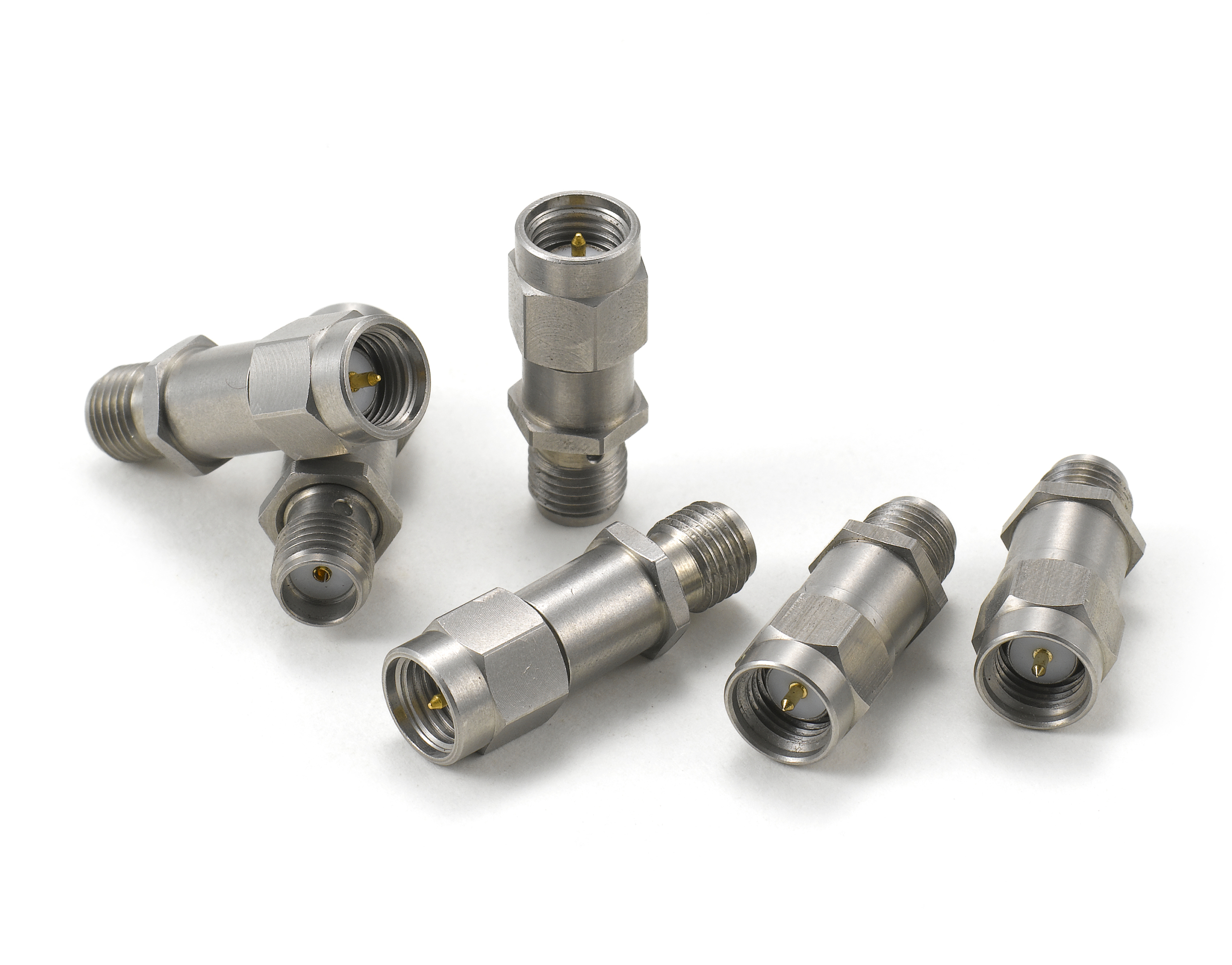
An RF attenuator is a passive two-port device used in radio frequency (RF) and microwave systems to reduce the amplitude (power level) of a signal without significantly distorting its waveform. In simple terms, it’s like a “volume control” for RF signals, ensuring that signals remain within desired levels for transmission, measurement, or processing.
Key Functions of Attenuator
- Signal control: Adjusts the strength of RF signals to prevent overload in sensitive components.
- Impedance matching: Helps maintain proper impedance in circuits, reducing reflections.
- Testing & measurement: Protects instruments from high-power signals by lowering them to safe levels.
- System stability: Maintains consistent gain and suppresses variations due to temperature or power changes.
Types of RF Attenuators
- Resistive (Absorptive) Attenuators
- Built using resistors in configurations like T-type or π-type.
- Advantages: wide bandwidth (from DC to hundreds of GHz), flat attenuation, easy integration.
- Can be lumped-element (using discrete resistors) or distributed (thin-film or thick-film designs for high frequencies).
- Cutoff (Waveguide) Attenuators
- Use waveguides operated in cutoff mode to block or attenuate signals.
- Rotary Polarization Attenuators
- Employ waveguide transitions and absorbing plates at specific angles to control attenuation precisely.
Packaging Forms
- Connectorized attenuators: With RF connectors for lab or system use.
- Flange-mounted attenuators: With leads and heat sinks for high-power applications.
- Surface-mount attenuators: Compact chip-style devices for integration on RF boards.
Performance Parameters
- Attenuation (Insertion Loss): The reduction in signal power, measured in dB.
- Return Loss (Reflection): Indicates how well the attenuator matches impedance (low reflections are better).
- Flatness: Consistency of attenuation across the operating frequency band.
- Temperature stability: Some attenuators compensate for temperature changes to keep performance stable.
- Power handling: Maximum continuous-wave (CW) or pulsed power the attenuator can safely dissipate.
- Passive Intermodulation (PIM): Nonlinear effects that can generate unwanted signals in multi-tone environments, critical in cellular base stations.
Applications
- RF communication systems (cellular, satellite, radar).
- Test and measurement setups (signal generators, spectrum analyzers).
- Protecting receivers from strong signals.
- Controlling gain in amplifiers and transmission lines.
CentronRF highlights several advantages of RF attenuators, making them valuable components in communication and test systems. They are designed to protect circuits, improve matching, and ensure stable performance across a wide range of RF applications
Pros of CentronRF RF Attenuators
- Circuit Protection: Prevents downstream components from being damaged by signals that are too strong, ensuring safe operation.
- Impedance Matching: Improves the match between source and load, reducing reflections and maximizing power transfer.
- Versatility in Applications: Widely used in mobile communication network optimization, indoor distribution systems, satellite communication, radar, aerospace, and electronic navigation.
- Signal Conditioning: Helps maintain consistent signal levels, which is critical for accurate measurement and reliable system performance.
- Flexibility: Available in fixed and variable versions, with options for connectorized, flange-mounted, and surface-mount packaging, making them easy to integrate into different RF setups
- Broad Frequency Coverage: CentronRF attenuators support wide frequency ranges (from DC up to several GHz), suitable for modern broadband communication systems
- Power Handling: Models are designed to handle different power levels (e.g., 2W, 5W, 10W), making them adaptable to both low-power and high-power environments
Why This Matters
For engineers and system designers, these pros translate into reliability, safety, and performance optimization. Whether in a base station, satellite link, or test lab, CentronRF attenuators ensure signals are controlled precisely, equipment is protected, and communication remains stable.
Summary
CentronRF RF attenuator is essential in modern communication systems to control signal levels, ensure impedance matching, protect equipment, and maintain system performance. High-quality attenuators must combine precision attenuation, wide bandwidth, thermal stability, high power capacity, and minimal nonlinear distortion.
Leave a Reply