


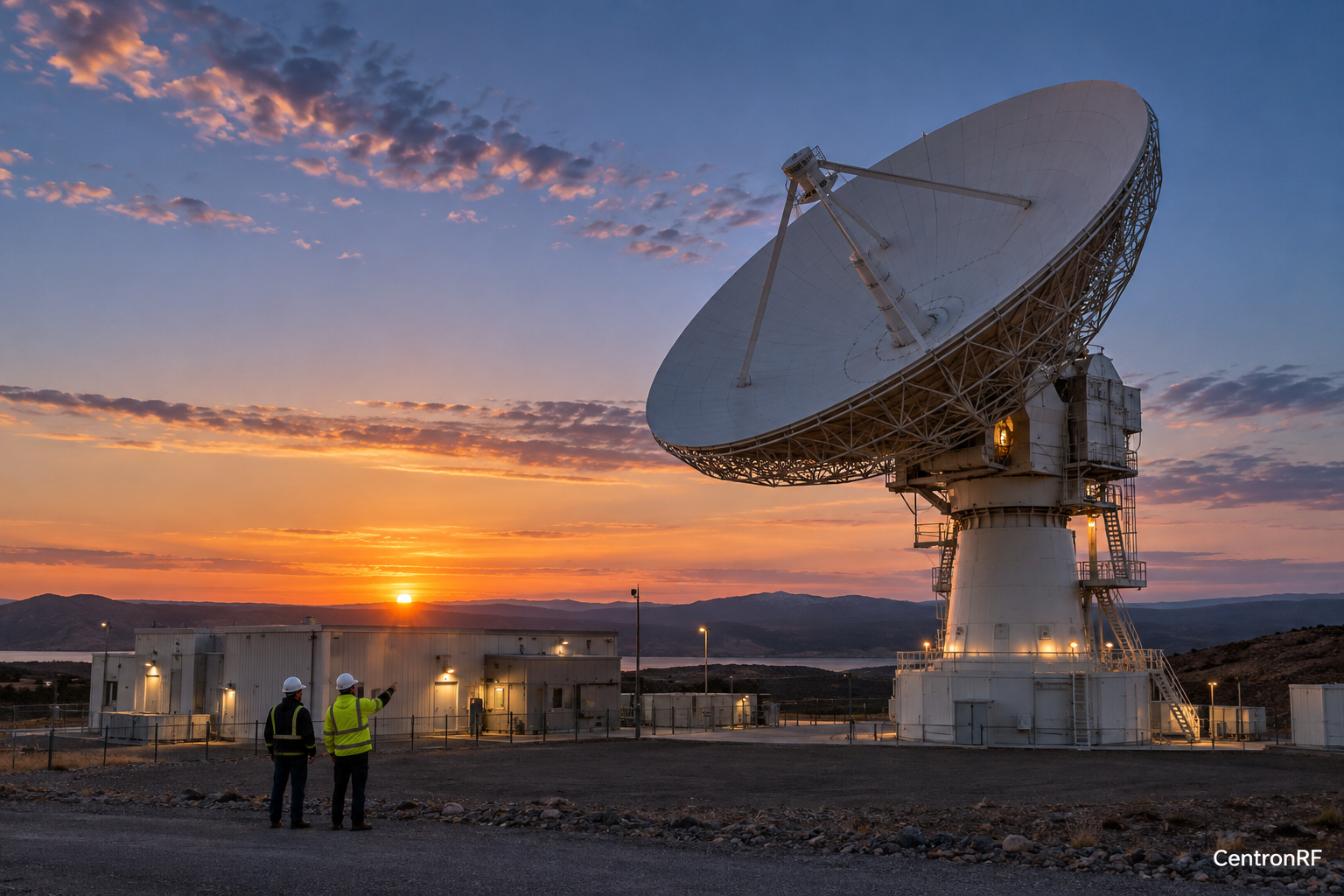
Satellite ground-test teams need RF accessories matched to the actual test frequency, power, bias and measurement plane. Requirements differ between an intermediate-frequency bench and an antenna feed.
Why this matters in the industry
A communication system combines several frequency conversions and signal routes. The product chosen for one route may be unsuitable at another, even when both use coaxial connectors.
The technical reasoning
Ground testing spans antennas, frequency conversion, receivers and mission interfaces. An observation at one IF connector cannot describe the entire earth-space link. Start by identifying the engineering boundary: modem behavior, RF front-end response, antenna performance or end-to-end compatibility. Assign each boundary its own frequency plan, reference conditions and evidence before comparing results.
Connecting engineering requirements with adequate evidence
An engineering requirement needs a stated quantity, operating conditions and a decision method. A descriptive label such as broadband, precision or rugged leaves those details unresolved. The evidence needed also depends on context: a laboratory demonstration, production screen, environmental evaluation and system qualification answer different questions. Documentation is useful when it identifies the actual method and conditions, rather than merely repeating a desired capability.
How to structure the investigation
Divide the setup into named RF and IF sections. Record frequency edges, maximum levels, DC passage and required measurement uncertainty for each section. Choose pads, loads and dividers from those numerical requirements, then characterize the assembled routes used in the test.
Translate the engineering question into measurable parameters and a scope of valid use. Identify which limits are established, which assumptions are made and which questions remain open. Link evidence to the exact configuration and revisions involved. Review exceptions before release and distinguish a requested document or planned test from evidence that has actually been supplied or completed.
Worked example or engineering scenario
A clean 1 GHz IF signal can coexist with an antenna-pointing problem at a much higher RF frequency. The IF observation helps isolate one section but does not eliminate the other possibilities.
Evidence to collect
| Record | Purpose |
|---|---|
| Identify each signal section | Defines the tested state and scope of the comparison. |
| Write numerical frequency edges | Makes the stimulus or route condition reproducible. |
| Check DC requirements | Supports interpretation of variation and possible confounding effects. |
| Measure assembled routes | Connects the observation with the stated engineering decision. |
Trade-offs and common interpretation errors
Do not promote a successful demonstration into a broad qualification claim. Likewise, paperwork cannot resolve a missing measurement model. A useful conclusion states what the evidence supports, what decision it informs and what additional observation would be needed to extend that conclusion to another configuration or environment.
What the result can support
Treat ground-segment measurements as a chain of defined boundaries rather than one universal link-quality number.
Ground-test suitability does not establish qualification for installation on a spacecraft.
Further technical reading
Related industry knowledge
- What Is a Satellite Ground Segment and Where Does RF Testing Fit?
- L-Band Satellite Bench Connections: A Component Checklist
Numerical scenarios are illustrative assumptions, not reported measurements of a supplied product or installation.