


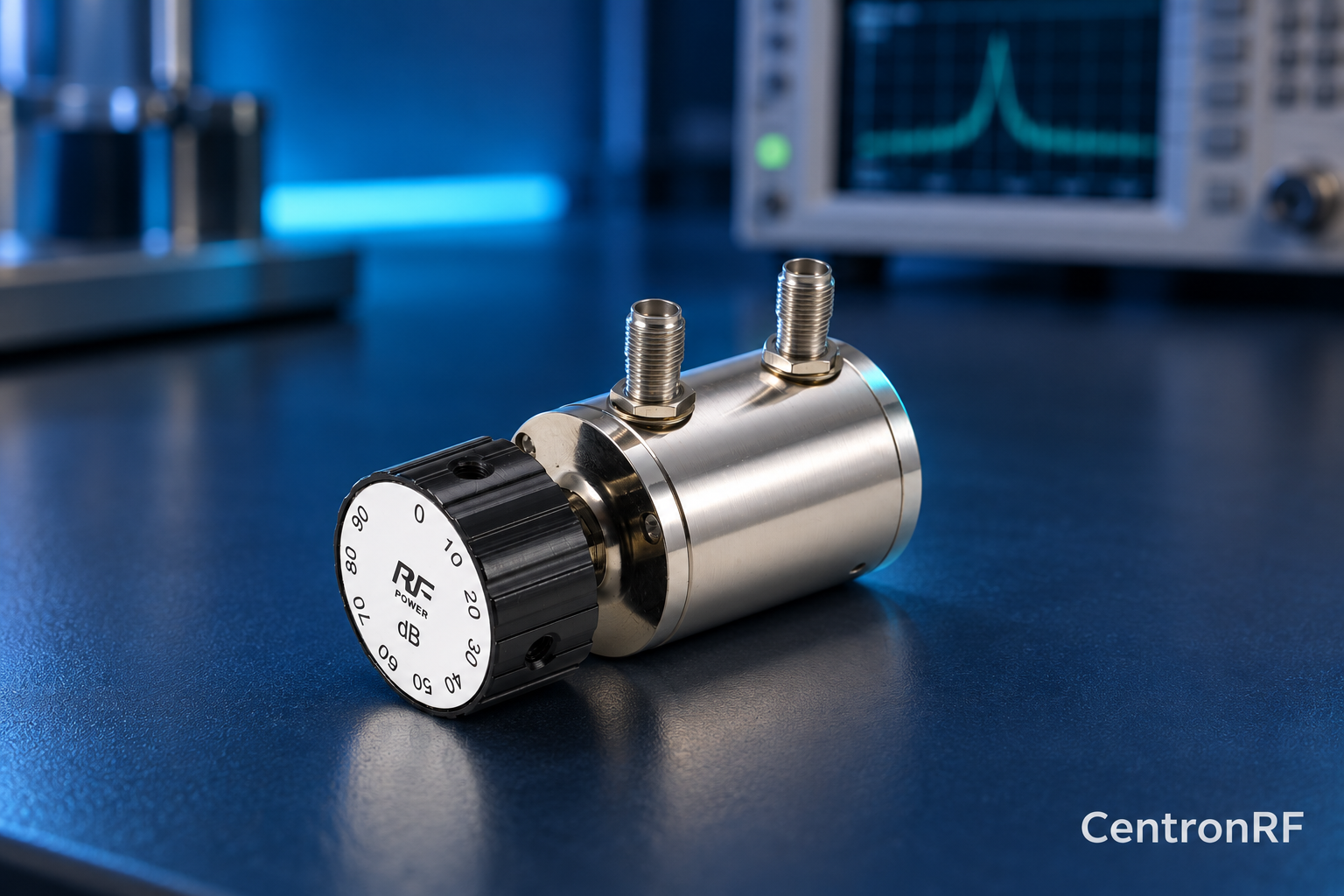
Protect the connectors, dial and housing from dirt, impact and cable strain. Handling practices support repeatable measurements but do not establish calibration.
How it works in practice
Use caps during storage and keep the component in a dry, clean environment within its specified storage limits. Disconnect heavy cables before moving equipment. Do not force a dial past its stops. If a unit is dropped or exposed to moisture, inspect and verify it before returning it to a calibrated path.
Example and interpretation
A bent center contact can change match or damage the mating instrument even if the rotary control still moves normally.
Checks before use
- Cap unused connectors
- Avoid heavy unsupported cables
- Inspect after impact
- Check performance before reuse
Important limit
Do not claim a calibration remains valid merely because the enclosure looks intact.
Related Centron RF product
SMA rotary attenuator with 10 dB steps. The linked rotary model lists 0–90 dB adjustment in 10 dB steps, 50-ohm impedance and a DC–6 GHz band. Its listed continuous input is 2 W; obtain explicit switching and pulse limits before applying those stresses.
Further reading
Keysight: Accurate Network Measurements. This background reference explains general principles; the selected Centron RF model’s datasheet governs its own ratings.
Related guides
Educational guide. Numerical examples use the stated assumptions and are not test results for a supplied unit.