


Repeatability describes how closely repeated selections return to the same measured attenuation. It differs from agreement with the nominal dial value.
How it works in practice
Keep frequency, cable placement and instrument settings fixed. Cycle between a few settings with the source muted when required, then measure the same state repeatedly. Large variation can indicate worn contacts, loose connectors or an unstable measurement setup. Compare results against the specified repeatability rather than inventing an acceptance limit.
Example and interpretation
Readings of 20.1, 20.2 and 20.1 dB show a 0.1 dB span in that experiment, not a complete accuracy specification.
Checks before use
- Fix the test conditions
- Cycle the selected state
- Log repeated readings
- Compare with the manufacturer's limit
Important limit
One good reading cannot establish long-term switch reliability.
Related Centron RF product
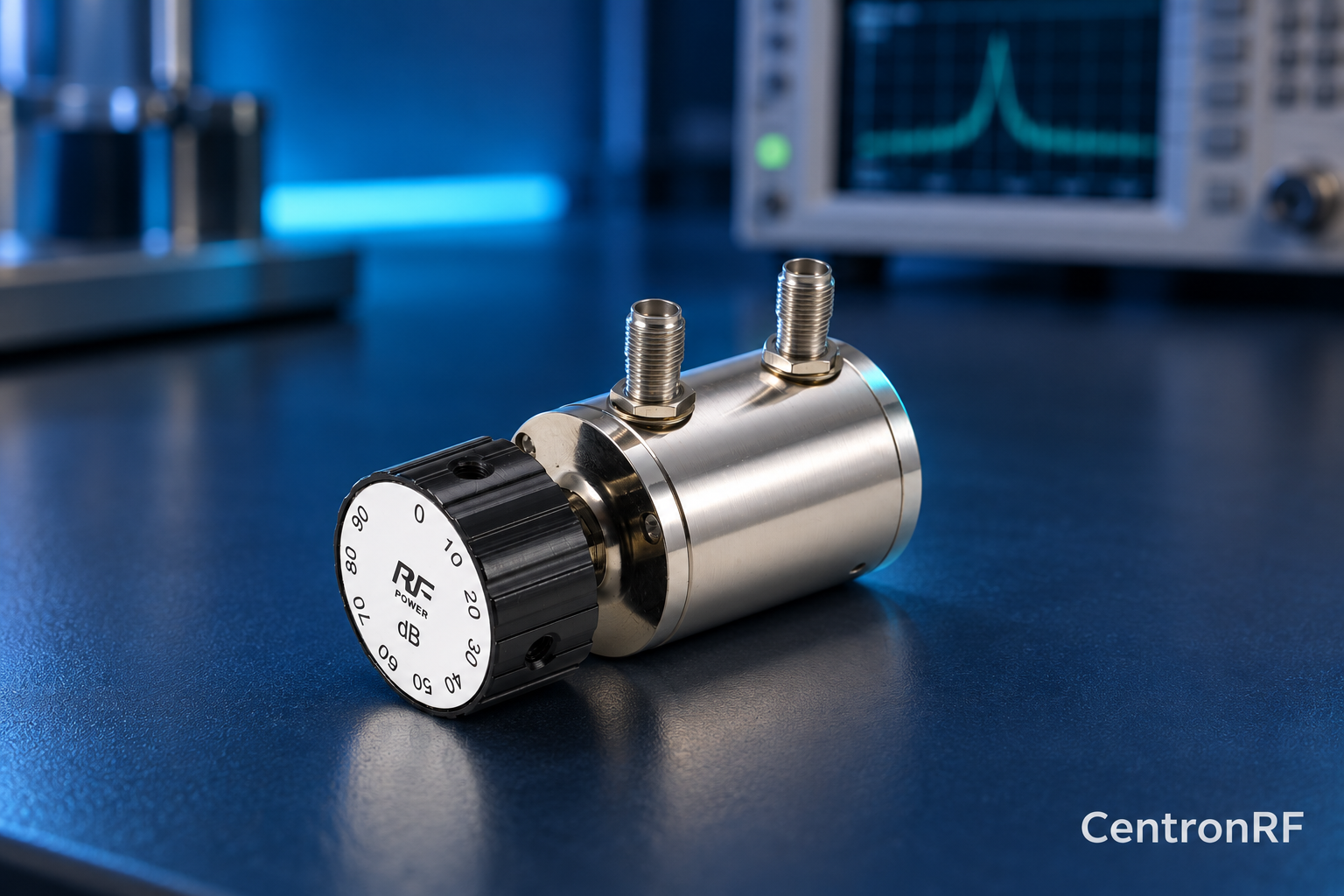
SMA rotary attenuator with 10 dB steps. The linked rotary model lists 0–90 dB adjustment in 10 dB steps, 50-ohm impedance and a DC–6 GHz band. Its listed continuous input is 2 W; obtain explicit switching and pulse limits before applying those stresses.
Further reading
Keysight: Accurate Network Measurements. This background reference explains general principles; the selected Centron RF model’s datasheet governs its own ratings.
Related guides
- Two-Dial Attenuators: Understanding Series and Parallel Product Names
- Using a Fixed Pad with a Rotary Attenuator
Educational guide. Numerical examples use the stated assumptions and are not test results for a supplied unit.